Ask two Canadian authorities how often to change a furnace filter and you get two different answers. That sounds like a problem. It is actually the solution.
Natural Resources Canada, in its Keeping The Heat In guidance, tells homeowners to "change or clean filters every three months or as they become loaded." The Heating, Refrigeration and Air Conditioning Institute of Canada says something quite different: "any regular furnace filter should be inspected, cleaned or replaced once a month during the cooling (and heating) seasons."
Look closely and the two are not in conflict at all. HRAI is telling you how often to look. The federal guidance is telling you how often to act — and note that even it ends with a condition rather than a date, "or as they become loaded." Put together, they describe exactly the habit that works: a monthly check through the heating and cooling seasons, with replacement driven by what you see rather than by what the calendar says.
That distinction matters because the calendar cannot possibly know your house. A one-inch filter in a home with two dogs, a gravel lane and a basement renovation under way will be finished long before a four-inch cabinet filter in a quiet condominium reaches the same state. The load factors that shorten the interval are worth naming, because most of them are things you already know about your own life: pets, the number of people in the house, a renovation or any indoor construction dust, a nearby road or farm field, a wildfire smoke episode, and — the one people forget — leaving the furnace fan in the "on" position rather than "auto," which pulls household air through that filter continuously instead of only during heating and cooling calls.
When Ontario and the Prairies spent stretches of recent summers under air-quality warnings, filters loaded in weeks rather than months; our coverage of the multi-day orange air-quality warning and what it meant for filters is a useful illustration of how quickly the interval can compress.
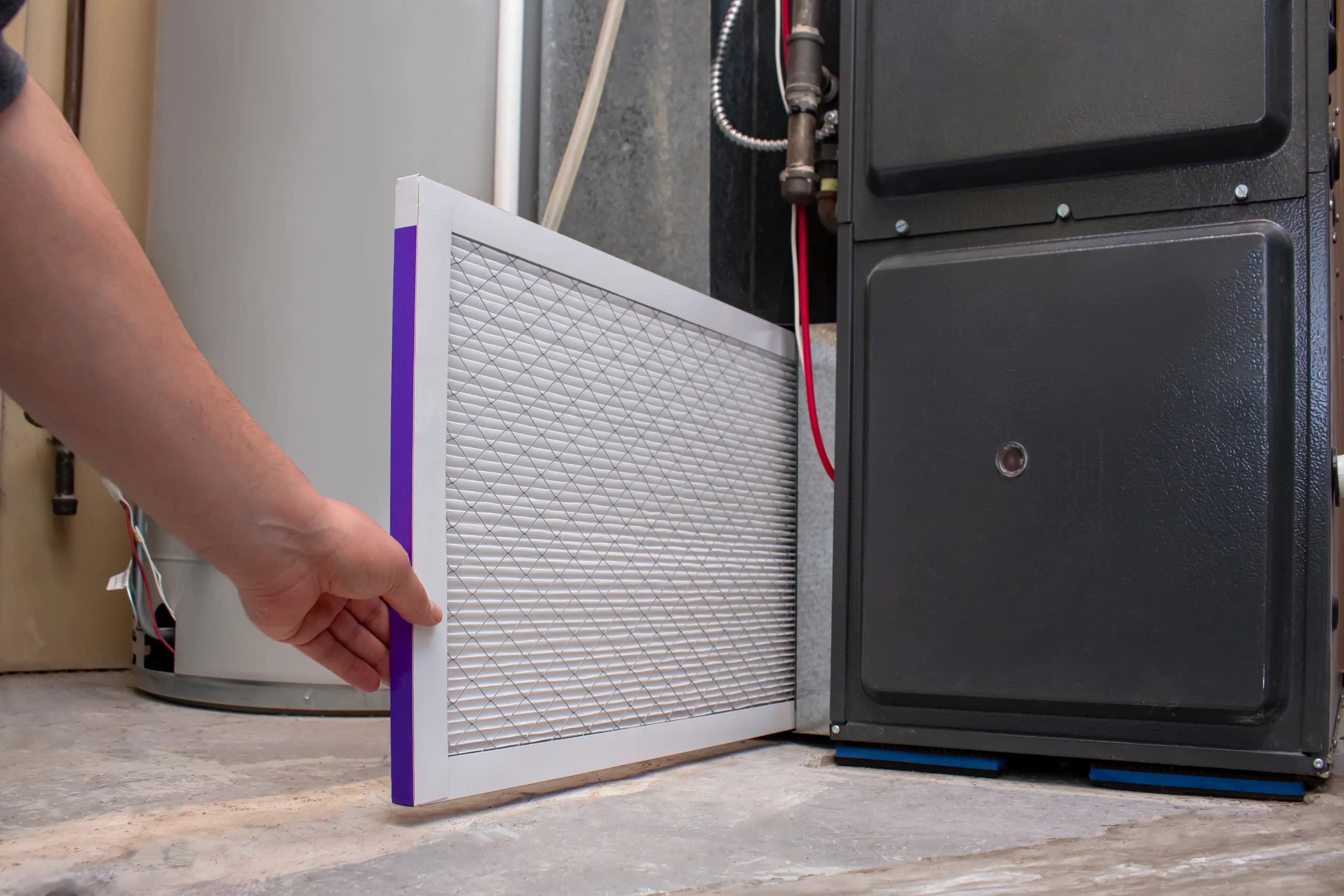
Checking is not complicated. Slide the filter out and hold it up to a light — a bulb, a window, the flashlight on your phone. A filter still doing its job lets light through the pleats fairly evenly. One that is finished looks like felt, and the light barely comes through the loaded areas at all. Alongside that, the performance signs are worth noticing: registers that have gone weak, a furnace that short-cycles, rooms furthest from the furnace that stop keeping up, or a blower that has grown noticeably louder at the same setting.
Three Errors That Waste a Good Filter
The first is the airflow arrow. Every filter has one printed on the frame, and it must point toward the furnace — in the direction the air is travelling, from the return duct into the blower. Installed backwards, the filter's structural side faces the wrong way and the media loses the support it was designed to have against the pressure.
The second is bypass, and it is the quiet one. If the filter does not seal to its frame, air simply takes the easier path around the edges, arriving at your blower and coil entirely unfiltered. The U.S. Environmental Protection Agency addresses this directly in its guidance: "make sure the filter fits snugly so air does not leak around the filter. Do not bend or crush the filter to make it fit." A slightly undersized filter in an oversized slot is one of the most common reasons an expensive filter delivers cheap results — and the trick of forcing a filter that is nearly right into a slot that is nearly right creates gaps rather than closing them.
The third is the washable filter. Reusable electrostatic filters are appealing on paper, and they do keep a recurring purchase off your list. But they generally sit at the low end of the efficiency scale, and their performance depends on the charge that the MERV-A conditioning step exists to measure the decay of. If your reason for caring about filtration is equipment protection alone, a washable filter can be defensible. If it is anything to do with what the people in the house are breathing, the disposable pleated options are doing more work.