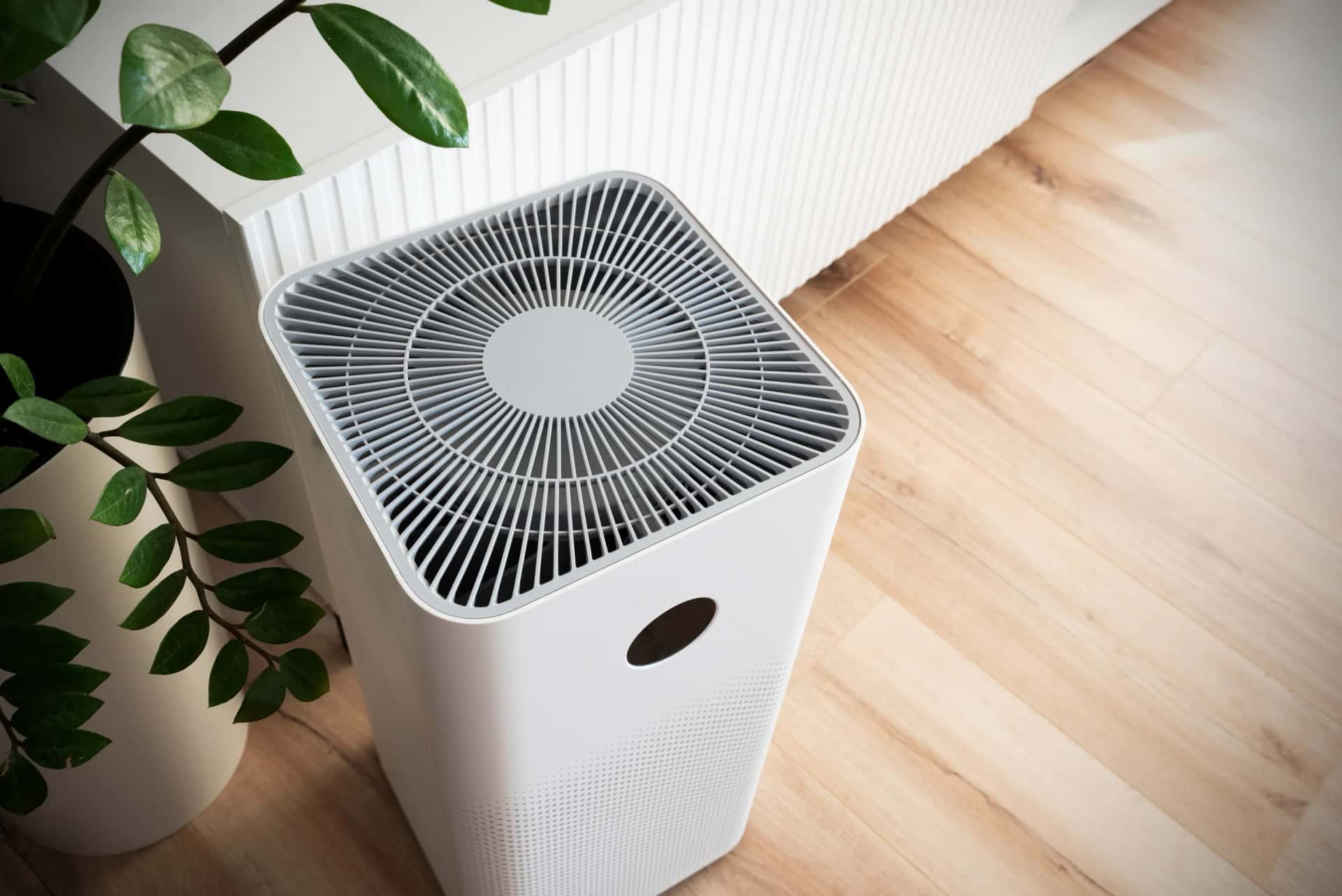
Every model below is listed on Amazon.ca, sized for Canadian living spaces, and selected to cover a real price tier. The comparison table is designed to be scannable — skim to find the unit that fits your space and budget, then read the writeup below for the nuance.
Prices verified on Amazon.ca at time of writing and subject to change.
Levoit Vital 200S-P — Best Overall Value
For most Canadian homes, this is the one to buy. The Vital 200S-P delivers a genuine 250 tobacco-smoke CADR for just over $200 — right in the sweet spot of the two-thirds sizing rule. That's enough clean-air output for a primary bedroom, a medium living room, or a home office during a smoke event. The three-stage filter pairs real HEPA with activated carbon and a washable pre-filter that catches pet hair before it clogs the more expensive stages.
You also get the smart features that matter: a built-in particle sensor, auto mode that responds to real-time air quality, VeSync app control, and a sleep setting that drops the fan to 27 dB. Not the loudest, not the quietest, not overbuilt — just the one that gets the job done without charging you for things you don't need.
One honest note: Levoit removed the "True HEPA" language after a filter-classification dispute, though independent testing sites still rate its real-world performance on par with True HEPA peers. For the average Canadian household dealing with seasonal smoke events, this is the purifier we'd buy first.
See the Levoit Vital 200S-P on Amazon.ca.
Blueair Blue Pure 311i Max — Best Quiet and Smart
If you're a light sleeper, or you're buying for a bedroom where the purifier will run overnight, pay the small premium for the Blueair 311i Max. Blueair's HEPASilent technology combines mechanical filtration with a gentle electrostatic charge, which lets the unit move more air at lower fan speeds — so it hits a 250 smoke CADR while running quieter than most competitors at realistic speeds.
The feature set is modern: Alexa integration, app scheduling, a Welcome Home geofence that pre-cleans your air before you walk in, and a real-time air-quality display. The aesthetic is Swedish-minimal, which matters if the unit is going to live in a visible corner of your living room. One thing to confirm: make sure you're getting the HEPASilent variant, not a pure-ionizer sibling model in the Blueair line.
At $255.98, it's about $45 more than the Levoit for similar particulate performance, and the premium is justified if quiet operation or aesthetics rank high on your list.
See the Blueair Blue Pure 311i Max on Amazon.ca.
MOOKA M03 — Best Budget Pick
At just under $150, the MOOKA M03 is the entry-tier pick for readers who need something real but can't stretch into the $200 range. It uses a genuine H13 HEPA filter (medical grade on paper), includes an activated carbon layer, and advertises an ultra-quiet 15 dB on sleep mode. The 360-degree intake design is efficient for its footprint.
The caveat: MOOKA doesn't publish an AHAM-verified smoke CADR. The 1,500-square-foot coverage claim is a manufacturer number, and without a third-party CADR measurement there's no way to confirm how fast it'll clear a room during an active smoke event. For a small sealed bedroom, a home office, or as a second unit alongside a more capable main-floor purifier, it's a legitimate budget choice. For a large open-concept main floor or a week-long smoke stretch, you'll want more verified airflow than this unit promises.
Think of it this way: the M03 is meaningfully better than nothing, and perfect for the 120-square-foot bedroom where you want quiet filtration overnight. It's not a substitute for a properly sized main-room purifier.
See the MOOKA M03 on Amazon.ca.
Coway Airmega ProX — Best for Whole-Home Coverage
This is a different class of machine. The Airmega ProX posts a tobacco-smoke CADR of 567 and manufacturer coverage up to 4,253 square feet, which means a single unit can serve an open-concept main floor — the kind of 2,000–2,500 square-foot Canadian layout where three smaller purifiers would otherwise be required.
Under the hood: two sets of extra-large True HEPA filters, a washable pre-filter, a real particulate sensor, turbo mode for fast recovery, wheels for mobility, and a five-year warranty (unusual and meaningful in this category). On low it runs at 23 dB — whisper-quiet for its size — and it tops out near 52 dB on turbo.
The $1,442.88 price tag looks steep until you do the math: three mid-tier units at $250 each is $750 up front and $240 a year in filters, with no unified coverage or app-level smart sensing. For larger Canadian homes with open floor plans, the ProX is genuinely competitive on cost per square foot and dramatically simpler to live with.
See the Coway Airmega ProX on Amazon.ca.
IQAir HealthPro Plus XE — Best Premium and Medical-Grade
The IQAir HealthPro Plus XE is the purifier you buy when cleaner air isn't a comfort — it's a medical need. The Swiss-engineered HyperHEPA filter is certified to capture 99.5 percent of particles down to 0.003 microns (roughly a hundred times smaller than standard HEPA targets), and the V5-Cell cartridge holds enough activated carbon and alumina pellets to meaningfully address wildfire-smoke gases and VOCs. The fully sealed housing means the air coming out the top has actually passed through the full filter stack.
The trade-off is coverage. Because HyperHEPA is so dense, airflow is more modest — the HealthPro Plus is rated for about 1,125 square feet, well below the Coway ProX. This isn't a whole-home purifier; it's a clean-room purifier, tuned for a single space. Noise at lower speeds sits around 35 dB, a little higher than the Blueair but fine for a bedroom.
Who it's for: households where someone has asthma, COPD, cardiovascular disease, an infant, or an elderly family member with respiratory vulnerability. Canadians in those households are exactly who Health Canada identifies as at elevated risk during wildfire smoke events, and for them, the HealthPro Plus XE earns every dollar of its $1,699.99 price tag. For most other buyers, it's more machine than they need.
See the IQAir HealthPro Plus XE on Amazon.ca.
Every model below is listed on Amazon.ca, sized for Canadian living spaces, and selected to cover a real price tier. The comparison table is designed to be scannable — skim to find the unit that fits your space and budget, then read the writeup below for the nuance.
Prices verified on Amazon.ca at time of writing and subject to change.
Levoit Vital 200S-P — Best Overall Value
For most Canadian homes, this is the one to buy. The Vital 200S-P delivers a genuine 250 tobacco-smoke CADR for just over $200 — right in the sweet spot of the two-thirds sizing rule. That's enough clean-air output for a primary bedroom, a medium living room, or a home office during a smoke event. The three-stage filter pairs real HEPA with activated carbon and a washable pre-filter that catches pet hair before it clogs the more expensive stages.
You also get the smart features that matter: a built-in particle sensor, auto mode that responds to real-time air quality, VeSync app control, and a sleep setting that drops the fan to 27 dB. Not the loudest, not the quietest, not overbuilt — just the one that gets the job done without charging you for things you don't need.
One honest note: Levoit removed the "True HEPA" language after a filter-classification dispute, though independent testing sites still rate its real-world performance on par with True HEPA peers. For the average Canadian household dealing with seasonal smoke events, this is the purifier we'd buy first.
See the Levoit Vital 200S-P on Amazon.ca.
Blueair Blue Pure 311i Max — Best Quiet and Smart
If you're a light sleeper, or you're buying for a bedroom where the purifier will run overnight, pay the small premium for the Blueair 311i Max. Blueair's HEPASilent technology combines mechanical filtration with a gentle electrostatic charge, which lets the unit move more air at lower fan speeds — so it hits a 250 smoke CADR while running quieter than most competitors at realistic speeds.
The feature set is modern: Alexa integration, app scheduling, a Welcome Home geofence that pre-cleans your air before you walk in, and a real-time air-quality display. The aesthetic is Swedish-minimal, which matters if the unit is going to live in a visible corner of your living room. One thing to confirm: make sure you're getting the HEPASilent variant, not a pure-ionizer sibling model in the Blueair line.
At $255.98, it's about $45 more than the Levoit for similar particulate performance, and the premium is justified if quiet operation or aesthetics rank high on your list.
See the Blueair Blue Pure 311i Max on Amazon.ca.
MOOKA M03 — Best Budget Pick
At just under $150, the MOOKA M03 is the entry-tier pick for readers who need something real but can't stretch into the $200 range. It uses a genuine H13 HEPA filter (medical grade on paper), includes an activated carbon layer, and advertises an ultra-quiet 15 dB on sleep mode. The 360-degree intake design is efficient for its footprint.
The caveat: MOOKA doesn't publish an AHAM-verified smoke CADR. The 1,500-square-foot coverage claim is a manufacturer number, and without a third-party CADR measurement there's no way to confirm how fast it'll clear a room during an active smoke event. For a small sealed bedroom, a home office, or as a second unit alongside a more capable main-floor purifier, it's a legitimate budget choice. For a large open-concept main floor or a week-long smoke stretch, you'll want more verified airflow than this unit promises.
Think of it this way: the M03 is meaningfully better than nothing, and perfect for the 120-square-foot bedroom where you want quiet filtration overnight. It's not a substitute for a properly sized main-room purifier.
See the MOOKA M03 on Amazon.ca.
Coway Airmega ProX — Best for Whole-Home Coverage
This is a different class of machine. The Airmega ProX posts a tobacco-smoke CADR of 567 and manufacturer coverage up to 4,253 square feet, which means a single unit can serve an open-concept main floor — the kind of 2,000–2,500 square-foot Canadian layout where three smaller purifiers would otherwise be required.
Under the hood: two sets of extra-large True HEPA filters, a washable pre-filter, a real particulate sensor, turbo mode for fast recovery, wheels for mobility, and a five-year warranty (unusual and meaningful in this category). On low it runs at 23 dB — whisper-quiet for its size — and it tops out near 52 dB on turbo.
The $1,442.88 price tag looks steep until you do the math: three mid-tier units at $250 each is $750 up front and $240 a year in filters, with no unified coverage or app-level smart sensing. For larger Canadian homes with open floor plans, the ProX is genuinely competitive on cost per square foot and dramatically simpler to live with.
See the Coway Airmega ProX on Amazon.ca.
IQAir HealthPro Plus XE — Best Premium and Medical-Grade
The IQAir HealthPro Plus XE is the purifier you buy when cleaner air isn't a comfort — it's a medical need. The Swiss-engineered HyperHEPA filter is certified to capture 99.5 percent of particles down to 0.003 microns (roughly a hundred times smaller than standard HEPA targets), and the V5-Cell cartridge holds enough activated carbon and alumina pellets to meaningfully address wildfire-smoke gases and VOCs. The fully sealed housing means the air coming out the top has actually passed through the full filter stack.
The trade-off is coverage. Because HyperHEPA is so dense, airflow is more modest — the HealthPro Plus is rated for about 1,125 square feet, well below the Coway ProX. This isn't a whole-home purifier; it's a clean-room purifier, tuned for a single space. Noise at lower speeds sits around 35 dB, a little higher than the Blueair but fine for a bedroom.
Who it's for: households where someone has asthma, COPD, cardiovascular disease, an infant, or an elderly family member with respiratory vulnerability. Canadians in those households are exactly who Health Canada identifies as at elevated risk during wildfire smoke events, and for them, the HealthPro Plus XE earns every dollar of its $1,699.99 price tag. For most other buyers, it's more machine than they need.
See the IQAir HealthPro Plus XE on Amazon.ca.