Strip away the branding and there are only a few things a purifier can actually do to your air. Some of them are well-proven and worth paying for. Others are marketing dressed up as innovation. Knowing the difference is most of the battle, because a lot of the disappointment people feel comes from buying a technology that was never going to solve their problem.
Mechanical Filtration: The Workhorse
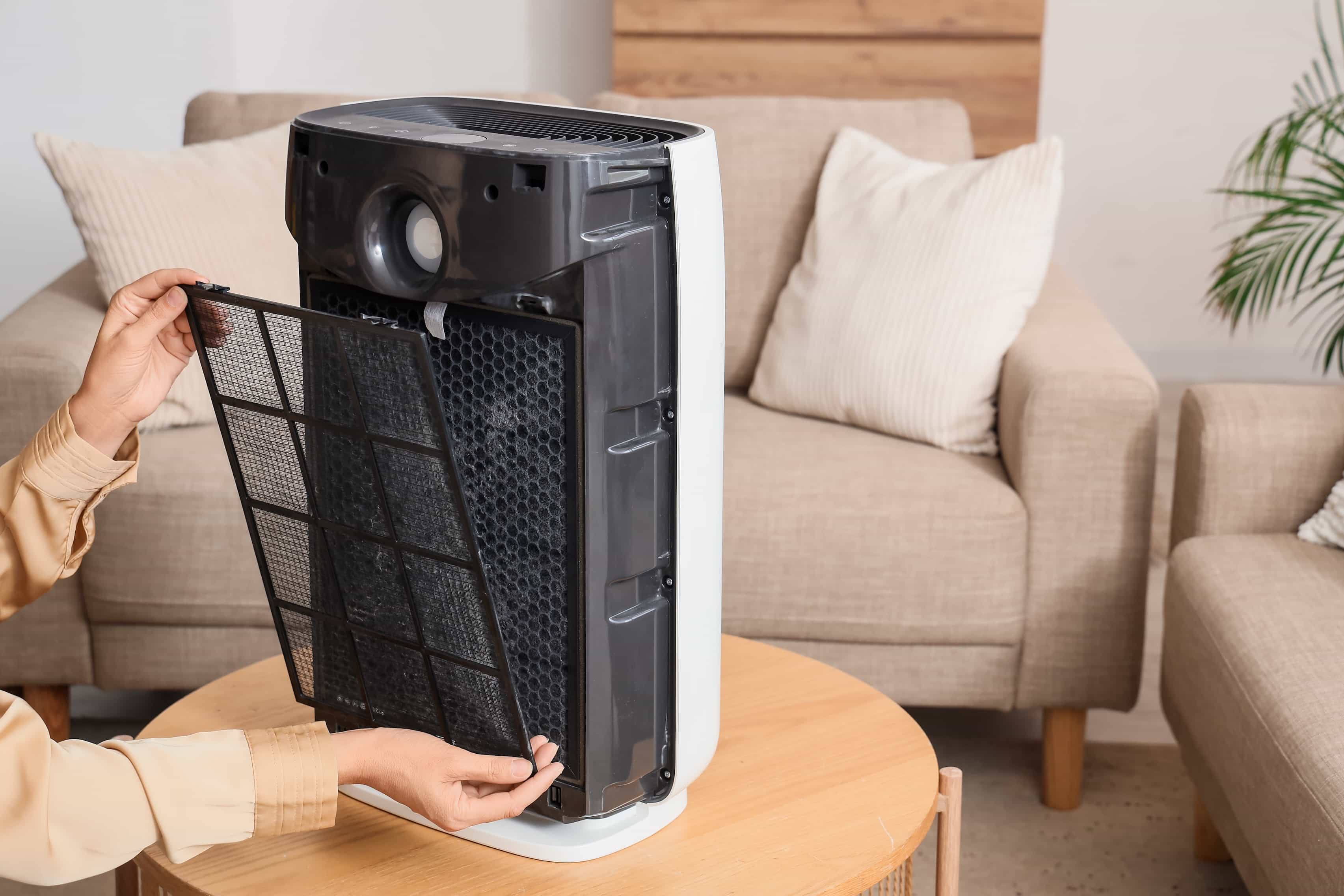
The core of any serious purifier is a mechanical filter — a dense mat of fibres that physically traps particles as air is forced through it. The gold standard is a True HEPA filter. A genuine HEPA filter is rated to capture 99.97% of particles at 0.3 microns, which the National Collaborating Centre for Environmental Health notes is equivalent to a MERV 16 or higher furnace filter. The 0.3-micron figure isn't arbitrary: that size is the hardest for a filter to catch, so a filter that nails it does even better on particles that are larger or smaller.
Watch the label language here. "True HEPA" or "certified HEPA" is the real thing. "HEPA-type," "HEPA-like," or "99% effective" are not — they are lookalike terms that can let the smallest, most dangerous particles slip through. For wildfire smoke especially, the difference is not cosmetic. It's the difference between filtering PM2.5 and pretending to.
Activated Carbon: For Odours and Gases, Within Limits
Mechanical filters trap particles. They do nothing for gases or smells, because odour molecules are far too small to be caught in a fibre mat. That's the job of activated carbon (also called activated charcoal) — a separate filter, made of porous material, that adsorbs certain gases and odours onto its enormous internal surface area. A purifier with a real carbon stage can take the edge off cooking smells, pet odours, and some of the volatile organic compounds (VOCs) in wildfire smoke.
But carbon has hard limits, and this is where expectations need managing. Carbon works by contact and capacity: a thin carbon-coated screen does very little, and even a substantial carbon filter fills up and stops adsorbing. Once it's saturated, it can even release captured gases back into the room. Crucially, there is no widely accepted performance rating for gas and odour removal the way CADR rates particles — so you can't compare carbon performance on a spec sheet. More carbon mass generally means more capacity and longer life, and that's about as precise as the comparison gets.
Ionizers, UV, and Ozone: Where to Be Cautious
This is the part of the category that earns the most skepticism, and deservedly so. Ionizers and electrostatic precipitators charge particles so they clump and settle out of the air or stick to a plate, rather than being captured in a filter. The problem is that some of these devices produce ozone as a by-product, and ozone is a lung irritant — Health Canada's residential indoor air quality guideline for ozone sets a maximum of just 8 µg/m³ (about 4 ppb) for indoor exposure, and the department advises against using ozone-generating devices as air cleaners in occupied spaces.
If you do consider a unit with an ionizer, look for independent ozone certification: in Canada, the relevant standard is CSA 22.2 No. 187-20, and only devices certified to produce little to no ozone should be used indoors. The bottom line for almost every household is straightforward. Mechanical filtration plus carbon is the proven combination. Ionizers are an optional extra at best, and ozone generators marketed as "air purifiers" should be avoided.