It brings fresh outdoor air into your home while exhausting stale indoor air, and it transfers heat from the outgoing air to the incoming air so you waste less energy during ventilation.
A Practical Guide to Balanced Ventilation, Heat Recovery, and Humidity Control

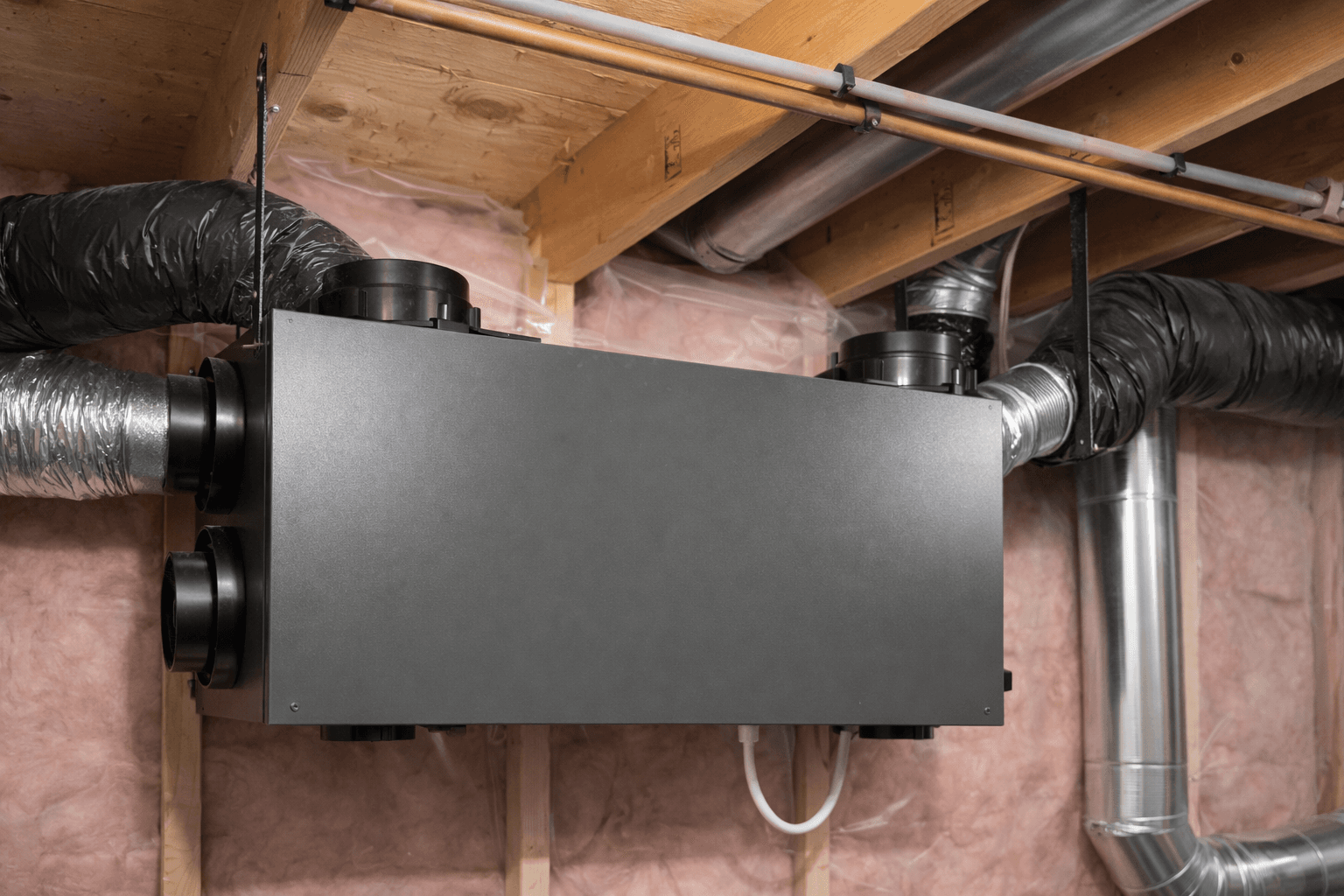
HRV unit tucked in the attic trades stale indoor air for fresh while reclaiming heat. (Credit: Homeowner.ca)
Canadian homes are built to survive real weather: long heating seasons, deep cold snaps, humid summers in many regions, and increasingly smoky or polluted outdoor air events. The practical result is that “fresh air” is not just a comfort feature—it’s part of how a home stays durable, healthy, and efficient.
At the same time, modern construction has made homes far tighter than older housing stock. Airtightness is a win for energy bills, but it changes the rules of indoor air quality and moisture management. A tight envelope is like a better lid on a pot: you keep heat in, but you also keep everything else in unless you intentionally manage airflow.
That’s where HRVs (heat recovery ventilators) and ERVs (energy recovery ventilators) fit. They’re purpose-built machines designed to exchange indoor and outdoor air in a controlled way, while recovering energy that would otherwise be lost—so you can ventilate without paying the full energy penalty.
This isn’t a new problem. Highly insulated, airtight “conservation house” concepts have been explored in Canada for decades, and the well-known Saskatchewan Conservation House example shows how pushing efficiency forward also pushes ventilation into the spotlight, as summarized in Wikipedia’s Saskatchewan Conservation House article as part of that broader history.
In this guide, you’ll learn how HRVs and ERVs actually work, what’s happening inside the heat-exchange core, how to think about climate fit across Canada, what installation and maintenance look like in real homes, and how to use Canadian standards and labels to compare options confidently.

Ventilation is not a vague “airing out” concept—it’s a specific process with a purpose. In Health Canada’s ventilation and indoor air quality infographic, ventilation is framed as the movement of air into and out of a home to improve indoor air quality by removing pollutants and bringing in fresh outdoor air.
That simple definition matters because it clarifies what ventilation is for: it’s an exchange process. You’re not just “filtering” the indoor air; you’re replacing a portion of it with outdoor air to dilute indoor contaminants and manage moisture.
Most homes get ventilation through a mix of:
The problem is that natural leakage is inconsistent. It changes with wind, temperature differences, and how the house “stacks” air from basement to attic. Spot exhaust helps, but it can’t reliably manage whole-home airflow balance, and it can create negative pressure if it’s the only strategy.
A useful way to think about ventilation is as a “Goldilocks” system: too little and too much both cause issues. Health Canada’s infographic lays out homeowner-visible signs of insufficient ventilation (like high humidity, mould, odours, and stuffiness) and signs of excessive ventilation (like higher heating or cooling bills, dry air, drafts, and discomfort), and those are exactly the kinds of clues that should trigger a closer look at your ventilation strategy.
Ventilation symptoms overlap with insulation, air leakage, and heating system issues. The goal isn’t to diagnose everything from one sign—it’s to spot patterns that justify measuring and adjusting airflow intentionally.
When a house is leaky, it “ventilates” whether you want it to or not. That’s not a compliment—it’s just an observation. A leaky home can have cold drafts and uneven temperatures, but it may also dilute indoor pollutants by accident.
As you air-seal and insulate, you improve comfort and energy performance, but you also remove the accidental ventilation. That’s why modern high-performance homes treat mechanical ventilation as a core system, not an optional upgrade.
In Canada’s high-efficiency housing context, Natural Resources Canada’s details of the R-2000 Standard emphasizes that a properly designed mechanical ventilation system is essential for maintaining good indoor air quality, and it connects ventilation requirements to recognized Canadian standards and National Building Code expectations.
The practical takeaway: if your home is tight (by design or retrofit), you should assume you need a deliberate ventilation plan. Otherwise, you’re relying on random air pathways to do a job that affects health, durability, and comfort.
Think in three layers:
HRVs and ERVs are primarily the “whole-home balance” layer. They don’t replace your range hood or bathroom fan; they make the rest of your house behave more predictably between those big events.
If you’re planning major air sealing (new windows, attic air sealing, spray foam, basement insulation), treat ventilation planning as part of the same project. Tightening a house without upgrading ventilation can create humidity and comfort problems that look “mysterious” later.
An HRV (heat recovery ventilator) and an ERV (energy recovery ventilator) are both whole-home ventilation machines that exchange indoor and outdoor air while transferring energy between the two air streams.
In Natural Resources Canada’s description of heat recovery ventilators and energy recovery ventilators, the operational concept is described as moving stale indoor air out while bringing fresh outdoor air in through a heat-exchange core in a way that keeps the two airstreams isolated, and it highlights that ERVs are essentially HRVs designed to transfer both heat and moisture between those airstreams.
That one sentence contains most of what homeowners need to understand:
When you’re comparing systems, ask one simple question: “How will this be balanced and verified?” A great unit installed poorly will underperform a modest unit installed and commissioned properly.
The core is the “exchange surface” where energy transfers between the outgoing and incoming air streams. From a homeowner perspective, the core is why balanced ventilation doesn’t automatically mean huge energy penalties.
A straightforward way to picture the process is:
With an HRV, the focus is on sensible heat (temperature). With an ERV, the core is designed to transfer both sensible heat and some moisture (latent energy), which changes indoor humidity behaviour.
Moisture transfer can be helpful when:
Moisture transfer can be less helpful—or require more caution—when:
If you have visible mould, damp building materials, or persistent water entry, treat ventilation as support—not the cure. Moisture problems usually require source fixes (leaks, grading, foundation water control) before ventilation tuning can really stabilize the home.
Canada isn’t one climate—it’s a spectrum. Choosing between HRV and ERV is usually about two things:
A practical “Canadian default” approach many homeowners use:
You’ll typically see HRVs and ERVs installed one of two ways: with dedicated ducting, or integrated into an existing forced-air system. As described in Health Canada’s guidance on ventilation in the indoor environment, HRVs and ERVs are balanced mechanical ventilation systems that can run with their own fans and can be ducted using dedicated ventilation ducting or connected to an existing forced-air furnace duct system, and that same guidance also notes these systems use filters on both supply and exhaust sides with routine cleaning to avoid airflow reduction.
Here’s how to think about the two pathways.
Balanced ventilation means supply and exhaust are matched closely enough that you don’t create strong positive or negative pressure in normal operation. In real houses, “balanced” is not a philosophical concept—it’s a commissioning task.
A well-commissioned system should:
Commissioning is where performance becomes real. If the installer can’t tell you the measured supply and exhaust airflow, you don’t actually know what the system is doing.
Use this as a planning checklist when you’re talking to an HVAC contractor.
If you have fuel-burning appliances (especially older naturally drafted equipment), any ventilation change should be evaluated with combustion safety in mind. Balanced systems reduce many risks compared to exhaust-only ventilation, but pressure effects and venting safety still deserve professional attention.
Most homeowner maintenance is simple, but it matters because airflow is the currency of ventilation. If airflow drops, you don’t get the air exchange you think you’re getting, and heat recovery performance can suffer.
A practical routine:
Put filter checks on the same schedule as furnace filter checks or smoke alarm tests. The easiest maintenance plan is the one you’ll actually follow.
Many homeowners buy an HRV/ERV thinking it’s primarily an “air cleaner.” Ventilation systems help indoor air quality by replacing air, but standard filters are often designed to protect equipment from larger debris, not capture the smallest particles. If you have outdoor air quality concerns, talk to your contractor about higher-efficiency filtration options that fit your system design and airflow goals.
One reason HRVs and ERVs can feel confusing is that product marketing varies, but standards are more consistent. When you read a spec sheet, you want to know you’re comparing similar categories of equipment.
In Natural Resources Canada’s guide to Canada’s Energy Efficiency Regulations for energy and heat recovery ventilators, the regulatory definitions describe these products as factory-built packaged units with fans or blowers that transfer energy between two isolated airstreams and include a maximum rated airflow threshold (142 L/s, commonly referenced as 300 ft³/min at 0°C), and the same guidance identifies CAN/CSA-C439-18 as the laboratory test method used for rating performance.
That gives homeowners three concrete advantages:
You’ll often see a mix of the following concepts (terms vary by manufacturer, and that’s okay):
If you’re overwhelmed, anchor on two homeowner questions:
A unit that looks great “on paper” can disappoint if it can’t deliver rated airflow through your actual duct system. Airflow and balancing come first; everything else rides on that foundation.
Homeowners don’t need to memorize regulations, but it helps to know that Canada has a framework for reporting, verification, and (in some cases) future minimum performance requirements.
In Natural Resources Canada’s recovery ventilators regulatory update, the federal context is outlined, including that HRVs and ERVs manufactured on or after January 1, 2020 are covered under Canada’s Energy Efficiency Regulations for reporting and verification requirements and that NRCan has indicated potential future application of minimum energy efficiency standards to products manufactured on or after January 1, 2026 using the CAN/CSA-C439-18 test method.
What this means in plain terms:
Standards and labels don’t replace good design. They help you filter the market, but the contractor’s design choices and commissioning practices still decide how the home feels.
When you’re comparing several brands, certification can help narrow the field. In Natural Resources Canada’s ENERGY STAR technical specifications for HRVs and ERVs, NRCan explains the performance criteria products must meet to be certified under the Canadian-administered ENERGY STAR program, and it also identifies the technical specification version used to define those requirements.
A practical way to use this:
If two quotes differ wildly in price, ask what’s different about ducting scope and commissioning. The hardware is only part of the system cost.
If you want a decision process that holds up, use a three-layer filter: climate, house, and comfort goals.
Ask:
If winter dominates and dryness is already an issue, be cautious about over-ventilating regardless of unit type. If summer humidity is a major comfort and durability concern, an ERV often aligns with that reality.
Ask:
A tight home benefits most from predictable, balanced ventilation. A leaky home may still benefit, but you may need to address envelope and moisture sources to feel the full value.
Ask:
The “best” unit is the one that will be balanced properly, maintained consistently, and operated at a rate that matches your house and lifestyle. Get those three right and the HRV vs ERV choice becomes far less stressful.
It brings fresh outdoor air into your home while exhausting stale indoor air, and it transfers heat from the outgoing air to the incoming air so you waste less energy during ventilation.
Both recover heat, but an ERV is designed to transfer some moisture as well, which can help moderate indoor humidity depending on season and climate.
In normal operation, the airstreams should remain isolated inside the core—energy transfers across the core material, not by mixing the air itself.
Common clues include persistent stuffiness, odours that linger, high indoor humidity, window condensation, and mould risk in cooler corners or closets.
Typical signs include dry indoor air in winter, new drafts, discomfort, and higher heating or cooling bills than expected for the same weather.
No. They’re common in new tight homes, but retrofits can benefit too—especially after air sealing, insulation upgrades, or window replacements that reduce natural leakage.
Many systems are designed to run using their own fans, which helps ventilation remain consistent even when heating isn’t calling.
Dedicated ducting gives more direct control, but integration can work well in many homes if the duct design avoids short-circuiting and the system is balanced and verified.
Typically from areas that generate moisture and odours (bathrooms, laundry, sometimes near kitchens), while supplying fresh air to bedrooms and living spaces.
Usually, yes. Spot exhaust handles short, high-moisture events efficiently, while the HRV/ERV provides steady background ventilation.
It can help manage humidity and stale air, but mould often involves a moisture source issue (leaks, damp materials, cold surfaces) that must be fixed directly.
A common homeowner routine is checking monthly and cleaning on a 1–2 month cycle, adjusting for pets, dust, and seasonal conditions so airflow stays strong.
Standard filters are often meant to protect the equipment from larger debris; if fine-particle control matters, ask about higher-efficiency filtration options that won’t choke airflow.
Skipping commissioning. Without measured balancing, the system may be under-ventilating, over-ventilating, or causing pressure-driven comfort and odour issues.
In cold weather, moisture in exhaust air can condense as it transfers heat, so the unit often needs condensate management to prevent water problems.
Yes—there’s a federal framework for reporting and verification, and minimum efficiency standards have been proposed for future application to newer manufactured units.
It can be a helpful filter that indicates a product meets specific performance criteria, but it should be combined with good design, measured airflow, and maintenance access.
Many homes do well with an ERV because of humid summers and mixed seasons, but the best choice still depends on airtightness, existing humidity issues, and how the system will be designed and balanced.
Many homes lean toward HRVs due to long cold winters, but avoiding over-ventilation and dialing in control settings is just as important as unit type.
Ask for the design airflow targets, how balancing will be measured, how drains and defrost are handled for winter, where outdoor hoods will be placed, and what ongoing maintenance access looks like.