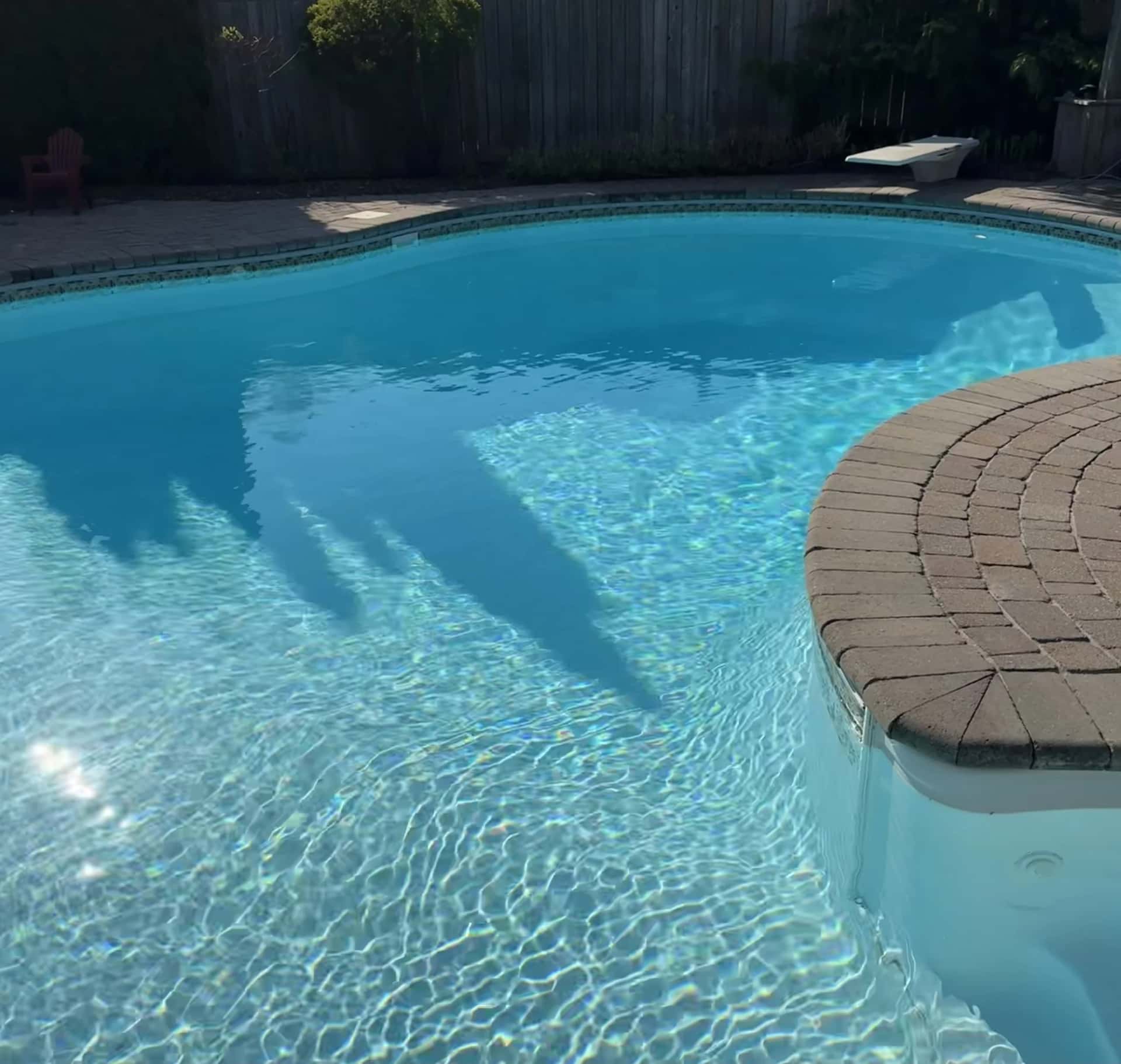
No. A salt cell makes chlorine on site from dissolved salt. The water still contains chlorine and is sanitized by chlorine — the only difference is how the chlorine gets into the pool.
A Plain-Language Owner's Guide for Canadian Pools

Credit: Homeowner.ca
The phrase "salt water pool" is one of the most successful pieces of marketing in residential pool history. It conjures images of gentle, ocean-like water and pools that somehow run themselves. The reality is more useful and less romantic: a salt pool is a chlorine pool with a small, on-site chlorine factory bolted into the plumbing. The factory is the salt cell. Understanding that single fact reframes nearly every decision an owner has to make.
I run a Hayward TurboCell S340 on a 20-by-40 inground pool in Ontario. We bought the home in 2017 with the pool already installed, and I'm now on my second cell. That second-cell datapoint is exactly what the manufacturer warranty literature predicts — cells are consumable parts with a measurable life in operating hours, not permanent infrastructure. Most of what's written about salt pools online is either marketing or a video of someone scrubbing plates with muriatic acid. The middle ground — a working mental model, a few honest specs, and a diagnostic order of operations — is what this guide is for.
What follows is structured the way I'd want a friend to walk me through it: how the system actually works, what the numbers on the box mean, the maintenance rhythm that keeps a cell alive in a Canadian climate, a symptom-to-cause troubleshooting map, and the clean-versus-replace decision when output finally drops off. None of it requires becoming a pool chemist. All of it assumes you'd rather understand what your equipment is doing than guess.
Strip away the branding and a salt chlorine generator (SWG, sometimes called a chlorinator) does one thing: it runs an electric current through low-salinity pool water, splits chloride ions off the dissolved salt, and produces free chlorine — primarily hypochlorous acid and hypochlorite — directly in the return line. That chlorine sanitizes the water, oxidizes contaminants, and then reverts back to chloride, ready to be split again. The salt is never "used up" in the chemical sense; it cycles. What gets consumed is the cell's ability to keep running the reaction, plus whatever salt you lose to splash-out, backwashing, and rain dilution.
Health Canada is explicit on this point. The agency's home safety guidance for swimming pools and spas treats devices that create chlorine from salt as chlorine sanitizer equipment, and chlorine generator devices are required to be registered as pest control products under federal regulation. There is no regulatory category for a "chlorine-free" salt pool because, chemically, no such thing exists. Anyone selling you one is selling you a chlorine pool with a different delivery mechanism.
Every modern SWG is really two components doing different work: a control unit (sometimes called the power unit, controller, or power centre) mounted on a wall near the equipment pad, and an electrolytic cell installed in-line on the return plumbing after the filter and heater. They are easy to confuse and even easier to mis-diagnose.
The control unit takes 120/240V mains power, converts it to low-voltage DC, and decides how much of the time the cell should be energized. It also reads sensors — salinity (via conductivity), water temperature, sometimes flow — and shows you status lights or a digital readout. When something seems wrong, the control unit is where you look first.
The cell is the chemistry. Inside the housing is a stack of titanium plates with a specialized ruthenium- or iridium-based coating. Pool water passes between the plates, the current does its work, and chlorine is generated. Manufacturer documentation for systems like the Jandy TruClear and the Pentair IntelliChlor follows this same architecture. When you read about "cell life," it's the coating on those plates that's wearing out. Once it's gone, no amount of cleaning brings it back.
The most consistently misunderstood control on any SWG is the output % setting. Owners read it as a concentration knob — turn it up and the cell makes "stronger" chlorine. That isn't what happens. Output % is a duty cycle. At 50%, the cell is energized for roughly half the time the pump is running. At 100%, it's energized continuously while there's adequate flow. The chlorine itself is the same chlorine at any setting.
This matters because the two real levers for chlorine production are output % and pump runtime — and they multiply together. A cell at 50% output running 8 hours a day produces about the same chlorine as the same cell at 100% output running 4 hours. If your pool is consistently low on chlorine, the question isn't "how do I make stronger chlorine" but "how do I get more energized cell-time during the day, and is anything stopping the cell from working when it thinks it's running?"
A salt pool is a chlorine pool. The cell only produces chlorine when water is flowing through it, the unit isn't faulted, and water temperature is in the operating range. If the pump is off, your sanitation is off. Plan filtration runtime accordingly — it's the foundation everything else sits on.
The numbers printed on the side of the control unit and in the cell's product literature are useful, but only if you understand what they're describing. Most of them describe ceilings under ideal conditions, not guarantees in a backyard in Mississauga in late July with a pool full of teenagers.
Brand variation here matters more than most consumers realize. The Hayward AquaRite S3 manual supports a wide salinity range from 1,200 ppm in low-salt mode up to 8,000 ppm, but the recommended Standard Salt mode operating range is 2,700–3,400 ppm — meaningfully lower than the 3,000–4,000 ppm range that's typical for Pentair and Jandy systems. If you're switching brands or troubleshooting a low-salt warning, check your specific manual before adding salt. Adding salt to "fix" a reading that's actually within range is one of the easier ways to over-salinate a pool, and the only fix for that is dilution.
Cell sizing on the box is given as a maximum pool volume — for example, the Hayward TurboCell S340 is rated for 40,000 US gallons. Canadian pool professionals consistently recommend oversizing the cell relative to actual pool volume, particularly for pools in shorter swim seasons or hot southern Ontario summers. A cell sized exactly to your pool will spend most of its life running at high output % to keep up with peak demand — high heat, high bather load, high UV — and high duty cycles age cells faster.
My pool is roughly 30,000 US gallons. The S340 is rated for 40,000. That headroom is the difference between a cell that hums along at 50–60% output through July and one that lives at 85–100% from June to September and burns through its operating hours in three summers instead of five.
Cell life indicators on premium models — Pentair's IntelliChlor IC40 has them, as do recent Hayward AquaRite displays — are time-based estimates derived from total operating hours. They're useful for budgeting but not a perfect proxy for performance. A cell can be at 80% of life remaining and still produce poorly because of scaling. A cell can also be at 10% remaining and still meet your pool's chlorine demand if your runtime and chemistry are dialled in.
If you're shopping for a new system or a replacement cell, the Hayward TurboCell S3 line introduces a transparent housing — a sight glass that lets you see scale buildup on the plates without disconnecting the cell from the plumbing. After two cells in our pool, I genuinely consider this a category-changing feature. Pre-S3 cells require unionizing the cell off the plumbing every few months just to confirm whether what you're seeing in the panel is scaling or wear. Visual confirmation in 10 seconds is a meaningful upgrade for high-hardness regions.
Salt cells in Canada are subject to a maintenance reality that doesn't apply to year-round pools in California or Florida: every season has a hard start and a hard stop. The cell goes through a four- to six-month workload window, then sits dormant for the rest of the year. How you handle the bookends — opening and closing — has more impact on cell life than what you do mid-season.
Pool opening is the moment to set the cell up for a long, low-stress year:
Mid-season maintenance is mostly a discipline of light-touch monitoring, not heavy intervention:
Our region has very hard water — calcium hardness from the municipal supply runs higher than what a salt cell would prefer to see. Scaling is the single biggest mid-season threat to cell performance in hard-water Ontario, and it's why I monitor calcium hardness more aggressively than other parameters. (If you're not sure whether you're in a hard-water region, the household signs of hard water are usually the first clue.)
When scale does need to come off, the procedure is straightforward but the precautions matter:
Use this procedure as the exception, not the routine. The official Pool Supplies Canada acid wash guide and most Canadian service company documentation align on the same point: clean only when needed, and use the gentlest dilution that gets the job done.
Muriatic acid is hazardous. Wear chemical-resistant gloves and eye protection, work outdoors with good ventilation, and never mix acid with chlorine or chlorine-bearing water. Add acid to water — never water to acid — to avoid violent splash reactions. If you're not comfortable with the procedure, this is one of the few maintenance tasks that's genuinely worth paying a service technician to handle.
Closing is where Canadian pool ownership diverges sharply from year-round operation, and where careless handling causes the most preventable cell failures. Two practices matter most:
First, balance the water before closing. Pool service companies in Ontario consistently emphasize testing and balancing pH, alkalinity, calcium hardness, and sanitizer immediately before closing, as Pool Craft's closing preparation guide outlines in practical detail. Imbalanced winter water — especially low pH or high calcium — accelerates scaling or corrosion across the entire equipment pad through the off-season, including inside a stored cell.
Second, remove the cell. We remove ours every winter, store it indoors in a dark, dry spot, and reinstall in spring. Several Ontario service companies, including Finn Pools, do the same as standard practice during professional winterizations. (For broader cold-weather home prep, our winterizing checklist for Canadian homeowners covers the rest of the property.) The risk in leaving a cell in-line through a Canadian winter isn't theoretical — water trapped in the housing, even in trace amounts, can freeze and crack the housing or damage internal components. The cell itself becomes a freeze liability. A 10-minute removal in October prevents a $400–$700 spring surprise.
Most pool problems that get blamed on the salt system aren't the salt system. They're chemistry, runtime, scaling, or sensor drift — and they're diagnosable in 20 minutes with a test kit. The single most useful habit you can build as an SWG owner is a fixed diagnostic sequence that you run before you change anything on the panel.
When something is off, test in this order — every time:
This is the sequence Canadian retailers and service techs come back to repeatedly because it works. Pool Supplies Canada's ideal chemical ranges reference anchors most of the targets above. They line up with what Health Canada guidance and Ontario's Regulation 565 require for public pools: minimum 1 ppm free chlorine, pH between 7.2 and 7.8, and CYA capped at 60 ppm in stabilized pools. Residential pools aren't legally required to meet those numbers, but they're the most defensible targets you can aim for.
The single most common reason an SWG owner adds too much salt is a panel reading that doesn't match reality. The unit measures salinity through conductivity, and conductivity is affected by water temperature, scale on the sensor, and overall water condition — not just dissolved salt. Cold water reads lower than warm. A scaled sensor reads lower than a clean one.
The fix is a simple discipline: when you see a "Check Salt" or "Low Salt" warning, run an independent salt test before doing anything else. If your independent test reads in range, the panel is the problem — clean the sensor area, give the cell a visual inspection, and recheck after a few hours of warm water flow. Adding salt to chase a faulty panel reading is how you end up with a 5,500 ppm pool that you then have to dilute by partial drain and refill. A drop test costs about $15.
Recalibrating a salt cell — particularly on Hayward systems — is its own rabbit hole, and the official documentation isn't always as helpful as it should be. We're working on a separate Homeowner.ca guide focused specifically on the Hayward AquaRite recalibration workflow with the steps that aren't well-documented elsewhere. For this guide, the high-level rule applies: independent salt test first, recalibrate second, add salt last.

Eventually, every cell reaches the end of its useful life. The question isn't whether — it's how to recognize the difference between a cell that needs a cleaning and one that needs replacement. Getting this wrong wastes money in either direction: replacing a perfectly cleanable cell, or repeatedly cleaning a cell whose plates are genuinely worn.
Cell life is measured in operating hours, not calendar years. Industry guidance and manufacturer documentation generally place residential SWG cell life in the 3-to-7-year range, depending on water balance, total runtime, output %, and cleaning discipline. A pool running 12 hours a day at 80% output through a long swim season will burn through cell hours faster than a pool running 8 hours a day at 50%.
I'm on my second cell in a Hayward system that came with the house in 2017. That puts the first cell at roughly six seasons of Ontario use — squarely in the middle of the manufacturer's expected range. There was nothing dramatic about its end. Output dropped, cleaning briefly recovered some performance, and within a few weeks the cell couldn't keep up regardless of output % or salt. That's the classic signature of plate coating wear.
The diagnostic question is whether you're looking at scale (reversible) or coating wear (not).
Replacement cells must match the control unit by manufacturer, series, and output rating. This is non-negotiable. A Hayward AquaRite controller takes specific Hayward cells. A Jandy TruClear takes a TruClear cell, not an aftermarket substitute. Mismatched cells can fail immediately, throw constant errors, void warranty coverage, and in some cases damage the controller itself.
Three rules that prevent the most common mis-purchases:
Salt cells typically carry a limited warranty measured in years, often pro-rated against expected hours of operation. Two practical implications:
About the Author
Ryan is the founder of Homeowner.ca and a proud Canadian homeowner based in Guelph, Ontario. Over his 25-year career in digital publishing, he has focused on transforming complex information into clear, practical guidance that helps people make confident, well-informed decisions.
No. A salt cell makes chlorine on site from dissolved salt. The water still contains chlorine and is sanitized by chlorine — the only difference is how the chlorine gets into the pool.
1–3 ppm free chlorine is the standard target for outdoor residential pools, in line with Health Canada's proposed labelling for chlorine generators and most Canadian retailer guidance.
Check your specific model. Hayward S3 Standard Salt mode runs at 2,700–3,400 ppm. Pentair and Jandy systems typically target 3,000–4,000 ppm. The right number is whatever your manual specifies — not a generic figure.
Cyanuric acid (CYA) acts as a UV stabilizer for chlorine. Without it, sunlight burns off chlorine almost as fast as the cell can make it. Aim for 30–50 ppm in outdoor pools.
It controls the percentage of pump runtime during which the cell is actively producing chlorine. At 50%, the cell is energized roughly half the time the pump runs. It does not change the strength of the chlorine produced.
Only when visible scale is impeding plate exposure. Many cells need cleaning once or twice per season; some need none at all. Aggressive or routine acid washing erodes the plate coating and shortens cell life.
Three to seven years of operating use is the typical residential range, with chemistry, runtime, and cleaning discipline being the largest variables. A cell in a hard-water region with poor pH control will land at the bottom of that range; one in soft, well-balanced water at the top.
It's the recommended practice. Water trapped in a cell can freeze and crack the housing or damage internal components. Most Ontario pool service companies remove and store cells as part of standard winterization.
Salt panels read salinity indirectly via conductivity, which is influenced by temperature, sensor scaling, and water condition. Always run an independent salt test before adding salt or replacing hardware. The panel is often the issue, not the salinity.
It's normal. Salt cells produce small amounts of sodium hydroxide near the plates, and pool aeration drives off CO₂. Both push pH up. Plan for periodic muriatic acid additions through the season.
Run the diagnostic sequence: test FC, pH, CYA, salt (independently), water temperature, and confirm pump runtime and output %. Most "low chlorine" issues trace to chemistry or runtime, not the cell.
Possible but risky. Aftermarket cells can void warranty coverage, throw error codes, and in some cases damage the controller. Match the original by manufacturer, series, and output rating using the manufacturer's compatibility documentation.
Yes. Hard water leads to faster calcium scaling on the plates, which reduces output and triggers warning lights. In hard-water regions, monitor calcium hardness more closely and inspect the cell more frequently. The signs of hard water in your home are usually a reliable indicator.
Most cells specify a minimum water temperature in the 12–15 °C range, with reduced output below 18 °C. In Canadian shoulder seasons, you may see the cell suspend production during cool nights. Check your specific manual for the exact threshold.
Yes — periodically and after heavy use, rain events, or algae issues. Most modern SWGs have a "Boost" or "Super Chlorinate" mode that runs the cell at 100% for 24 hours. For larger spikes, supplemental liquid chlorine is faster.
It does, slightly. The dissolved salt at 3,000-ish ppm changes how the water feels on skin — closer to how soft water feels coming out of a water softener than to ocean water (which is roughly ten times saltier).