Three vespid groups account for almost everything a Canadian homeowner meets, and they behave differently enough that species changes the verdict.
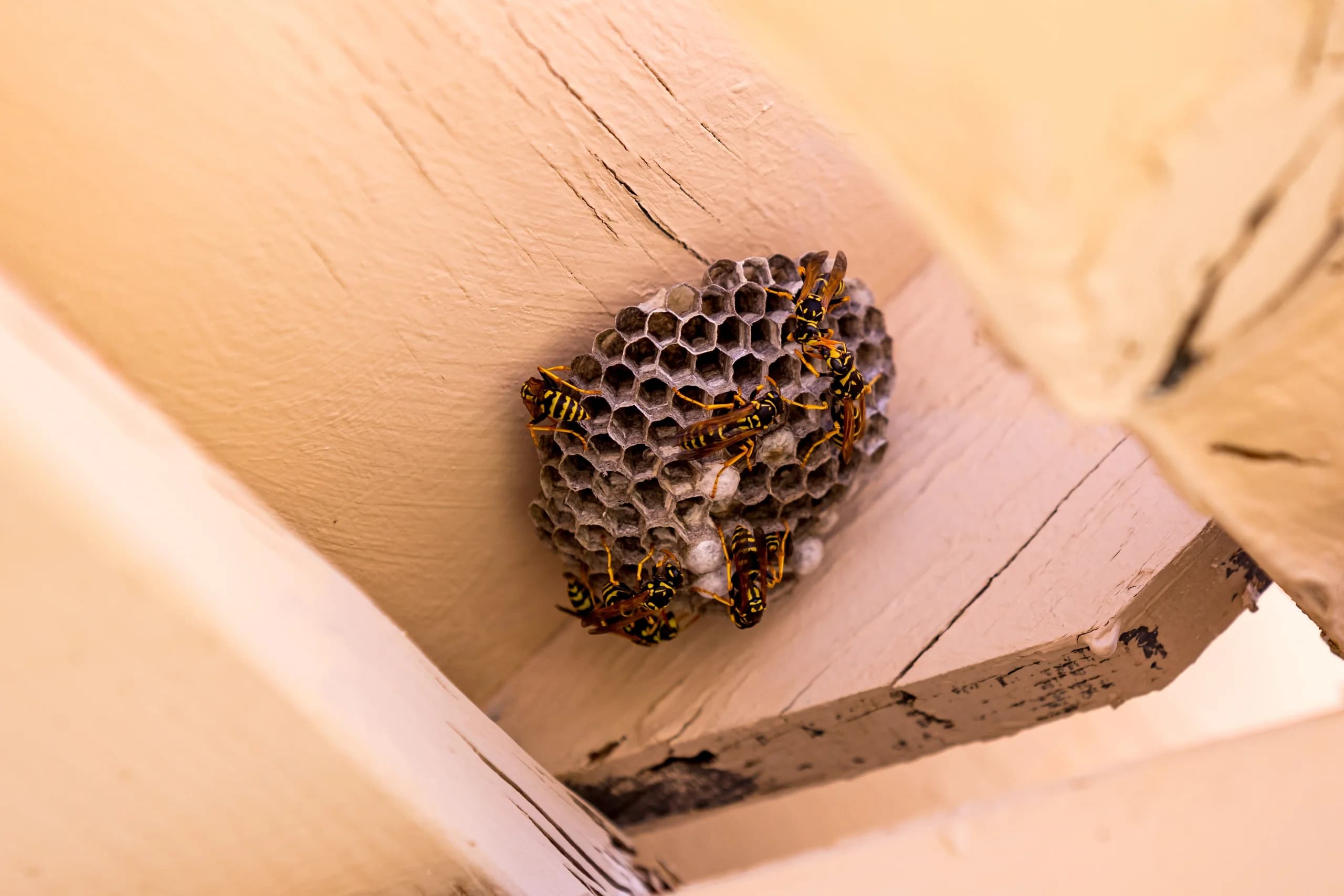
Paper wasps build an open comb with no paper envelope around it — a bare, umbrella-shaped disc of cells under an eave, a rail or a light fixture. That single field mark identifies the least dangerous group at a glance. The Ottawa Field-Naturalists' Club describes them as "elongate, narrow, slow-flying and bumbling," and records that the European paper wasp is now established alongside the native northern paper wasp, turning up in trail signage and garden sheds. Small colony, low defensiveness, open comb. Almost always a wait.
Bald-faced hornets are the black-and-white ones — cream to nearly bone white where a yellowjacket is yellow — and they build the large grey shapeless nests that get photographed. Aerial nesters, so they do not scavenge, and their tactic is to fly at an intruder, sting and depart. Height is not a species clue: hornet nests have been recorded at half a metre off the ground and at three metres in the same season.
Then there is the German yellowjacket, which is why this decision cannot be made on the calendar alone. Established in Canada since the 1960s, it "is more inclined to nest in cities and suburbs, and will use the inside walls of buildings, attics, and even the joist space between a floor and the ceiling below" — and, the critical line, it "remains active in the fall much longer than most North American yellowjackets and is considered somewhat more aggressive." Health Canada independently calls German yellow jackets the most aggressive of the social wasps.
Read those two properties together. The species most likely to be inside a Canadian wall is also the species that stays active latest into the fall. The two conditions that make waiting look attractive — an enclosed nest nobody walks past, and a frost date a few weeks out — are precisely the conditions under which waiting fails.