Canadian practice recognizes three approaches. They are not a hierarchy from cheap to good — they solve different amounts of the problem, and the right one depends on your house's condition and what you need to prove.
Replacing the devices with rated ones
The first path swaps the receptacles and switches for devices approved and marked for use with aluminum conductors. In Canada the test is a marking, not a brand. Table F1 of the Ontario Electrical Safety Code, reproduced in the ESA Flash notice, sets them out: receptacles rated 20A or less must be marked CO/ALR or AL–CU; receptacles above 20A must be marked AL–CU or CU–AL; switches rated 20A or less must be marked CO/ALR; and wire connectors must be marked AL–CU or CU–AL.
The code also governs how the conductor lands on the device. Rule 12-118 requires the conductor to be formed clockwise around the screw into three-quarters of a complete loop, with only one conductor per screw, and it prohibits devices with push-in terminations on aluminum conductors outright. That last point is a live risk in any house where someone has swapped in inexpensive modern devices over the years, since push-in terminals are exactly what those devices offer.
Pigtailing to a copper tail
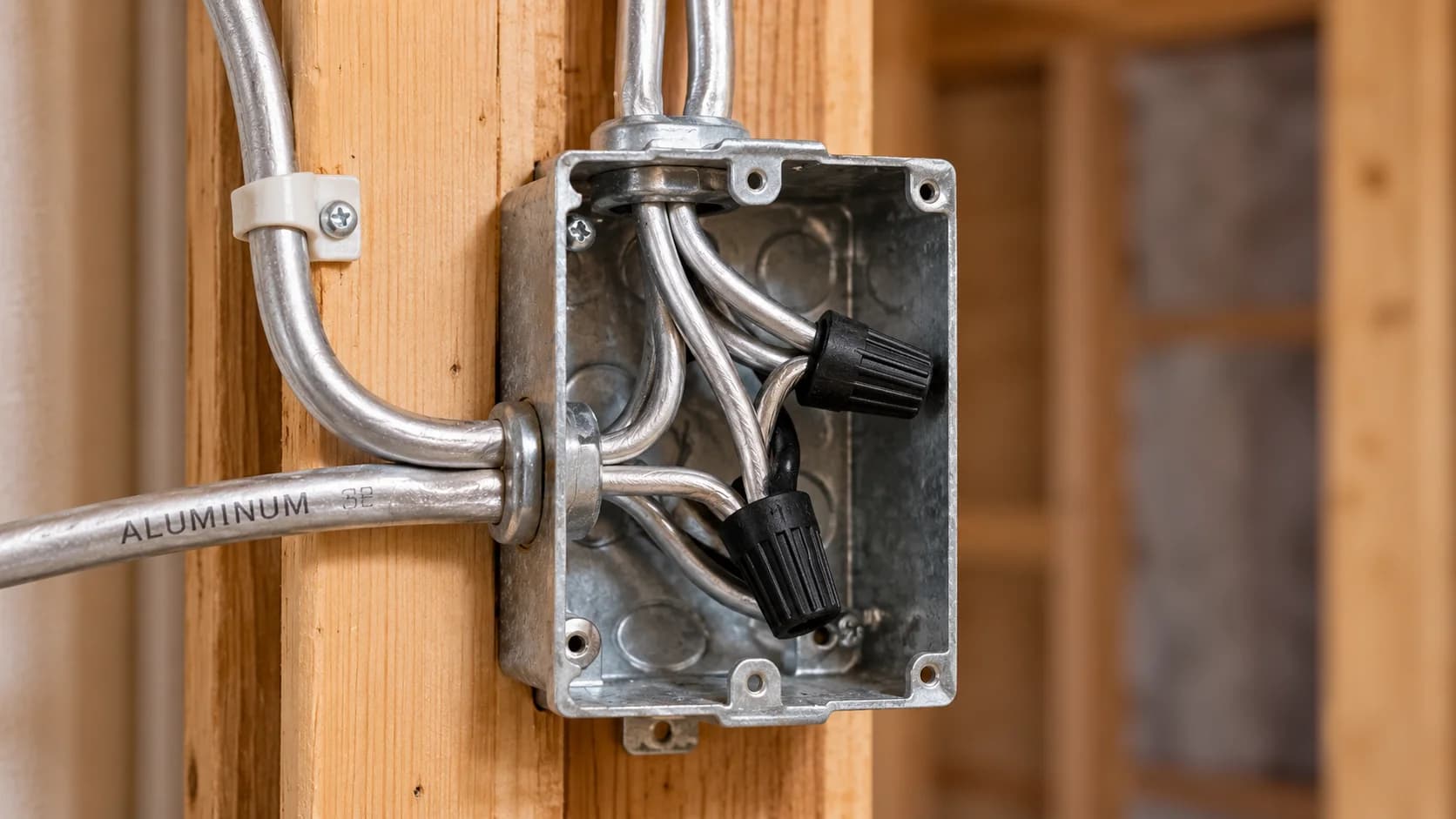
The second path leaves the branch conductor alone and changes what it connects to. A short copper "pigtail" is joined to the aluminum conductor with a connector certified for the aluminum-to-copper transition, and the copper tail lands on the device. Alberta's Safety Codes Council describes it as the recognized alternative to using approved devices, and the entire certification burden sits on the connector rather than on the technique.
This is where Canadian readers get misled, and it is worth being precise. Search results on this topic — including pages published by Canadian contractors and Canadian insurers — routinely name two American repair systems, the COPALUM crimp and the AlumiConn connector. Both are genuinely endorsed by the U.S. Consumer Product Safety Commission. Neither endorsement is a Canadian approval. King Innovation's own product listing for the AlumiConn connector states that it is approved by the Consumer Product Safety Commission, UL, and numerous insurance companies — and names no CSA, cUL or cULus certification anywhere on the page.
The practical instruction that follows is simple, and it is the one to carry into a conversation with a contractor: do not ask for a brand. Ask the electrician to confirm that the connector they intend to use carries a Canadian certification mark and the AL–CU or CU–AL marking the code requires. A product endorsed in another jurisdiction is not thereby acceptable here.
Full rewiring
The third path replaces the aluminum branch circuits with copper. It is the only option that removes the condition rather than managing it, and it is the only one that ends the conversation permanently — no future owner, inspector or underwriter will ever raise it again.
It is also the most disruptive and the most expensive by a wide margin, involving opened walls and ceilings across the whole house. Square One publishes an estimate of $8,000 to $15,000 to rewire a 1,500 to 3,000 square foot home, which is one insurer's published figure rather than a Canadian price, and material costs on a copper-heavy job move with the market. Anyone budgeting a full rewire in the current climate should also read our breakdown of renovation materials affected by Canada–U.S. tariffs.
Setting the three against each other
Two notes belong under that table. First, the American and Canadian positions on device replacement genuinely differ: the U.S. commission treats rated devices alone as, at best, an incomplete repair, while Canadian authorities treat properly marked and properly terminated devices as a permitted path. That is a jurisdictional difference rather than one authority being wrong, and it explains why a U.S.-sourced page and your own electrician may not agree.
Second, and more practically: with pigtailing, scope is everything. A quote that pigtails the receptacles but skips the junction boxes, the light fixtures and the panel terminations has remediated some of your connections. Ask any quote to state how many connections it covers and which locations are excluded, in writing, before you sign it.