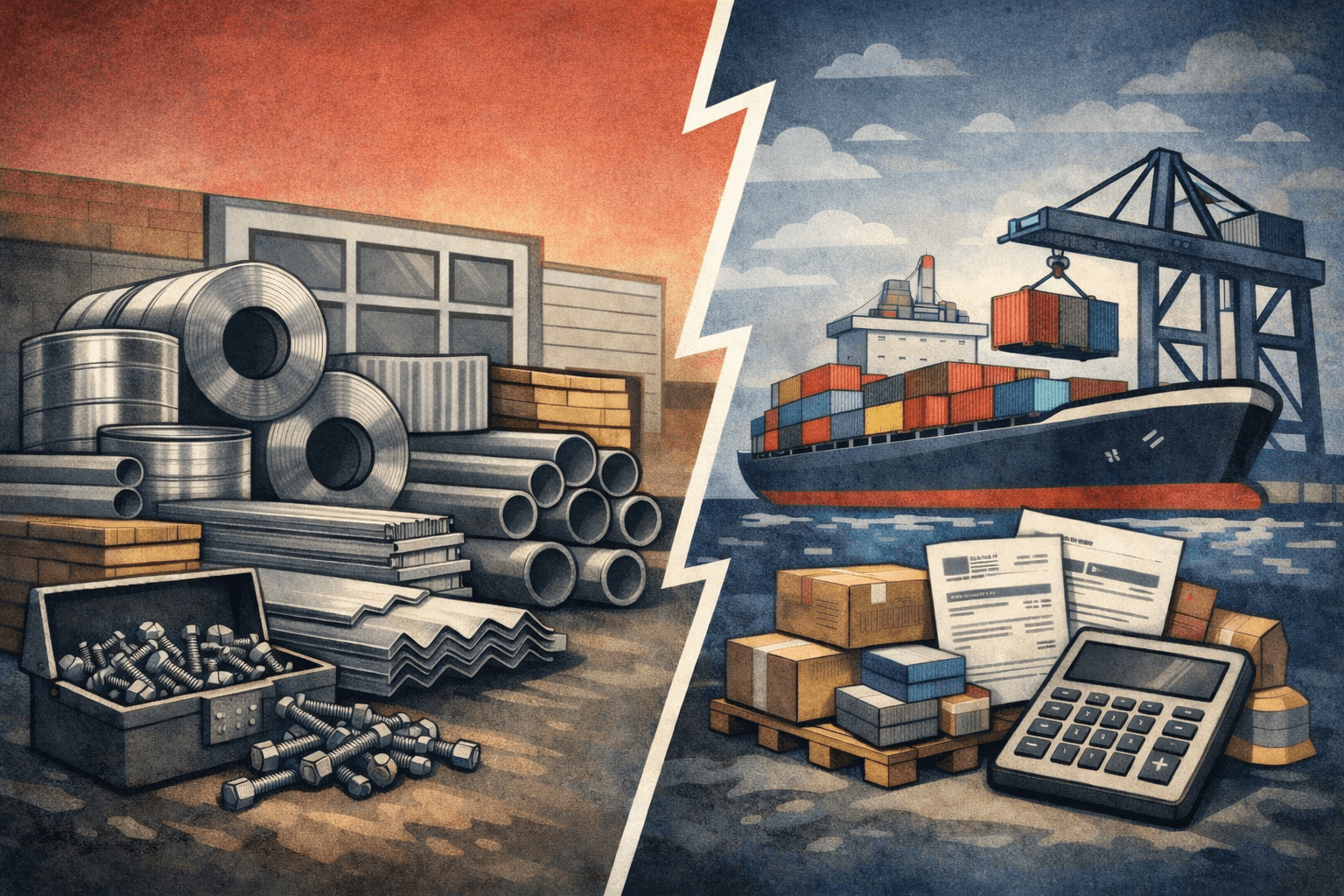
Renovation Materials Affected by Canada-U.S. Tariffs — and How Much More You'll Pay
A Homeowner’s Field Guide to 2026 Metal-Heavy Renovations, Price Volatility, and Smarter Buying
By
Published: March 20, 2026
Fact-checked · , including Department of Finance Canada, Global Affairs Canada & Canada Border Services Agency
Credit: Homeowner.ca
Key Takeaways
•A 25% tariff doesn’t automatically mean your whole renovation costs 25% more—what matters is which line items are tariff-exposed and how much metal is inside them.
•Since September 1, 2025, many broad counter-tariffs were removed, but steel and aluminum cost pressure can still show up through metal-specific measures and steel-derivative rules.
•You can’t “budget your way out” of uncertainty, but you can reduce exposure by checking origin, splitting quotes into material vs labour, and planning purchase timing for metal-heavy items.
Tariffs rarely feel “political” when you’re the one standing in an aisle comparing fasteners, flashing, or a window quote that just jumped overnight. But that’s exactly how trade policy shows up in real life: as a surprise line-item premium on renovation materials that contain steel and aluminum—even when the product itself doesn’t look like a “metal purchase.”
In March 2025, a new phase of tariff pressure began when the U.S. reimposed Section 232 25% tariffs on Canadian steel and aluminum, and Canada moved to challenge the action through dispute processes, as described in Global Affairs Canada’s March 12, 2025 statement while the practical reality for homeowners became simple: metal got riskier to price, source, and schedule.
The nuance homeowners need (and rarely get) is that tariff exposure isn’t static. Canada later removed many counter-tariffs that had been applied earlier in 2025 on most U.S. imports, while keeping steel, aluminum, and automobiles in focus, as laid out on the Department of Finance’s Canada’s response to U.S. tariffs page in language that makes two things clear for renovation planning: not everything stays tariffed forever, and metals remain a persistent cost driver.
This guide is built around a homeowner-friendly question: Where do tariffs actually show up in my renovation—and how much could they move my budget? You’ll see 15 “tariff touchpoints” that map to real renovation categories (roofing, windows, HVAC, plumbing, connectors, tools). For each, I’ll break down how the tariff exposure typically enters the quote, what “25%” can look like in practice, and what you can do to reduce surprise costs without compromising your project.
Structural Steel And Rebar
Credit: Shutterstock.com
When A “Small” Steel Line Item Creates A Big Scheduling Problem
If your renovation touches structure—basement underpinning, beam replacement, garage openings, posts, lintels, or major deck work—you’re in steel territory. Even when the metal portion is a minority of the total budget, it’s often the critical path item: if it’s delayed or repriced, everything downstream stalls (framing, inspections, drywall).
Here’s the practical homeowner takeaway: steel isn’t just a commodity price; it’s a coordination price. Fabrication slots, delivery windows, and contractor sequencing can matter as much as the per-pound cost. When tariffs or trade measures tighten supply options, the symptom you feel is often lead time and “quote expiry dates,” not just the sticker price.
A useful way to estimate “how much more you’ll pay” is to isolate the tariff-exposed portion of the job. If steel is 20% of a structural renovation quote, even a sharp increase on that portion can translate into a smaller—but still meaningful—percentage increase on the whole job.
Scenario
Simple Math
What It Can Mean For Your Budget
A metal component you buy directly is tariff-exposed
$1,000 × 25% = $250
The landed cost can jump by hundreds, and retail markups may amplify it
Tariff exposure hits only part of a contractor quote
The full job might rise ~7.5% if pass-through is close to 100%
A supplier absorbs some cost to stay competitive
$1,000 × 25% = $250 but only $150 passed through
Your price moves, but not in a one-to-one way with the tariff rate
Tip
Ask your contractor to separate material allowances (steel, connectors, sheathing) from labour and overhead so you can see how much of the quote is actually exposed to metal price swings.
Steel Derivative Products
Credit: Shutterstock
The Tariff Can Hit The Finished Component, Not Just Raw Steel
Many homeowners assume “tariffs on steel” mainly affect raw stock like coil or rebar. In 2025–26, an important shift is that policies increasingly focus on derivative or downstream products—items where steel content is a large share of the final value.
Effective December 26, 2025, Canada applied a 25% tariff on the full value of listed steel derivative products from all countries and also described how tariff-rate quotas (and over-quota surtaxes) shape import economics, as detailed in the Prime Minister’s November 26, 2025 backgrounder on steel and lumber measures in a way that matters directly to renovations because categories include items homeowners routinely buy as “finished goods,” not raw metal.
Why this changes your pricing reality:
It expands the “tariff zone.” Even if a supplier finds a different source for raw steel, the finished component you actually purchase can still be tariffed as a derivative product.
It can concentrate increases on specific categories. Doors, windows, wire, cables, chains, fasteners, and structural items can become more sensitive to policy than they were in earlier cycles.
It can create step-changes, not gradual creep. A tariff that applies to the full value of a product is a cleaner shock than a smaller surcharge buried in upstream inputs.
The budgeting move here is straightforward: if you’re buying fabricated metal components (not just materials), treat those line items as “high sensitivity” and plan for wider quote ranges—or lock orders earlier when your design is settled.
A “Durable Upgrade” That Is Also A High-Metal Purchase
Metal roofing, valleys, drip edge, chimney flashing, eavestroughs, downspouts, and snow-guards are a perfect example of how a premium renovation category can become tariff-sensitive.
Even if your shingles aren’t metal, the parts that protect your home from water intrusion often are. When steel and aluminum pricing moves, it can show up in:
Perimeter systems (drip edge, fascia flashing, gutter runs)
How much more you’ll pay tends to depend on whether you’re choosing standard profiles and colours that are stocked locally versus custom profiles, unusual finishes, or long runs that need special-order coil.
Warning
If you’re choosing specialty metal roofing (custom colour or profile), assume your “final” price is only final if you also confirm order lead time and quote validity period in writing—metal pricing can move between deposit and delivery.
Aluminum Siding And Exterior Trim
Credit: Shutterstock
Where “Low Maintenance” Can Become “Higher Variance”
Aluminum shows up in siding systems, soffits, fascia, capping, and many exterior trim packages. Even if the core wall assembly is wood-framed, your exterior finish can still be metal-heavy.
In a typical exterior refresh, aluminum-based products often behave like “linear-foot multipliers.” A modest per-foot increase becomes significant when you multiply across a full house perimeter. This is why homeowners sometimes feel tariff-driven cost jumps more acutely on exteriors than on, say, a bathroom refresh.
Cost-mitigation ideas that don’t require sacrificing performance:
Standardize profiles across the project (fewer special orders).
Reduce colour changes (colour transitions add complexity and waste).
Consider hybrid detailing where appropriate (using non-metal trim in low-exposure locations while keeping metal where water and wind demand it).
Windows And Doors With Metal Frames Or Reinforcement
Credit: Shutterstock
Hidden Metal Inside “Non-Metal” Assemblies
Even when you’re not buying aluminum windows, many window and door systems contain metal reinforcement, hardware, tracks, or metal-clad components—meaning tariff exposure can arrive through the internal structure of the unit, not just the visible frame.
Where metal often hides in this category:
Reinforcement inside vinyl frames (to handle size and wind load)
Thresholds and sill pans
Multi-point locking hardware
Patio door tracks and rollers
How much more you’ll pay depends on whether the manufacturer can shift sourcing to reduce exposure and whether your chosen system is more “standard line” or more bespoke (oversized units, special glazing packages, custom colours).
The homeowner strategy here is to treat windows/doors like a procurement project, not a single purchase: get multiple quotes, ask about origin/manufacturing location, and avoid last-minute scope changes that force special orders.
Garage Doors And Door Hardware
Credit: Shutterstock
A Steel-Heavy Package That Often Gets Forgotten In The Budget
Garage doors and related components are deceptively metal-intensive: door skins, internal stiffeners, tracks, springs, hinges, and fasteners. If you’re doing a garage conversion, adding a wider opening, or upgrading to insulated doors, this is a category where pricing can move quickly.
Two practical “how much more” realities:
Insulation upgrades can amplify steel cost impacts because better doors often use heavier gauge construction and more reinforcement.
Hardware packages can shift based on availability (substitutions can be common, and not all substitutions are equal in durability).
If you want cost stability, try to finalize door size, insulation level, and colour early—then ask the installer to place the order as soon as your project schedule is realistic.
Sheet Metal Is Everywhere, Even In “Simple” HVAC Work
Renovations that touch heating and cooling often trigger duct adjustments, new vents, returns, hoods, and sometimes new flue or venting runs. Even when the equipment itself isn’t a tariff flashpoint, the sheet metal work can be.
Why this matters for your budget:
HVAC is a “many small pieces” trade. Tiny price changes per fitting add up across a full system rework.
Lead times and availability can influence labour, because crews lose productivity if materials arrive piecemeal.
If your renovation includes open ceilings, basement finishing, or major kitchen/bath ventilation work, ask for a ducting allowance as its own line item so you can track how much of the HVAC quote is exposed to metal cost variability.
Cast-Iron And Metal Plumbing Components
Credit: Shutterstock
Bathroom And Basement Renovations Can Still Be Metal-Driven
Cast-iron components and metal plumbing parts show up in drain stacks, cleanouts, certain fittings, and retrofit transitions in older homes. Even when you’re upgrading to modern plastic piping, renovations often involve interfaces with existing metal systems.
Canada’s March 2025 counter-tariff package explicitly included cast-iron products in the list of affected additional U.S. goods, as stated in the Department of Finance’s March 12, 2025 news release on Canada’s tariff response which is a useful reminder that plumbing budgets can be hit indirectly—even when you think you’re “just buying fixtures.”
For homeowners, the most actionable move is to anticipate metal-related surprises in older homes:
Budget for transition parts when tying into existing stacks.
Expect extra labour if corroded metal needs removal.
Ask your plumber whether they’re pricing based on “best case” material availability or including contingency for substitutions.
Fasteners, Anchors, And Structural Connectors
Credit: Shutterstock
Small Items That Multiply Across The Whole Job
Fasteners are the classic renovation trap: each box feels small, but the project eats dozens of boxes. Screws, nails, anchors, joist hangers, straps, brackets, and Simpson-style connectors can make up a meaningful portion of framing and deck budgets.
Two ways tariffs can show up here:
Direct exposure if the connector/fastener category is subject to tariff measures.
Indirect exposure because these products are overwhelmingly metal-based, and upstream steel costs ripple into finished pricing.
How much more you’ll pay is rarely noticed as a single “sticker shock” moment; it’s more like the slow bleed of reorders and add-ons. The mitigation strategy is to plan quantities carefully and consolidate purchases to reduce waste and emergency trips where you pay whatever’s on the shelf.
Fencing, Railings, And Exterior Metalwork
Credit: Shutterstock
The “Linear Foot Multiplier” Problem, Again
Exterior metalwork—railings, privacy screens, fencing panels, posts, brackets, and gates—can be a major tariff-sensitive category because it combines high metal content with fabrication labour.
The budget risk increases when you choose:
Custom heights or profiles
Powder-coated finishes (often special-order or batch-dependent)
Complex site conditions (slope, corners, stair runs)
If your project is rail-heavy, consider value engineering that keeps safety and code compliance intact: simplify picket spacing, use standard panel sizes, and minimize custom bends or welded transitions.
Tools And Renovation Equipment
Credit: Shutterstock
When Buying The “Wrong” Tool At The “Wrong” Time Costs More Than The Tool
Tools are a renovation cost that homeowners often overlook until the receipts pile up. The tariff environment in 2025 created periods where certain tool categories were explicitly included in counter-tariff packages, and then later policy changes reduced broad exposure on many goods.
The practical takeaway isn’t to panic-buy tools—it’s to treat tools like a strategy decision:
Rent for one-off specialty needs (concrete cutting, demolition, large-hole drilling).
Buy when the tool is a reusable asset and you’re confident you’ll use it again.
Borrow when the timing is tight and the cost risk is high.
If you’re hiring a contractor, pay attention to whether tool costs are embedded in labour rates or being charged as separate consumables. It’s often more cost-effective to negotiate for “all-in” pricing than to end up paying retail for rush purchases.
Supply-Chain Diversion And The Double Squeeze On Metal Inputs
Why “Just Buy Non-U.S.” Is Not Always A Clean Escape
Homeowners often ask: “Can I avoid this by buying non-U.S. metal products?” Sometimes yes, but the policy environment has also tightened around global steel flows and trade diversion risks.
In March 2025, the federal government launched consultations on new trade measures to prevent diversion of steel products into Canada and also noted a 25% surtax on steel and aluminum products from China effective October 22, 2024, as explained in the Department of Finance’s March 22, 2025 consultation release which signals a wider “metal cost squeeze” beyond one bilateral dispute.
What this means in homeowner terms:
Some low-cost supply channels can become less available or less predictable.
Substitution can shift costs rather than remove them.
Availability may improve in some categories even while compliance and enforcement tighten.
The right mindset is to focus on functional equivalence (what performance you need) rather than fixating on one country-of-origin as the magic solution.
Remission, Non-Stacking, And Timing Windows
Why Some Businesses Get Relief, But Homeowners Still Feel Pressure
Tariff policy isn’t only about imposing costs; it can also include time-limited relief mechanisms that help certain sectors adjust supply chains. That matters because industrial pricing stability can flow down into the renovation economy—but it’s rarely “clean” or universal.
In December 2025, Canada extended horizontal remission timelines for certain steel and aluminum goods used for specific purposes, with defined expiry windows into 2026, as set out in the Department of Finance’s December 12, 2025 release on steel industry measures which also helps explain why homeowners may see uneven pricing: some inputs are temporarily stabilized for some uses, while other renovation-relevant products remain fully exposed.
There’s a second homeowner-relevant concept here: non-stacking. When multiple steel and aluminum measures exist at the same time, rules determine which one applies to a given product, affecting landed costs, sourcing choices, and how quickly suppliers reprice. In plain English, this generally means you won’t be hit by two separate 25% tariffs on the same piece of steel—the government applies one applicable measure rather than stacking them.
So what do you do with this?
If your project is metal-heavy, assume pricing can remain volatile through 2026.
Treat “good until end of month” quotes seriously, especially for fabricated metal items.
Consider phasing: lock the metal-heavy scope first, then proceed to finishes.
Policy Volatility: Adjustments, Quotas, And Procurement Rules
How Government Decisions Can Move Prices Mid-Project
If you want one reason renovation pricing can feel chaotic in 2025–26, it’s this: governments can adjust tariff settings based on negotiations, market conditions, and enforcement priorities. For homeowners, the outcome is not just “higher” prices, but moving prices.
In June 2025, Canada announced it would adjust existing counter-tariffs on steel and aluminum products as of July 21, 2025 and also move toward reciprocal procurement policies, as described in the Department of Finance’s June 19, 2025 news release which reinforces a key renovation-planning rule: timing and policy can interact, so big projects benefit from deliberate purchase sequencing rather than “we’ll buy it later.”
Separately, federal industrial policy also pushed toward increased use of Canadian inputs, with Industry Canada directed to prioritize funding for projects using predominantly Canadian steel and aluminum—a move that affects homeowners indirectly by shaping what suppliers stock and what contractors source, rather than providing any direct grants or rebates for residential renovations.
The homeowner strategy here is to adapt to policy volatility rather than try to predict it:
Get quotes with clear validity periods and material allowance assumptions.
Lock long-lead metal components earlier than finishes.
If you’re flexible on design, keep a “Plan B material” ready (e.g., alternative railing system, alternate cladding detail).
A Tariff-Resilient Renovation Buying Checklist
A Step-By-Step Process To Reduce Surprise Costs
You can’t personally change border policy—but you can stop being surprised by it. The goal is to turn tariff exposure into a checklist item, not a budget crisis.
Step 1: Separate “Metal-Heavy” From “Metal-Light” Scope
Your first pass should be brutally simple: structural work, exterior metal, windows/doors, and mechanicals are usually higher sensitivity than paint, trim carpentry, and tile.
Step 2: Confirm Origin, Not Brand
Tariffs often apply based on where a good originates, not the logo on the box. Canada’s backgrounder for the March 13, 2025 tariff list explicitly ties application to goods considered eligible to be marked as U.S. goods under origin-marking rules, as explained in the Department of Finance’s March 13, 2025 product-list backgrounder which is why asking “Where is this actually made?” can be more useful than debating brand preferences.
Step 3: Treat Tariff Administration As A “System,” Not A Guess
If you’re doing a major project and importing specialty items (or buying through a supplier who does), you’ll benefit from understanding how surtax and tariff administration gets communicated to importers, and the Canada Border Services Agency’s notices are organized and updated through the Canada Border Services Agency Customs Notices index which is a practical place to see how rules get operationalized.
Step 4: Build A Pricing Buffer Where It Actually Matters
Instead of padding the whole budget, put your contingency into the most tariff-sensitive line items: steel fabrication, metal roofing systems, windows/doors with metal components, and HVAC/plumbing metal parts.
Step 5: Use Timing As A Tool (Without Gambling)
You don’t need to “time the market,” but you can avoid avoidable pain by placing special orders when your design is final and your contractor is ready to schedule.
Important
The best protection against tariff-driven surprises isn’t a perfect forecast—it’s clarity in scope, clarity in origin, and clarity in quotes (what’s included, what can change, and when prices expire).
Ryan is the founder of Homeowner.ca and a proud Canadian homeowner based in Guelph, Ontario. Over his 25-year career in digital publishing, he has focused on transforming complex information into clear, practical guidance that helps people make confident, well-informed decisions.
No. Different measures apply to different products, and policies changed over 2025. Some earlier broad counter-tariffs were removed, while metals and certain metal-related measures can remain cost drivers. The practical approach is to treat steel- and aluminum-heavy items as higher sensitivity and verify your specific products with suppliers.
Not automatically. “25%” is a policy rate that can apply at the border to certain goods, but your retail increase depends on the product’s tariff exposure, the share of metal content in its value, shipping, supplier contracts, and whether the seller absorbs part of the increase to stay competitive.
Bathrooms often involve metal in hidden ways: plumbing transitions, fasteners, brackets, shower door framing, vents, and sometimes cast-iron components in older homes. Even if your visible finishes are tile and fixtures, a reno can still rely on metal inputs that are exposed to price swings.
These are downstream goods where steel content is a meaningful share of the product’s value—think certain fasteners, structural components, and some door/window categories. When tariffs target derivatives, it’s no longer just about raw steel pricing; it can hit the finished items homeowners actually buy.
No. Brand and origin aren’t the same thing. Some U.S. brands manufacture in multiple countries, and tariff treatment typically depends on origin rules, not the brand identity. When you’re making a large purchase, ask the supplier for the product’s actual country of origin.
Usually, no—at least not across the board. Trade disputes and policy adjustments can take time, and there’s no guaranteed timeline for resolution. A better approach is to reduce exposure: phase metal-heavy scope, confirm origin, and avoid last-minute special orders.
Sometimes, but it’s not a universal fix. Steel markets are global, and trade measures can affect non-U.S. supply options too. The smarter approach is to compare functionally equivalent products from multiple origins and focus on availability, lead time, and total installed cost.
Many will, especially for long-lead or fabricated metal items. This is why quote validity periods and allowances matter. A good quote explains what’s fixed, what’s variable, and how substitutions or price changes will be handled.
Structural steel, exterior metalwork (roofing, railings, cladding), windows/doors with metal components, HVAC ducting and venting, and high volumes of fasteners/connectors tend to be higher sensitivity. Pure finish work (paint, trim, interior decor) tends to be lower.
Get clarity. Ask for line-item separation (materials vs labour), confirm origin for big-ticket purchases, and lock in special orders once your design is final. Contingency works best when it’s targeted at the line items most likely to move.