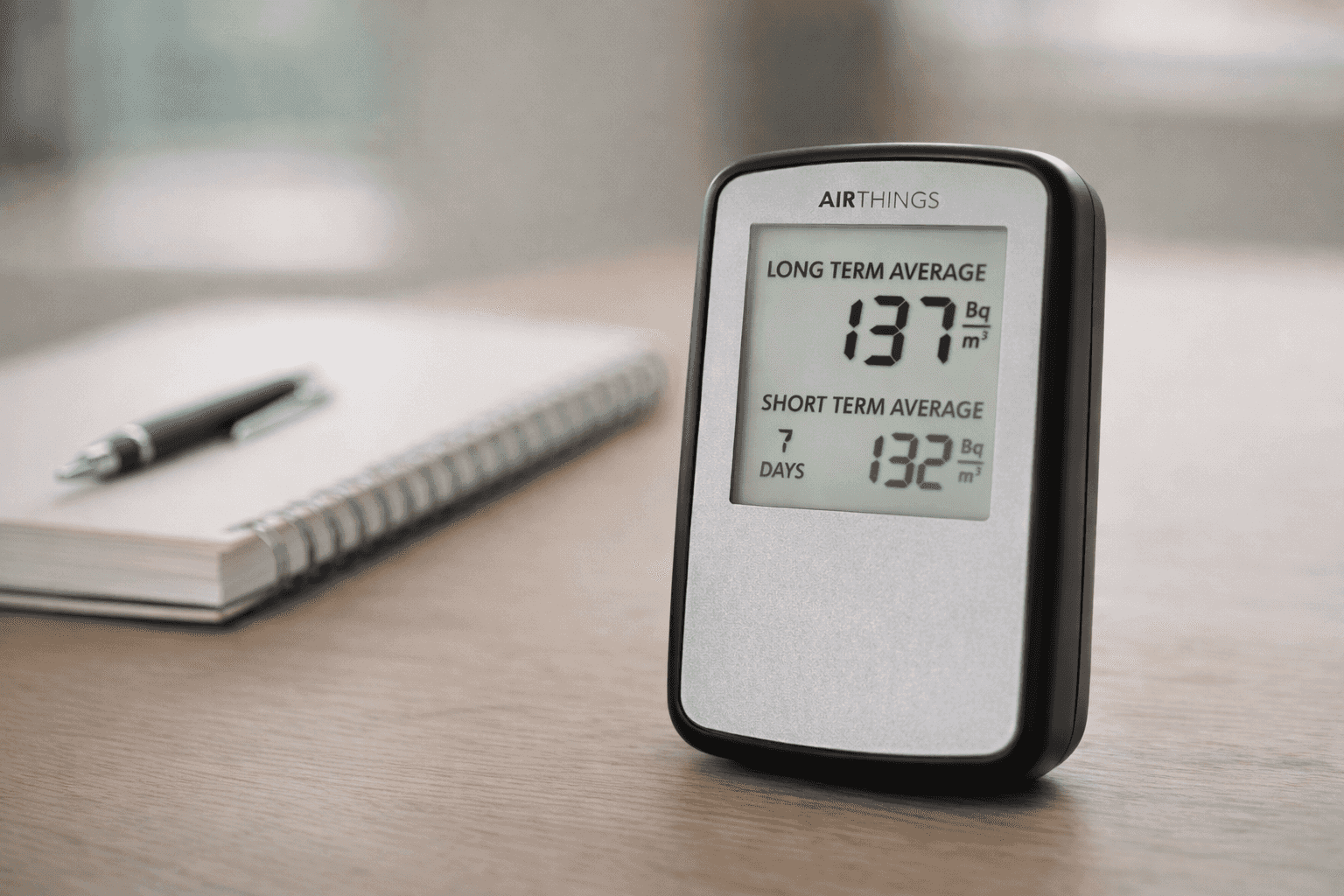
The single most consequential misconception about radon is that 200 is a boundary between safe and unsafe. It is not. It is a policy judgement, and understanding what kind of object it is changes how you read your own result.
Take Action on Radon, the national awareness initiative delivered with Canadian radon scientists, publishes lifetime lung cancer risk by exposure band. The numbers describe a slope, not a cliff:
- Under 100 Bq/m³ — about 1% lifetime risk, or 12% for a person who smokes
- 100 to 199 Bq/m³ — about 1.5%, or 15% for a person who smokes
- 200 to 599 Bq/m³ — about 2%, or 17% for a person who smokes
- 600 Bq/m³ and above — about 4%, or 26% for a person who smokes
Nothing discontinuous happens at 200. Risk rises steadily across the whole range, and the initiative states directly that while risk below the guideline is small, there is no level considered risk free, and that each homeowner decides what exposure they are willing to accept. Researchers make the same point more bluntly: your body cannot distinguish 195 from 205.
That the threshold is a choice becomes obvious once you notice how many different numbers apply to Canadians. Canada's guideline was set at 200 in 2007, down from 800. The World Health Organization recommends a national reference level of 100 and advises countries not to exceed 300. The Canada Labour Code still uses 800 for federal workplaces. And Health Canada told CBC News in March 2026 that it has no plans to change the guideline for now, preferring to concentrate on getting more Canadians to test at all.
What the guideline does mark is where action is recommended, and the current instruction for homes is tighter than the one most Canadian articles still repeat. Above 200 Bq/m³, Health Canada's residential guide calls for corrective action within one year — not the two-year window that survives in its separate guide for public buildings.
On the risk itself, the federal framing is worth reproducing carefully, because it is neither alarming nor reassuring. Radon is the number one cause of lung cancer in non-smokers, responsible for an estimated 16% of lung cancers and more than 3,000 deaths in Canada each year. The risk is also, as Health Canada puts it, long-term rather than immediate, and it compounds sharply with smoking.
That last point is the one to sit with. A high reading is a serious finding that you have time to address properly. It is not an emergency requiring a decision this week — which is precisely why running a proper 91-day test instead of acting on a two-day reading costs you nothing.
For a fuller treatment of what to do at each level, see our guide to understanding radon test results across low, borderline and high readings.