Most standard active sub-slab depressurization systems are installed in a single day. More complex homes — those with multiple foundation types, crawlspaces, or difficult pipe routing — may require two days.
Your Step-By-Step Guide To Testing, Mitigation, And Long-Term Confidence

Credit: Homeowner.ca
If you've just learned your home has elevated radon levels, you're probably doing what most homeowners do first: searching for how much it costs to fix. That's a reasonable instinct. But cost is actually the second question — the first is whether you truly need a system at all, and that answer depends entirely on how (and how well) your home was tested.
Radon is a naturally occurring radioactive gas that seeps up from the soil beneath your home. You can't see it, smell it, or predict it based on your neighbourhood, the age of your house, or the type of foundation you have. It's the second leading cause of lung cancer in Canada after smoking, and roughly 7% of Canadian homes have levels above the national guideline. The only way to know your home's level is to test.
This guide walks you through the full sequence: what radon is and why it matters, how to test properly so you can trust the results, what drives the cost of mitigation in Canada, the most common system types and how they compare, and what maintenance looks like once a system is in place. By the end, you'll have enough clarity to move forward with confidence — whether that means ordering a test kit, interpreting a result you already have, or getting quotes from a certified professional.
Radon forms naturally from the breakdown of uranium in soil and rock — a process that happens everywhere in Canada. Outdoors, it disperses harmlessly. Indoors, it can accumulate to concentrations that pose a real health risk over time.
For most of the year, the air pressure inside your home is slightly lower than the pressure in the surrounding soil. That difference acts like a gentle vacuum, pulling soil gases — including radon — through any opening where the house meets the ground. Cracks in the foundation slab, gaps around utility penetrations, floor drains, sump pits, and the joint where the basement wall meets the floor are all common entry points. Even well-built and newer homes can have these pathways, as described in Health Canada's Radon Reduction Guide.
The health risk from radon is cumulative and long-term. It's not about a single day's exposure — it's about years of breathing elevated levels in the spaces where you spend the most time. Health Canada estimates that a non-smoker exposed to elevated radon over a lifetime has about a 1 in 20 chance of developing lung cancer. For smokers, the combined effect pushes that risk to roughly 1 in 3.
That sounds alarming, but the practical message is more grounded: radon is a slow, fixable problem. You test, you learn your number, and if the number is high, you act. There's no emergency timeline. There's a measured, well-supported process — and it starts with getting a reliable reading.
One of the most important things to understand is that radon levels cannot be predicted based on a home's age, design, or neighbourhood. Two identical homes on the same street can have dramatically different readings. Soil composition, foundation condition, occupant habits, weather patterns, and HVAC configuration all influence how much radon accumulates — and none of those variables are visible from the outside.
The only way to know is to measure. And how you measure matters a great deal.

Health Canada recommends a long-term radon test lasting at least three months, ideally during the fall or winter heating season. This matters because radon levels in a home fluctuate significantly — hour to hour, day to day, and season to season. A short-term snapshot can give you a false alarm or a false sense of security. The long-term average is what tells you whether your home actually exceeds the Canadian guideline.
Place your detector on the lowest level of the home where someone spends at least four hours per day. That usually means a finished basement, a main-floor bedroom, or a ground-level family room. Keep it at breathing height (roughly half a metre to two metres above the floor), on a stable surface away from drafts.
Avoid placing detectors in kitchens, bathrooms, laundry rooms, unfinished basements, or near exterior walls, windows, doors, vents, heat sources, or major appliances. These locations can skew results and lead to inaccurate readings. Health Canada's electronic radon monitor guide provides detailed placement instructions.
Canadian homeowners have two main testing options. The first is a do-it-yourself long-term test kit — typically an alpha track detector that you purchase online, from a community health organization, or at a home improvement retailer. You place it in your home for three or more months, then mail it to a lab for analysis. Kits typically cost $30 to $60. If you'd like a deeper comparison of options, our guide to DIY radon test kits vs. professional testing breaks down what each approach actually delivers.
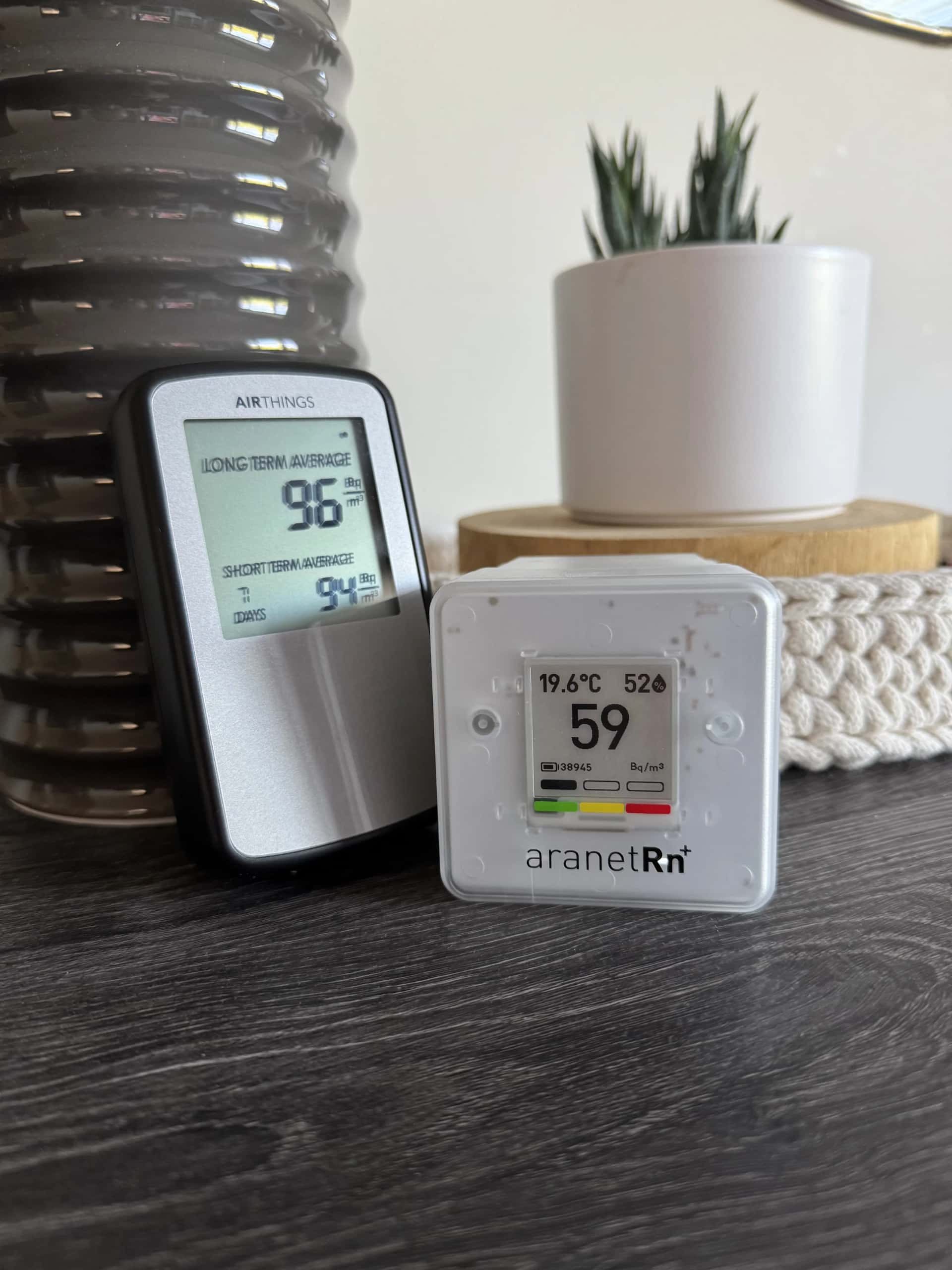
The second option is an electronic radon monitor (ERM) — a consumer device that measures continuously and displays readings on a screen or app. Popular C-NRPP-approved monitors include models from Airthings, Ecosense, and SunRadon. These are more expensive upfront ($200–$350) but reusable, and they let you watch trends in real time. Just remember: regardless of what the hourly reading says, you need at least three months of data before making any mitigation decision.
You can also hire a Canadian National Radon Proficiency Program (C-NRPP) certified measurement professional to test your home. This is especially useful if you want an independent result for a real estate transaction or need confidence in the methodology.
For more on that scenario, see our article on radon testing for home sales in Canada.
The Canadian guideline for radon in residential indoor air is 200 becquerels per cubic metre (Bq/m³). That's the threshold at which Health Canada recommends remedial action. But the urgency depends on how far above the guideline your reading falls.
There is no completely risk-free level of radon. Some homeowners choose to mitigate even below 200 Bq/m³ — that's a personal decision. The guideline represents the point at which Health Canada formally recommends action.
For a more detailed walkthrough of interpreting readings, including borderline cases and what to do with unexpected numbers, check out understanding radon test results.
Health Canada's consumer radon brochure states that the cost for radon reduction typically ranges from about $2,000 to $4,000, depending on the size and design of the home and the work required. Industry data from CARST and C-NRPP puts the national average at approximately $2,900, based on systems installed between 2013 and 2018. More recent data from Take Action on Radon suggests the range may extend from $3,000 to $11,000 for complex installations.
The Health Canada Reduction Guide narrows the range slightly for the most common system type: sub-slab or sub-membrane depressurization systems typically cost $2,000 to $3,000 for material and labour.
Here's the honest framing: for a straightforward basement with a single concrete slab, one suction point, and accessible routing, you're likely in the $2,000–$3,000 range. For homes with mixed foundations, crawlspaces, multiple slabs, or difficult routing, the price climbs.
Several factors affect where your specific quote lands within — or beyond — the typical range.
A well-structured quote from a C-NRPP-certified mitigator typically covers the system itself (pipe, fan, suction point drilling), sealing of major entry routes, a system performance indicator (manometer), and installation labour. It should also specify any electrical work and whether a post-installation short-term test is included.
Items that are sometimes quoted separately or as add-ons include extended warranties, service plans, aesthetic upgrades (interior pipe concealment, drywall repair), and long-term follow-up testing. Health Canada's contractor guide recommends getting a written cost estimate that outlines all work, warranties, and conditions before signing.
Get at least two quotes from different C-NRPP-certified professionals. Ask each contractor whether they performed a site inspection before quoting. A contractor who quotes without visiting the home is estimating — not diagnosing. As Health Canada notes, the lowest quote may not be the best choice: a very low bid may mean the contractor has underestimated the work or doesn't plan to do a complete job.
Radon mitigation is a professional service, so GST/HST applies at the standard rate for your province. There is currently no federal tax credit specific to radon mitigation. However, some provincial programs offer limited financial assistance. The Canadian Lung Association has provided grants of up to $1,500 toward mitigation costs. Saskatchewan Lung offers up to $500 in reimbursement through its Caring Breaths Financial Assistance Program. Nova Scotia's Radon Reduction Grant Program provides up to $2,500 for qualifying low-income households. These programs have limited funding and eligibility requirements — check directly with the relevant lung association or Take Action on Radon for current availability.
In Ontario, Tarion warranty coverage applies to new homes within the first seven years of construction. If a home tests above the Health Canada guideline, the warranty program may cover the cost of mitigation when installed by a C-NRPP professional.
This is the standard. A pipe is installed through the basement floor slab into the granular material beneath, and a small fan runs continuously to draw radon-laden soil gas from under the house and exhaust it outdoors. The fan reverses the pressure difference that normally pulls radon inside, and the system can typically reduce indoor radon levels by more than 80%.
For a detailed look at how these systems work in practice, see our guide on how radon mitigation systems work.
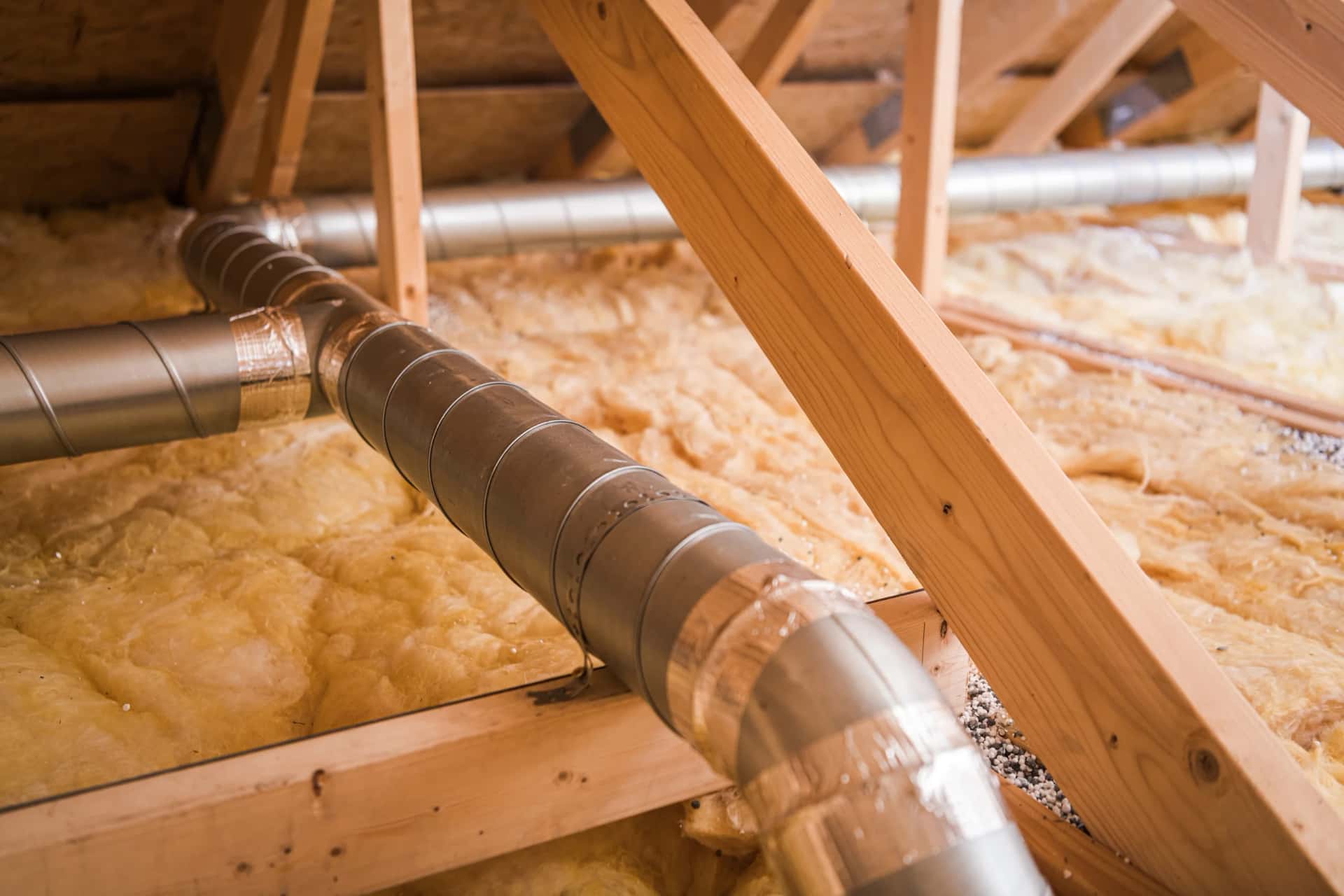
The exhaust pipe can be routed either up through the house and out the roof, or sideways through the rim joist at ground level. In many Canadian climates, Health Canada notes that fans and pipes located outside the living space (attic or garage) can cool during winter, leading to condensation and ice buildup that can damage the fan and reduce effectiveness. Routing the system indoors with a ground-level discharge avoids most of these cold-climate complications.
Typical cost: $2,000–$3,000 for standard installations. Most systems are installed in a single day.
Fan energy cost: Approximately $50–$75 per year in electricity, depending on fan size and local energy rates.
A variation of ASD for homes that already have a sump pump. The sump pit is capped, sealed, and used as the suction point for the radon pipe — it continues to drain water while also serving as the depressurization connection. If a basement floor drain leads to the sump, a mechanical trap seal is installed to prevent house air from short-circuiting the system.
This can be a cost-effective option when a usable sump already exists, since it eliminates the need to core a new hole through the slab.
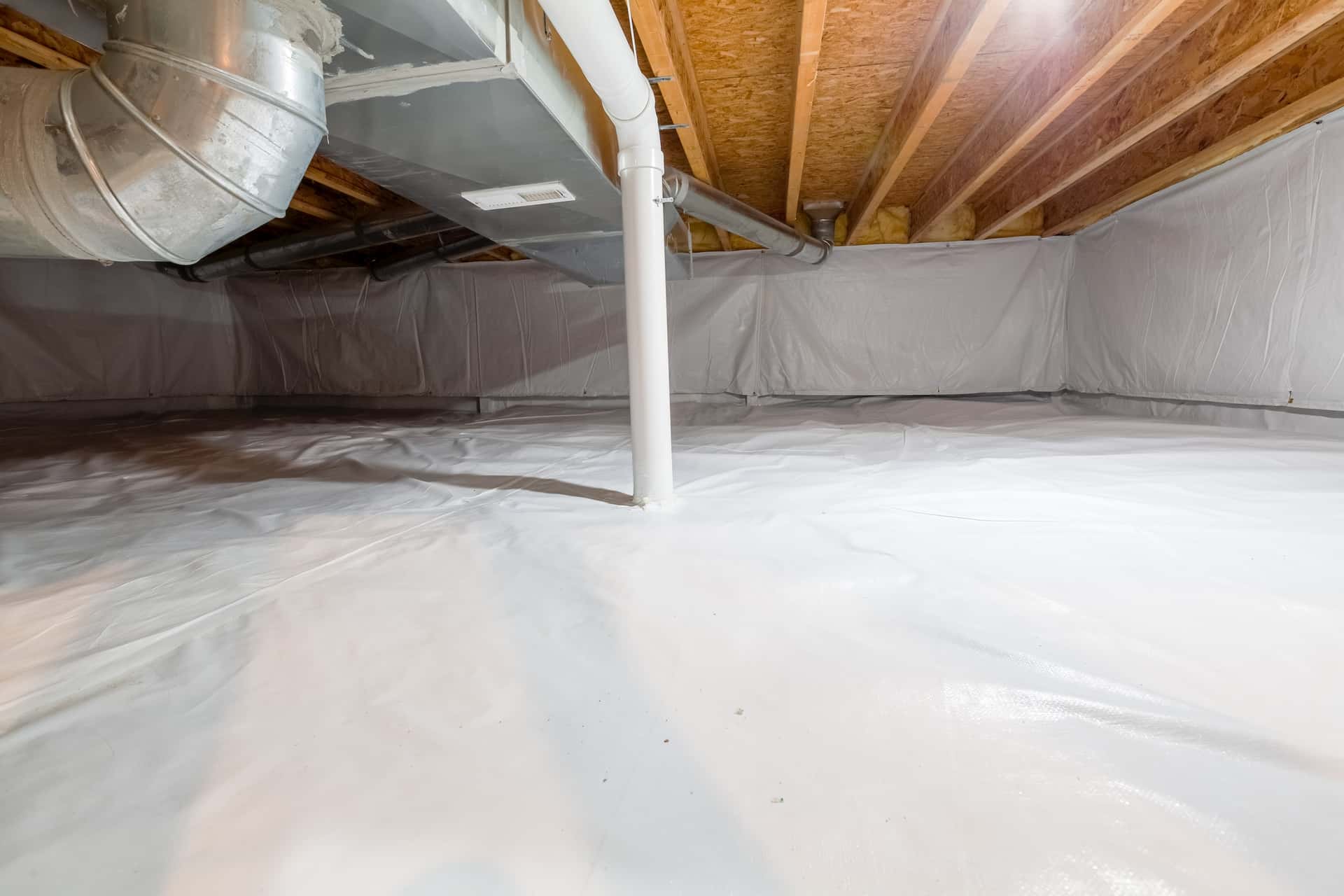
For homes with dirt-floor crawlspaces, a thick polyethylene membrane is laid over the exposed soil and sealed to the foundation walls. A pipe and fan draw radon from beneath the membrane and exhaust it outdoors. This is essentially the crawlspace equivalent of sub-slab depressurization. The seal quality is critical — any gaps in the membrane reduce effectiveness.
A heat recovery ventilator (HRV) or energy recovery ventilator (ERV) increases outdoor air exchange, which can dilute indoor radon concentrations. Health Canada notes that this method can reduce radon levels by roughly 25–50% in most homes, making it suitable only when modest reductions are needed.
HRVs work best in airtight homes with low natural ventilation rates. The intake and exhaust air flows must be properly balanced — if the system depressurizes the house, it can actually draw more radon in. Regular filter maintenance and annual balancing by an HVAC professional are required.
Typical cost: $1,500–$3,500 for material and labour, plus ongoing electricity and increased heating costs due to higher ventilation.
Sealing cracks, floor-wall joints, sump pits, floor drains, and utility penetrations can reduce radon entry but is not reliable as a standalone solution. Health Canada describes sealing as "a basic part of most approaches to radon reduction" — it supports other methods but rarely solves the problem on its own, because it's nearly impossible to find and permanently seal every opening.
Typical cost: A few hundred dollars to $2,000 or more, depending on scope. Labour-intensive and requires ongoing maintenance as the house settles.
When any active depressurization system is installed, make sure the contractor tests for backdrafting of combustion appliances (furnace, water heater, fireplace, wood stove). Depressurization can cause smoke and combustion gases to spill indoors instead of venting properly.
Once your system is activated, your contractor should verify that all seals and joints are functioning correctly and label the system with the activation date and suggested re-test intervals. A short-term test after activation — started at least 24 hours after the fan is turned on — provides an initial confirmation. But the real validation comes from a follow-up long-term test (three months) during the next heating season, to confirm the annual average is below 200 Bq/m³.
Health Canada recommends that the follow-up test be performed by someone other than the company that installed the system — this avoids any conflict of interest in verifying results. For guidance on placement and timing, see where to place a radon detector in your home.
Most ASD systems include a U-tube manometer — a simple, liquid-filled pressure gauge mounted on the pipe that shows whether the fan is creating suction. When the liquid levels on both sides of the U-tube are different, the system is working. When they're even, the fan has stopped or the system has lost suction.
Get in the habit of glancing at the manometer every month or so. It takes two seconds and tells you everything you need to know about day-to-day operation.
The radon fan is the only mechanical component in the system, and Health Canada notes that its lifespan varies between five and ten or more years. Replacement cost is typically $200–$300 for the fan itself, plus installation labour if you hire a professional. Some Canadian mitigation companies report fan lifespans of 10–15 years under normal conditions.
The fan must run continuously — turning it off allows radon to accumulate again. If you notice the manometer readings flatten or hear the fan stop, arrange service promptly.
Health Canada recommends re-testing within two years of system activation and at five-year intervals afterward. You should also re-test after any major renovation that changes the foundation layout or HVAC configuration — for example, finishing a previously unfinished basement, adding an extension, or replacing your furnace.
Step 1: Check the manometer monthly. Confirm the liquid levels are uneven, indicating the fan is running and creating suction. If levels are even, the fan may need service.
Step 2: Listen to the fan seasonally. A healthy radon fan produces a steady, low hum. New rattling, grinding, or silence means it's time for inspection.
Step 3: Inspect the exhaust outlet annually. Make sure the discharge point (whether at ground level or roofline) is clear of debris, snow, ice, or nesting material.
Step 4: Inspect visible seals annually. Check the seals around the sump pit cover, floor-wall joints, and pipe penetrations. Re-seal any that have cracked or separated.
Step 5: Run a long-term follow-up test. First test within two years of activation, then every five years. Use a new detector or calibrated ERM, placed in the same location as your original test.
Step 6: Record everything. Keep your original test result, contractor documentation, post-mitigation test result, and maintenance observations together. If you sell the home, this documentation demonstrates due diligence and adds value.
Most standard active sub-slab depressurization systems are installed in a single day. More complex homes — those with multiple foundation types, crawlspaces, or difficult pipe routing — may require two days.
Permit requirements vary by municipality. Some require electrical permits for the fan wiring. Ask your C-NRPP-certified contractor whether any permits are needed in your area before work begins.
Health Canada recommends hiring a C-NRPP-certified professional to ensure the system is designed correctly for your home's foundation and conditions. DIY installation is technically possible but risks improper placement, inadequate sealing, and no performance guarantee.
A documented, professionally installed system with follow-up test results can reassure buyers and avoid delayed or failed transactions. In many markets, having a radon test and mitigation record is increasingly seen as a positive.
No. Health Canada explicitly states that short-term tests (two to seven days) should not be used to determine whether a home exceeds the Canadian guideline. Only a long-term test of at least three months provides a reliable basis for mitigation decisions.
The 200 Bq/m³ guideline is the threshold for recommended action, but there is no completely risk-free level. Some homeowners choose to mitigate at lower levels — that's a personal decision based on your comfort with the residual risk.
Most properly installed radon fans produce a low, steady hum comparable to a bathroom exhaust fan. Fans mounted indoors near the suction point and discharged at ground level tend to be quieter than roof-mounted configurations, partly because the indoor mounting avoids vibration transfer through the structure.
Health Canada estimates the annual electricity cost for a radon fan at roughly $50–$75, depending on the fan size and your local energy rate. That's comparable to running a standard light bulb year-round.
An HRV can dilute radon concentrations by improving air exchange, but its effectiveness is limited — typically a 25–50% reduction. If your levels are significantly above 200 Bq/m³, an HRV alone is unlikely to bring you below the guideline. Active sub-slab depressurization is far more effective.
A rough-in (Level 1 in the National Building Code) is a capped pipe through the slab — it's a preparation for a future system, not a functioning one. You still need to test. If levels are high, a C-NRPP professional can activate the rough-in by adding a fan and connecting the exhaust, which is typically faster and less expensive than a full retrofit.
Yes — radon dissolved in well water can be released into indoor air when the water is agitated (showering, washing). However, Health Canada notes that radon entering through water is generally a much lower risk than radon entering through the ground.
There is no federal rebate program specific to radon. However, the Canadian Lung Association has offered grants up to $1,500, Saskatchewan Lung provides up to $500 through Caring Breaths, and Nova Scotia has a Radon Reduction Grant Program for low-income households (up to $2,500). Ontario's Tarion warranty may cover mitigation for new homes within the warranty period. Availability and funding vary — check with your provincial lung association for current programs.
Yes. Health Canada recommends re-testing within two years of system activation and every five years thereafter. Changes to your home — finishing the basement, adding an extension, replacing HVAC equipment — are also triggers for re-testing.
A passive system relies on the natural thermal stack effect (warm air rising through the pipe) to draw radon out. An active system adds a fan for continuous, mechanical suction. Passive systems are simpler and have no energy cost, but they're less effective — especially in Canadian winters when temperature differentials can work against the intended airflow. If a passive system doesn't reduce levels enough, activating it (adding a fan) is usually straightforward.
Finishing a basement doesn't increase radon entry, but it can change the dynamics. If you're adding living space below grade, test before and after the renovation. A finished basement with elevated radon means more hours of exposure in that space.