Activated Surfaces, Nominal Ratings, and What "Up to" Really Means
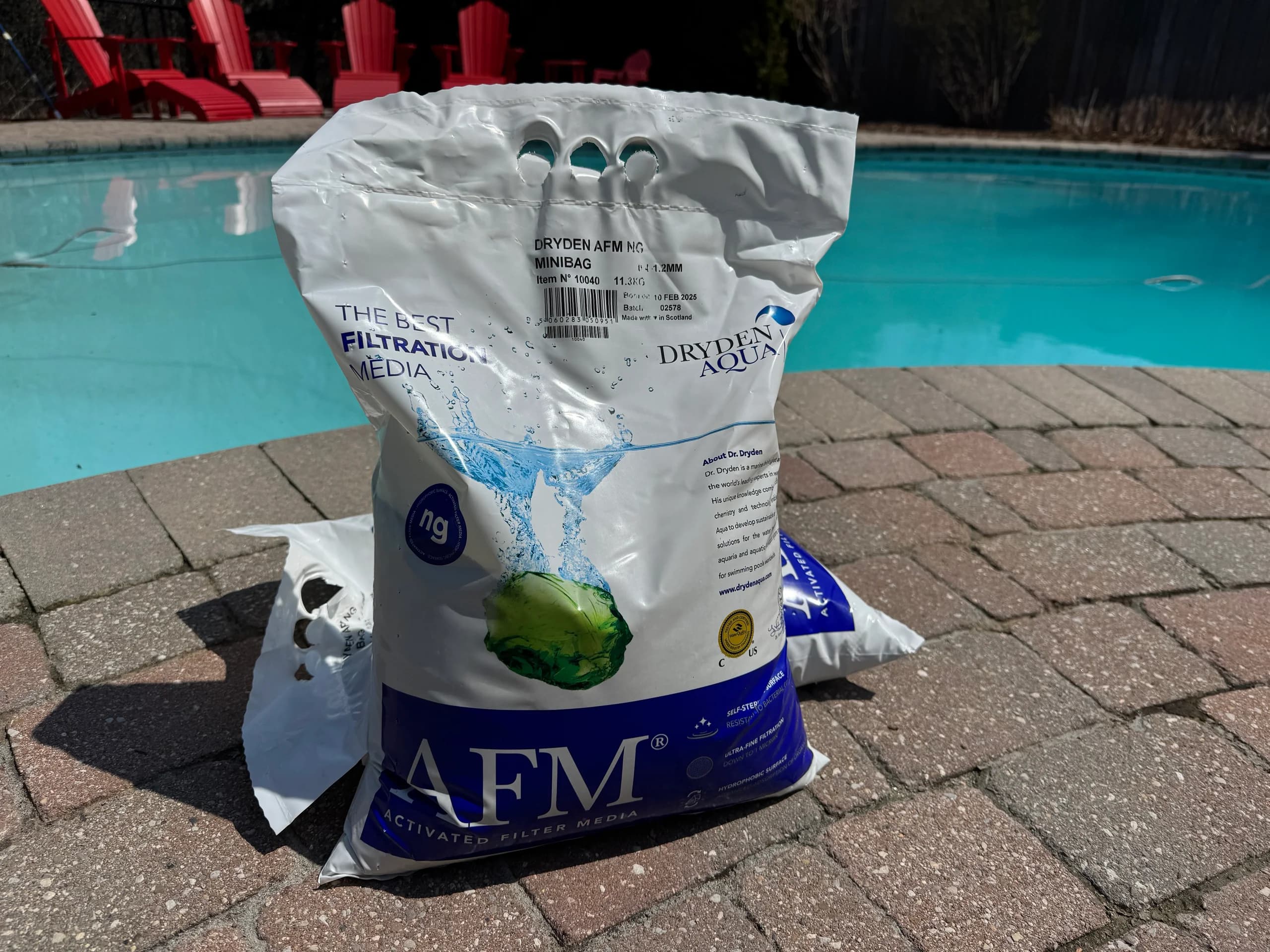
Glass filter media is recycled green and brown bottle glass, crushed, graded to specific particle sizes, and run through a surface-activation process. The activation step is what separates Dryden Aqua's AFM from cheaper crushed-glass products — and it's the differentiator buyers most often miss. A negatively charged, hydrophilic surface resists biofilm buildup, suppresses the clumping and channeling that plague aged sand beds, and increases adsorption of fine particles. AFM Grade 1 carries roughly 50,000 m² of surface area per 1,000 kg compared to about 3,000 m² for equivalent silica sand — roughly a 16-fold difference, according to Dryden Aqua's product specifications.
The headline marketing claim is finer filtration. Manufacturers state nominal capture in the 1–5 micron range under optimal conditions, with independently verified results showing 95% removal of particles greater than 1 μm for the next-generation grade and 95% removal of particles greater than 4 μm for the standard grade. That's a real step down from sand's roughly 20-micron clean ceiling.
Now the fine print. Micron numbers on bags are nominal, not absolute. Real-world capture depends on flow rate, filter sizing, water balance, and how long since the last backwash. A glass-media filter pushed at twice the rated flow won't capture finer than a sand filter pushed at half rated flow. The media changes the ceiling. The plumbing decides whether you reach it.
That's the difference between "5 micron filtration" and "5 micron filtration if your pump, tank, water, and operating discipline cooperate."