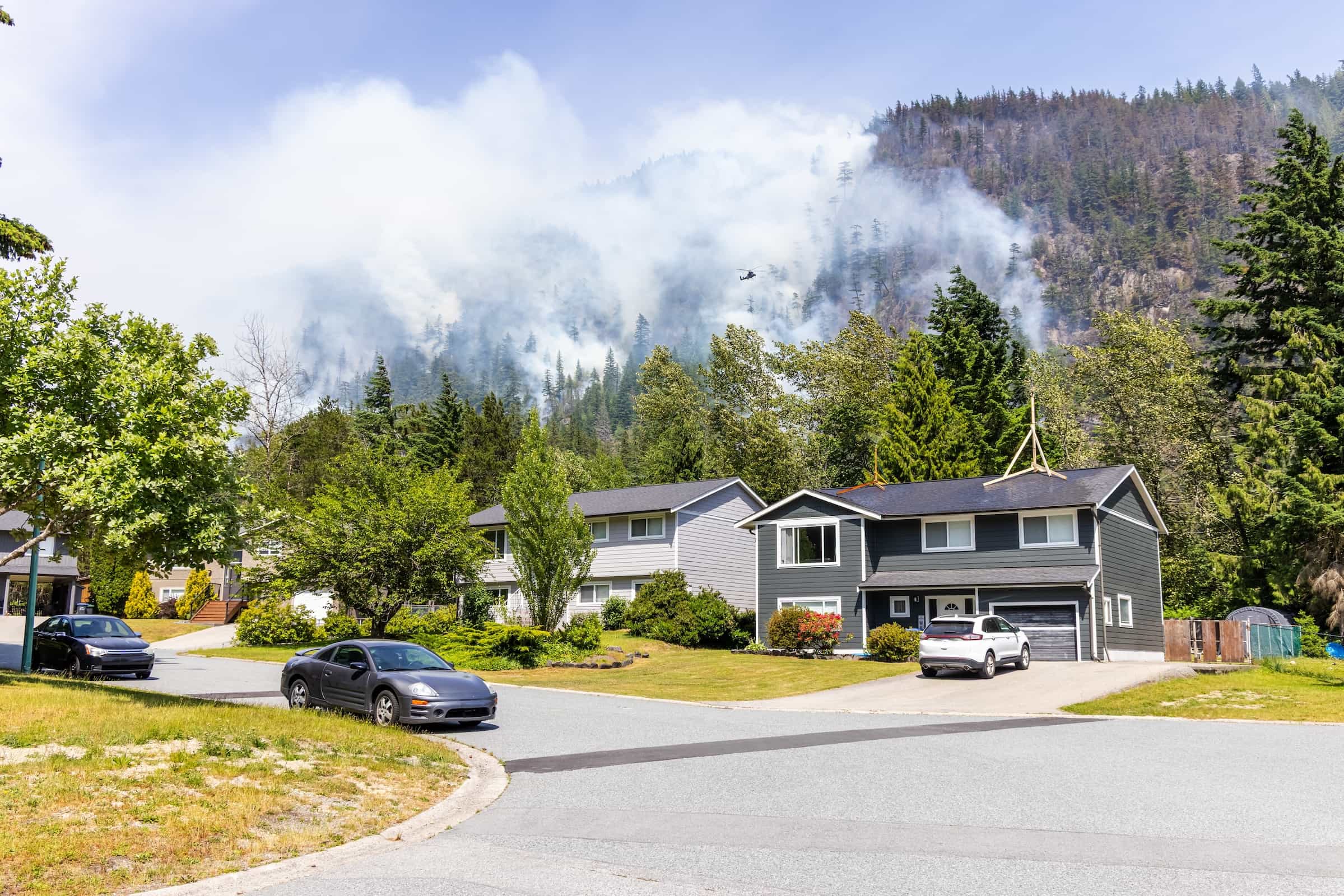
IBC Opens Wildfire Claims Helpline as 50 BC Fires Burn Out of Control, Testing Living-Expense Coverage
What the Insurance Bureau of Canada's New Helpline Means for Evacuated Homeowners, and Why Additional Living Expenses Coverage Is the Clause to Understand First
By
Published: August 6, 2026, 8:00 p.m. ET
Fact-checked · , including Government of British Columbia, BC Wildfire Service & BC Financial Services Authority
Credit: Shutterstock
Key Takeaways
•The Insurance Bureau of Canada has opened its V-CAMP helpline (1-844-227-5422) for British Columbia residents, and you can begin a claim when you are ready, not only once you know whether your home was damaged.
•The coverage under the most pressure right now is additional living expenses, or ALE. It is triggered by an authority-issued evacuation order, and it is capped two ways, a dollar limit and a time limit, that vary widely between policies.
•Start a receipt trail today, and ask your insurer two questions: what is my ALE dollar cap and how long does it last, and does my policy treat smoke damage under a separate sublimit.
On August 5, 2026, with out-of-control wildfires forcing evacuations across British Columbia and destroying homes, the Insurance Bureau of Canada (IBC) opened a dedicated helpline for affected residents. The service is meant to answer a question thousands of displaced households are asking at once: what does my insurance actually do while I am out of my home?
For most people, that is where the confusion starts. The headline coverage in a wildfire is fire damage, and that part is straightforward. But the clause doing the quiet, immediate work during an evacuation is a different one, additional living expenses, and most owners have never read theirs. It is the coverage that pays for the hotel, the restaurant meals, and the laundromat while you wait to go home. It is also the coverage most likely to run out in ways people do not expect.
This is a plain-language guide to what the helpline offers, how a claim begins, and how additional living expenses coverage works, what sets it off, what it pays, and the two limits that decide how far it stretches. Policies vary, and none of this replaces a conversation with your own broker or insurer. But knowing the questions to ask is half the battle when you are living out of a suitcase.
Stay on top of Canadian homeowner news
The Helpline, and the Emergency Behind It
The new service is IBC's Virtual Community Assistance Mobile Pavilion, or V-CAMP, a channel staffed by trained insurance-industry personnel. IBC launched the helpline on August 5 alongside guidance for policyholders, citing BC Wildfire Service figures of roughly 115 active wildfires as of that Wednesday morning, more than 50 of them out of control, and five designated Wildfires of Note. Aaron Sutherland, IBC's Vice-President, Pacific and Western, said anyone whose property was damaged or destroyed can contact their insurance representative when they are ready to start the claims process.
The situation has kept moving since. As of Thursday, CBC News reported that more than 110 wildfires were burning across the province with almost 50 out of control, and that the Bradley Creek fire near Vernon had destroyed at least 200 homes on Okanagan Indian Band reserves, according to preliminary estimates from the band. Hot, dry weather and possible lightning were expected to push fire activity higher.
The helpline is not a substitute for your own insurer. It is a general-guidance line for people who are unsure who their broker is, or who simply want to understand how their home, business, or vehicle coverage works, including additional living expenses for evacuees and the mechanics of a claim. You can reach it at 1-844-2ask-IBC (1-844-227-5422) or by email at AskIBCWest@ibc.ca.
Starting a Claim When You Are Ready
"When you are ready" is a deliberate phrase, and it is worth taking literally. You do not need to wait until you have re-entered your property, confirmed the damage, or built a perfect inventory before opening contact with your insurer. Most carriers run 24-hour claims lines, and starting early tends to reduce confusion later, not create it.
The documentation that supports a claim is specific, and it is easier to gather now than to reconstruct later. IBC's wildfire claims guidance advises residents, once it is safe, to list damaged or destroyed items, assemble proofs of purchase, photos, receipts, and warranties where possible, take photographs of the damage, and keep damaged items unless they pose a health hazard. Confirm with your insurer before throwing anything out.
Tip
Two records matter most in the first days: photos of the property and its contents, and a running file of every displacement expense. Photograph what you can before you leave if it is safe, and keep the receipts as you go rather than trying to remember them afterward.
Additional Living Expenses: The Clause Doing the Real Work
Additional living expenses coverage exists for exactly this moment, the period when your home is unavailable and your cost of living jumps. It does not reimburse your ordinary expenses. It covers the increase, the gap between what life normally costs and what it costs while you are displaced.
What ALE Actually Pays For
IBC's home coverage guidance describes ALE as the cost of alternate accommodation and living expenses when a home becomes uninhabitable, with limited coverage for mass evacuation under certain circumstances. In practice, the recognizable categories are hotel or temporary accommodation, restaurant meals when you have no kitchen, and laundromat costs when your lodging has no laundry. Pet boarding, extra commuting fuel, and similar displacement costs can also qualify. The common thread is that these are costs above your normal spending, which is why the receipt trail matters so much: you are documenting the difference, not the total.
There is a documentation window here that closes quietly, the same one that opens for every household an evacuation order touches. Our coverage of how displacement reopens the insurance-documentation window makes the point that the record you build in the first days is the record your claim rests on.
The Two Caps: Dollar Limit and Time Limit
This is the part most owners miss. ALE is not open-ended. It is bounded on two axes at the same time.
The first is a dollar limit, a maximum amount the policy will pay. The second is a time limit, a defined window during which the coverage applies. For a mass evacuation ordered by a civil authority, coverage generally starts on the date of evacuation and expires after a specified number of days set by your policy. Where a home is made uninhabitable by insured damage such as fire, coverage typically runs for the reasonable time needed to repair or rebuild, or until the dollar limit is reached, whichever comes first.
Both caps vary widely between insurers, and the two interact. A generous dollar limit does not help if the time window closes while you are still displaced, and a long window does not help if you exhaust the dollar figure in a month of hotel bills.
Important
The single most useful thing you can learn about your ALE coverage is not whether you have it, most standard homeowner and tenant policies do, but what its two caps are. Ask your insurer for the dollar amount and the number of days, and ask how a claim is handled if the emergency outlasts either one.
Order Versus Alert: Why the Wording Decides Your Coverage
Two neighbours can leave the same street on the same day and end up with different coverage outcomes, and the reason is usually the wording on the notice they received. Evacuation coverage for a mass evacuation hinges on an authority-issued order, not on a personal decision to leave.
EmergencyInfoBC draws the line clearly. An evacuation alert means you should be ready to leave on short notice; leaving before or during an alert is treated as a voluntary evacuation. An evacuation order is an immediate-risk situation in which you must leave the area right away. That distinction is not bureaucratic hair-splitting. For the additional-living-expenses category tied to a civil-authority evacuation, the order is what starts the clock.
This is also why it pays to keep the official notice for your area. A dated evacuation order is part of the paper trail that supports the coverage. For a closer look at how coverage shifts between the two states, see our explainer on what home insurance covers under an order versus an alert.
Cottages, Cabins, and Secondary Properties: A Separate Exercise
If you own a cottage, cabin, or other seasonal property in an affected region, treat its coverage as an entirely separate question from your principal residence. IBC has flagged that policies for these properties can carry different coverage, limits, and reporting requirements, and the differences are not always in your favour.
IBC's guidance on seasonal property insurance notes that coverage on a secondary property is often limited to named perils such as fire, wind, smoke, and explosion, and that protection can narrow further when a property sits unoccupied for long stretches. Insurers frequently expect owners to inspect, maintain, and check on a seasonal property, and a place left unwatched can run into a vacancy condition that complicates a claim. Check any secondary property when it is safe to do so, report damage promptly, and confirm the reporting requirements rather than assuming they match your home policy.
Coverage also differs by where you live and what you own. Our guide to wildfire season by province lays out how expectations change across the country.
Smoke Damage and the Fine Print Regulators Keep Flagging
Fire is not the only way a wildfire reaches a home. Smoke can settle into a house well outside the burn zone, and how a policy treats it is not always the same as how it treats flame. Some policies address smoke under a separate sublimit from fire damage, which is exactly the kind of detail worth confirming before you need it. Our reporting on how standard home policies cover wildfire smoke damage goes deeper on where that coverage begins and ends.
Regulators are pointing consumers in the same direction. The BC Financial Services Authority urges residents to review their deductible, coverage limits, and living-expense coverage, keep policy documents accessible, and record their belongings with photos or video.
Ontario's Financial Services Regulatory Authority frames the same homework as a set of questions: what does the policy cover, to what extent, for how long, and what does it exclude. That last question is not academic. In its 2024 home insurance review, Ontario's regulator found that about one in five reported claim denials traced back to exclusions and limitations, evidence that policy wording gaps are a real and recurring problem, not theoretical fine print.
The Five-Minute Call: What to Ask Before You Are Displaced
If you take one action from all of this, make it a short call to your broker or insurer. You are not asking for individualized claims advice; you are confirming the handful of facts that decide how your coverage behaves under pressure. The table below is built to be used in that conversation, or read from a hotel room if you are already out.
What to confirm
Why it matters
Where to find it
Your ALE dollar limit
Caps the total the policy will pay for displacement
Declarations page, or ask your broker
Your ALE time period
Defines how many days or months coverage lasts
Policy wording, or ask your broker
Whether an evacuation order applies to you
The order, not an alert, generally triggers evacuation ALE
Your local government or provincial emergency updates
Smoke-damage treatment
May sit under a separate sublimit from fire damage
Policy wording, or ask your broker
Secondary or seasonal property terms
Limits, perils, and reporting rules often differ from your home
The separate policy, or ask your broker
Receipts to keep
These become your claim: hotel, meals above normal, laundry, pet boarding, extra fuel
Keep originals and photograph them as you go
None of these questions require you to have suffered a loss yet, and that is the point. The households that struggle most are usually the ones who learn their limits after they have already blown past them. A five-minute call now is cheaper than a surprise later, and it is a good habit to carry into every renewal, alongside a broader look at why home insurance costs are rising and how to manage them.
For anyone under an order in British Columbia right now, the sequence is simple: leave safely, keep the notice and your receipts, and call your insurer or IBC's helpline when you are ready. The coverage is designed to help you through the displacement. Knowing its edges is what lets you use it fully.
Ryan is the founder of Homeowner.ca and a proud Canadian homeowner based in Guelph, Ontario. Over his 25-year career in digital publishing, he has focused on transforming complex information into clear, practical guidance that helps people make confident, well-informed decisions.