Usually no. Most systems reduce how much debris gets into the trough, but you’ll still want inspections and occasional surface clearing so water can enter the system efficiently—especially after storms and during fall leaf drop.
Warranty Fine Print, Realistic Cleaning, and the Hidden Add-Ons That Inflate Quotes

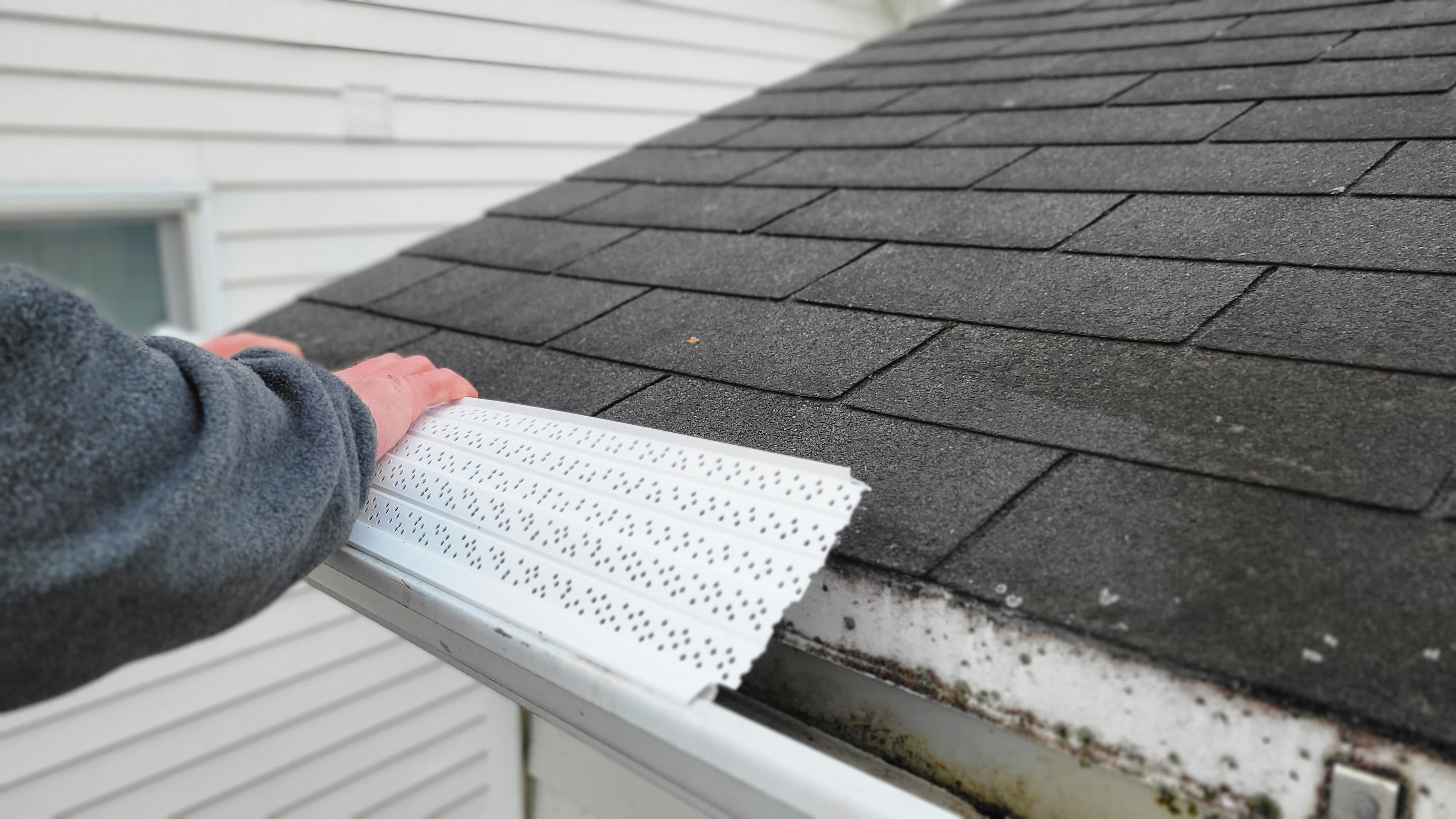
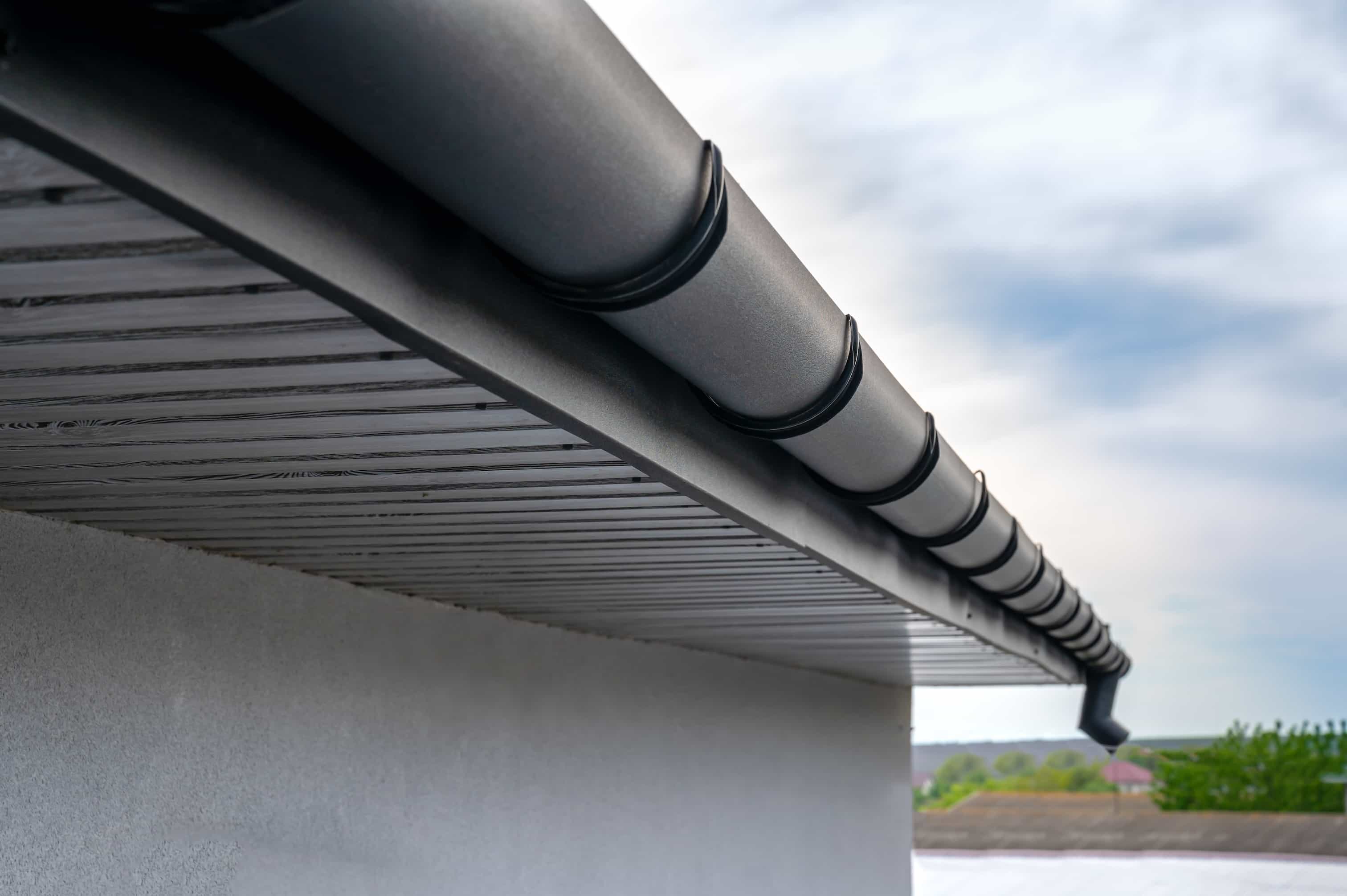
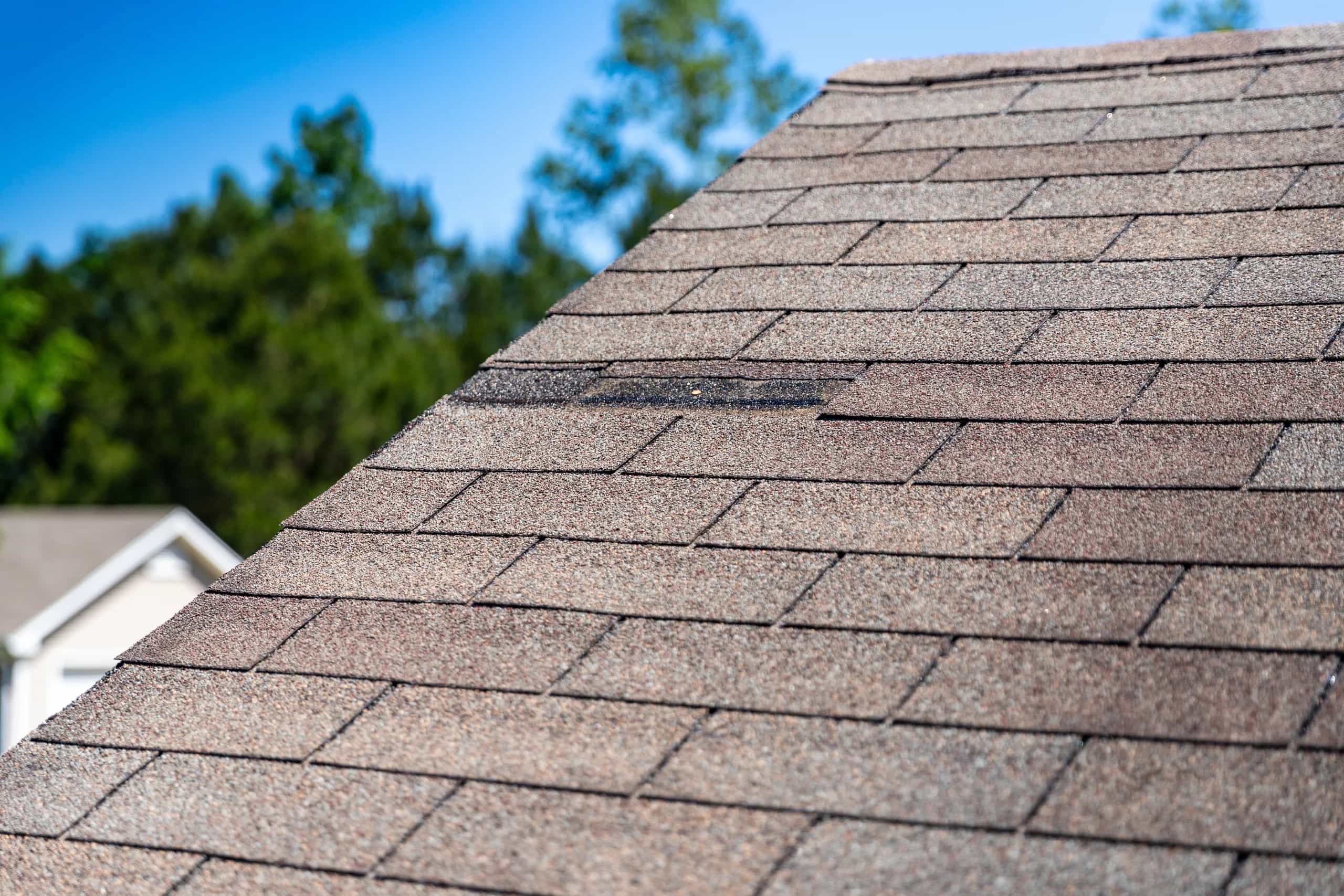
Homeowner snaps eavestrough guards into place, where warranty fine print meets real-world cleaning and winter clogs. (Credit: Shutterstock.com)
Eavestrough guards are one of those home upgrades that sound like a simple yes-or-no decision—until you look closely at what you’re actually buying. “No clogs” gets marketed as a product feature, but in practice it’s also a warranty promise, a maintenance expectation, and sometimes a pricing strategy.
In Canada, the stakes are higher because our weather is harder on roof edges and drainage. In mild climates, an occasional overflow might be an annoyance. Here, a small drainage problem can become an ice problem, and an ice problem can become a damage problem. That’s why the “before you buy” questions matter more than the brand name on the brochure.
It’s also worth remembering what you’re protecting. When gutters and downspouts don’t carry water away reliably, the overflow doesn’t just fall harmlessly to the ground—it can saturate soil beside the foundation, stain siding, rot wood, and contribute to basement water issues, which is a risk Square One Insurance highlights in its Square One Insurance resource on gutters and downspouts guidance for homeowners.
Finally, guards don’t exist in isolation. You’re buying a system outcome: water in, debris out, predictable drainage in spring melt, summer storms, and freeze–thaw shoulder seasons. This article gives you the questions (and the “why” behind them) so you can compare options like a pro—even if you never want to become one.
Before you talk warranties or pricing, define the problem you’re trying to solve in plain language. Otherwise, it’s easy to get sold an impressive-looking product that solves a different problem than the one your house actually has.
A quick homeowner-friendly framework:
This matters because many “clog-free” claims are really “large debris-resistant” claims, and fine debris is the usual spoiler. It also matters because snow shedding off a roof can physically stress guards in ways a summer-only sales pitch won’t mention.
If you can describe your outcome in one sentence, you’ll get better quotes. Example: “I want something that handles pine needles and doesn’t create ice issues, and I’m okay with a quick surface clean once or twice a year.” That single sentence changes which products, warranty terms, and maintenance expectations make sense for you.
“Lifetime warranty” is not a single thing. It’s usually a bundle of different coverages with different triggers—and some quotes blur them together.
Start by asking the installer (or manufacturer) to separate these three buckets in writing:
One reason this matters is that even within a single manufacturer, warranty strength can vary by product line. The Alu-Rex warranty overview page lays out different terms across its lines, which is a useful reminder to compare the specific system you’re buying, not just the brand name.
For a concrete example of how far a premium warranty can go, Home Service Solutions describes Alu-Rex DoublePro as carrying a “360° Lifetime Warranty” with lifetime performance coverage against clogging—even in coniferous areas—on its Home Service Solutions DoublePro warranty page warranty summary for homeowners.
Once you have the three buckets, ask one more question that people skip:
“What’s the remedy if something goes wrong—repair, refund, replacement, or labour coverage?”
Because a warranty that only covers materials can still leave you paying for labour, removal, and reinstallation at the worst possible time.
A fast warranty scan that works on any quote is the “C-C-E-R-T” test: Coverage (what’s included), Conditions (what you must do), Exclusions (what voids it), Remedy (what they’ll actually do), and Transfer (what happens when you sell).
“Clog-free” is the most emotionally persuasive claim in the category—and the easiest one to misunderstand.
You want two definitions, in writing:
This is also where you want to understand whether a “clog” includes overflow damage and what kind. For example, LeafFilter’s manufacturer warranty describes what happens if the system allows gutters to clog and overflow in a way that causes interior water damage on its LeafFilter warranty page warranty terms, which is the level of specificity you want to see in any performance promise.
If you’re looking at continuous-hanger systems, performance terms can be time-bounded or prorated even when other parts of the warranty are “lifetime.” Home Service Solutions summarizes Alu-Rex T-Rex as including a prorated 25-year performance warranty stating gutters installed with T-Rex will not clog and overflow due to leaves or small branches when correctly installed on its Home Service Solutions T-Rex warranty page warranty description for homeowners.
A practical follow-up question that prevents misunderstandings:
“Does ‘clog-free’ mean inside-the-gutter clogging only, or does it include surface buildup on the guard?”
Because many systems can keep the trough clear but still collect debris on top that needs brushing or rinsing to keep intake efficient.
If the salesperson says “maintenance-free,” ask them to define what they mean by “maintenance,” because many warranties treat “routine maintenance” as your responsibility even when performance is guaranteed.
In Canada, people move for work, family, or lifestyle, and resale timing is hard to predict. A warranty that can’t transfer can lose value the moment you list your home.
Ask these questions early, before you fall in love with the product:
LeafFilter’s Canadian purchase flow emphasizes registering a lifetime transferable warranty online after installation through its LeafFilter Canada purchase process page steps for homeowners, which is a good reminder that “great warranty” can still come with administrative conditions.
Also be careful with urgency-based pricing. Promotions can be real, but they can also be used to rush you past the fine print. If a quote is framed around time-limited discounts, use the discount conversation as a cue to slow down and read terms, since LeafFilter markets promotions prominently on its LeafFilter Canada discounts page pricing and discounts information for customers.
The goal is simple: you should be able to sell your home without wondering whether you’re selling a liability or a transferable benefit.
Most homeowners read the warranty headline and skip the exclusions. In practice, exclusions are where the warranty becomes real.
This is especially important in Canadian climates because exclusions often reference snow, ice, and weather-related impacts—and those aren’t edge cases here.
A strong example of why you must read exclusions is the long list of voiding conditions described in the 2.0 PRO terms from Gutter Guard Experts Inc., including exclusions tied to routine maintenance, environmental contaminants on mesh, and damage from snow sliding off a roof on the Gutter Guard Experts warranty terms page terms and exclusions document.
When you see exclusions like these, you’re not necessarily seeing a “bad” product—you’re seeing the rules of ownership. Your job is to make those rules explicit and manageable.
Ask the installer:
If “failure to perform routine maintenance” can void coverage, ask for a simple one-page maintenance schedule in writing and keep a folder of proof (photos and receipts) the same way you would for a furnace service history.
Some guard designs are easy to brush or rinse from the top. Others require partial removal to fully clean or inspect the trough and downspout transitions.
That distinction matters because it affects both:
Home Vision Contracting provides Canadian homeowner pricing context for professional gutter cleaning, including surcharges for heavily clogged gutters and additional costs when guards must be removed and reinstalled on its Home Vision eavestrough cleaning guide discussion of cleaning logistics and costs.
Before you buy, ask the installer to show you (physically, if possible) how maintenance works:
This is one of those questions that can save you money every year—not just once.
A professional guard installation is often more than “attach guard to existing gutter.” Many reputable installers will also correct what would make any guard fail: bad slope, leaky seams, loose hangers, or damaged sections.
The problem isn’t that extra work exists—it’s that it’s sometimes presented as a surprise add-on.
LeafFilter’s Canadian installation process describes steps like inspecting existing gutters, removing ineffective existing guards, cleaning debris, repairing pitch or seam issues, and sometimes installing new gutters before attaching the system as part of its LeafFilter Canada installation page overview of what the installation can involve.
Use that as your prompt to ask for line-item clarity:
If the quote is not itemized, ask for an itemized version before you sign anything, and ask how changes will be handled so you’re not negotiating costs mid-project on a ladder day.
Two quotes can look “close” on the surface while being totally different products.
A helpful way to compare is to classify the guard type first, then compare pricing within that type:
SRS Roofing & Exteriors provides a Canadian pricing breakdown by type, including typical installed ranges for screens, mesh, micro-mesh, and reverse-curve systems in its SRS Roofing cost guide summary of material and installation costs.
For a second pricing lens—DIY versus professional—RenoQuotes reports Canada-wide ranges for installation and ongoing gutter maintenance costs in its RenoQuotes gutter cost guide renovation pricing overview.
If you want a reality check on retail warranties versus professional systems, the Alu-Rex snap-in guard sold through Canadian Tire is covered by a relatively short exchange warranty compared with multi-decade manufacturer warranties, as shown on the Canadian Tire product listing warranty information presented to shoppers.
One practical way to “normalize” quotes is to convert everything into:
If a quote can’t be translated into those terms, it’s not comparable yet.
Guards are not one-size-fits-all. Compatibility issues are one of the most common reasons a guard underperforms or becomes a maintenance headache.
Start with dimensions and profile. Many consumer products are sized for common residential gutters, but “common” isn’t the same as “universal.” For example, Peak Products lists specific sizes and describes retrofit suitability and included hardware on its Peak Products aluminum gutter guard page product specifications.
Next consider gutter material. Some materials behave better in Canadian winters than others, and Square One Insurance notes trade-offs like vinyl cracking in cold weather while describing aluminum and coated steel as sturdier options in its Square One Insurance guide discussion of gutter materials.
Finally, ask about system integration. Continuous-hanger designs and pro-series systems may change how the trough is supported and how the guard is fastened, which can affect long-term sturdiness. If you’re considering Alu-Rex T-Rex specifically, the Alu-Rex T-Rex product page can help you understand the system category you’re being quoted.
A simple “quote photo set” makes compatibility discussions faster: take one photo of the gutter profile from the end, one of the roof edge/drip edge, and one showing downspout location and any tight corners.
Winter performance is where many guard decisions are won or lost.
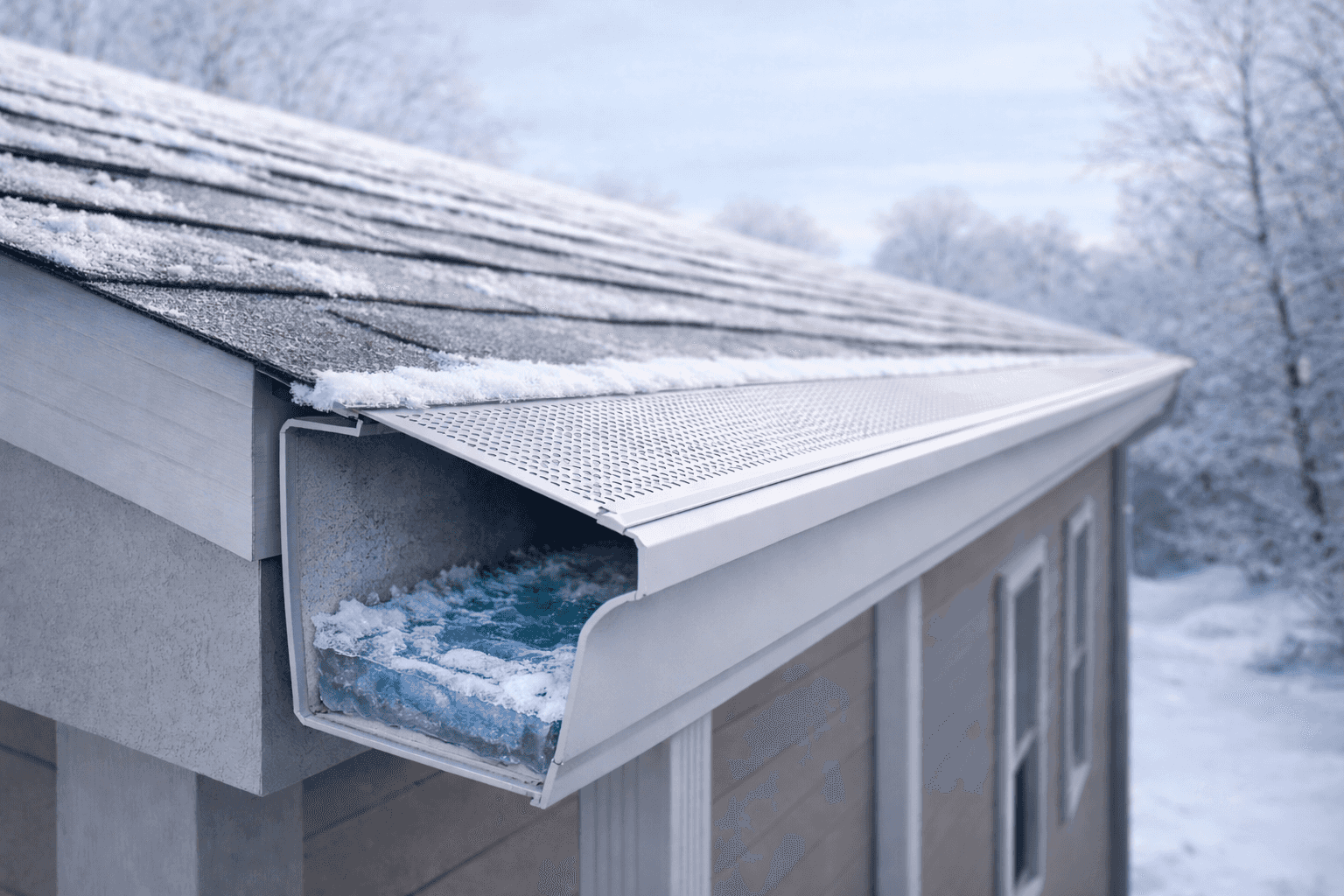
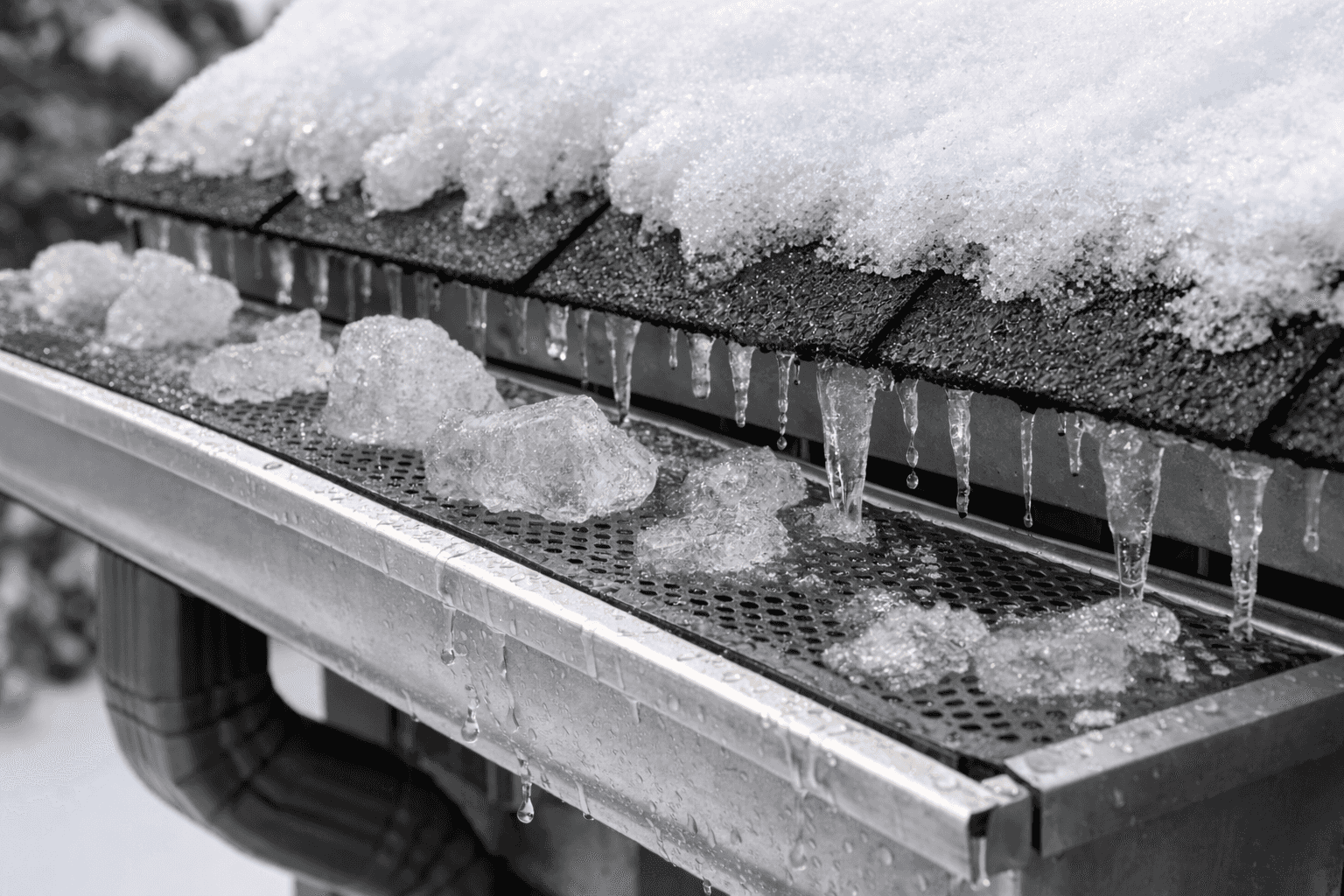
Ice dams can form during freeze–thaw cycles when meltwater refreezes at the roof edge and in the trough, which can trap water and create structural stress. All Weather Exteriors discusses the role of freeze–thaw conditions in ice dam formation, including Winnipeg-specific context, in its All Weather Exteriors ice damming page explanation of why ice accumulates at the eaves.
Sometimes the risk isn’t theoretical—it’s a seasonal headline. A Saskatchewan report connected mid-winter warm-ups with ice dam concerns in its paNOW ice dam article coverage of winter conditions and their downstream effects.
And heavy ice can physically damage eavestroughs. Weaver Exterior notes winter-related eavestrough damage concerns and protection ideas in its Weaver Exterior cold weather guidance discussion aimed at homeowners.
If you want a concrete drainage detail to sanity-check your setup, some Alberta guidance stresses directing downspouts a meaningful distance away from the home. Superior Roofing references directing water roughly 1.2–1.8 metres (4–6 feet) away while discussing freeze–thaw impacts in its Superior Roofing Calgary freeze–thaw article practical prevention tips.
In harsher regions, you may also encounter heated options. EavesArmour describes heated gutter guard solutions designed to prevent ice damming and pairs that with a long warranty positioning on its EavesArmour gutter protection page product overview.
The winter-focused questions to ask:
A guard that’s “perfect” in October but problematic in March is not a great Canadian solution.
Usually no. Most systems reduce how much debris gets into the trough, but you’ll still want inspections and occasional surface clearing so water can enter the system efficiently—especially after storms and during fall leaf drop.
A material warranty covers defects in the product itself. A “clog-free” warranty is a performance promise about how the system behaves in real conditions, and it often comes with conditions (correct installation, routine maintenance, and specific definitions of clogging).
It depends on the manufacturer. Some “lifetime” warranties are tied to the original homeowner, while others are tied to the home and can transfer. Always confirm transferability and whether registration is required.
Because snow shedding can create impact loads that bend or dislodge guards. In many regions, that’s a normal winter condition, so you should treat it as a key compatibility and warranty question.
A sensible baseline is at least once per year, with a second check in heavy tree areas or after severe weather. In freeze–thaw regions, winter monitoring matters because drainage problems can turn into ice problems.
Not automatically. DIY can work when your gutters are in good shape, the roof edge details are compatible, and you’re comfortable with seasonal inspection. The trade-off is often shorter warranties and more hands-on maintenance responsibility.
Gutter cleaning before installation, removal of old guards, repairs to pitch or seams, replacing damaged sections, adding downspouts or extensions, and fascia/soffit repairs discovered once work starts.
Convert both into the same structure: total linear feet, all prep work included (cleaning/repairs), total cost, warranty buckets (material/workmanship/performance), and the required maintenance plan.
Gutter width and profile (for example, common K-style sizes), total linear feet, number of downspouts, and any areas where water overshoots or overflows today.
They can be, but only in specific situations—persistent ice dams, high snow loads, and frequent freeze–thaw behaviour. You’re trading higher upfront cost and operating costs for more predictable winter drainage.
If the warranty is transferable, there may be a process: registration confirmation, paperwork for the buyer, or an official transfer step. If it’s not transferable, it may not add resale value, so treat that as part of your buying decision.
A quote that isn’t itemized and doesn’t explain how additional repairs or changes will be approved and priced—because that’s how “hidden add-ons” become expensive surprises.