Once host-finding biology is on the table, the categories sort themselves logically. Personal repellents and spatial repellents disrupt close- and medium-range cues. Fans and screening interrupt physical access. Larvicides shut down breeding. Traps try to intercept long-range orientation. Professional barrier treatments lay down residual insecticide where adult mosquitoes rest. Each one has a use case, a failure mode, and a clear set of conditions where the value is real. A useful companion piece for shoppers narrowing the field is the backyard mosquito control comparison guide, which sorts the same categories by what delivers real value and what is marketing.
The table below is the headline comparison. Read it as a shortlist tool: cross-reference your yard type and your tolerance for ongoing effort, and the answer for which two or three layers to build around becomes obvious. The chapters underneath the table explain the trade-offs in detail.
Personal Repellents
This is the foundation layer for almost every Canadian homeowner because it does something no yard-level tool can: it follows you. A registered DEET or icaridin spray applied to exposed skin gives you several hours of personal protection regardless of what is happening across the property. Personal repellents work whether you're sitting still on the deck, weeding the back garden, or hauling kids out of a canoe at the dock.
Where personal repellents fail is in their delivery, not their chemistry. They get applied too sparsely, missed on ankles and the back of the neck, sweated off without reapplication, or layered under sunscreen that dilutes them. The fix is not a different product; it is a more disciplined application. For most Canadian backyard use, a 20–30% DEET or icaridin product reapplied once during a long evening outside covers the realistic exposure window. The Public Health Agency of Canada's tick and mosquito bite prevention guidance frames repellents as part of a package with clothing and habitat measures, which is the honest framing.
The kid and pet rules are simple and worth memorizing. No DEET on infants under six months; physical barriers like mosquito netting on strollers and play areas instead. For children old enough to use DEET, lower concentrations are appropriate, not higher, and parents should apply repellent themselves rather than letting children spray their own hands and faces. Combination sunscreen-repellent products are explicitly not recommended in Canada because the two products have incompatible application schedules.
Spatial Repellents
Spatial repellents emit a volatile compound—most commonly transfluthrin in heated devices, or various pyrethroid-derived ingredients in coils and candles—into a defined air space. The repellent fills the immediate area around the device and disrupts close-range orientation. Field evaluations summarized in a recent Frontiers in Insect Science review show that spatial repellents can measurably reduce mosquito landings within a treated zone, but performance depends on continuous operation, the specific product, and environmental conditions.
In practice, this means spatial repellents are good at exactly one thing: protecting a stationary group of people in a small, defined outdoor area on a calm day. Around a patio table for dinner, under a gazebo, on a deck with limited cross-breeze—they earn their place. On a breezy evening, in an open yard with no enclosure, on a windy dock—they lose effectiveness fast because the active ingredient dilutes into the open air faster than it can build up around the people. The user experience trap with spatial repellents is the assumption that turning the device on equals coverage. It doesn't. Coverage is the cloud the device builds around itself, and that cloud is fragile.
Coils and citronella candles fall into the same category but at lower performance ceilings. Both produce a localized repellent or masking effect, both are highly sensitive to wind, and both work mainly when seated near them. They are not yard-level tools, regardless of how the packaging is photographed.
Fans
Fans are the most underrated tool on the list because they do two things at once for almost no cost. They disperse the CO₂ and scent plume that mosquitoes use to find you, and they generate airflow that weak-flying mosquitoes physically cannot work against. The catch is that the protection is geographically tiny—it covers exactly the volume the airflow reaches. A box fan pointed across a four-person seating area at the corner of the deck makes that corner of the deck distinctly less buggy. It does nothing for the kid playing on the lawn ten feet away.
Used well, fans are the cheapest defensive layer Canadian homeowners can add. They cost nothing to run that meaningfully changes the total. They don't require pesticides. They don't fail in the rain (assuming they are rated for outdoor use). They are also the layer most homeowners already own. Position one or two fans to push air across the spots where people actually sit, and the rest of the defensive plan has less work to do.
Screening and Netting
Screening is the boring, durable, high-value layer that most homeowners don't think of as mosquito defence at all. CDC guidance on mosquito nets and screens treats intact screens as a primary preventive measure for bites, especially in sleeping areas and porches. In Canadian residential settings, the highest-leverage applications are screened porches at cottages, bedroom window screens in good repair, and properly fitted screen doors that close on their own.
The maintenance side is what people miss. A screen with a fingernail-sized tear is a screen with no mosquito barrier at the spot of the tear—mosquitoes find the hole. A screened porch with a door that closes loosely on the latch is a porch full of mosquitoes by sundown. Inspecting and repairing screens in spring, replacing torn ones, and tightening screen door hardware does more for cottage comfort than almost any spray. Crib nets, stroller mosquito netting, and bed nets are the equivalent layer for infants and young children where chemical repellents are not appropriate.
Larvicides
Larvicides are the layer that targets the next generation of mosquitoes rather than the one biting you tonight. The most common homeowner-available product in Canada is Bti—Bacillus thuringiensis israelensis—a naturally occurring bacterium that kills mosquito larvae when they ingest it. The Simcoe Muskoka District Health Unit's larvicide guidance confirms that Bti products are available for private-property use in Canada and must be applied according to the product label, which specifies water-body type, dosing, and frequency.
Bti is a real tool, but it has narrow conditions where it earns its place. It is for standing water that cannot reasonably be drained: ornamental ponds, persistent low spots, ditches on rural property, rain barrels. It is not for short-term puddles—those should be dumped out. It is not for swimming pools or chlorinated water. Effectiveness drops sharply in dirty, organic-rich water where larvae have abundant alternative food sources. Provincial homeowner factsheets note that products intended for general garden use should not be used as larvicides unless specifically labelled for mosquito control. Buying a generic-purpose product and applying it to your pond is both ineffective and a label violation.
Mosquito Traps
CO₂ traps and similar attractant-based devices try to win the long-range orientation contest against you. They emit CO₂—typically from a propane tank or proprietary cartridge—plus a chemical lure that imitates skin emissions, and then catch the mosquitoes that orient toward the trap instead of toward people. In large open yards run as part of a broader plan, traps can thin the local biting population over weeks. In small yards, traps generally cannot beat the human attractant they are meant to compete with, and the placement is delicate—a trap close to your seating area becomes an attractant pulling mosquitoes toward people rather than away.
Traps are the highest-effort, highest-cost category on this list when run properly. Propane needs refilling. Lures need replacing on a fixed cadence. Catch chambers and fans need cleaning. The trap operates twenty-four hours a day during mosquito season and only justifies its cost when it is positioned thoughtfully (downwind of people, fifteen-plus metres from seating areas, near vegetation where mosquitoes rest) and maintained consistently. For most urban and suburban yards, a trap is not the first tool to add. For large rural properties with persistent pressure, a trap can be a meaningful layer.
Professional Barrier Treatments
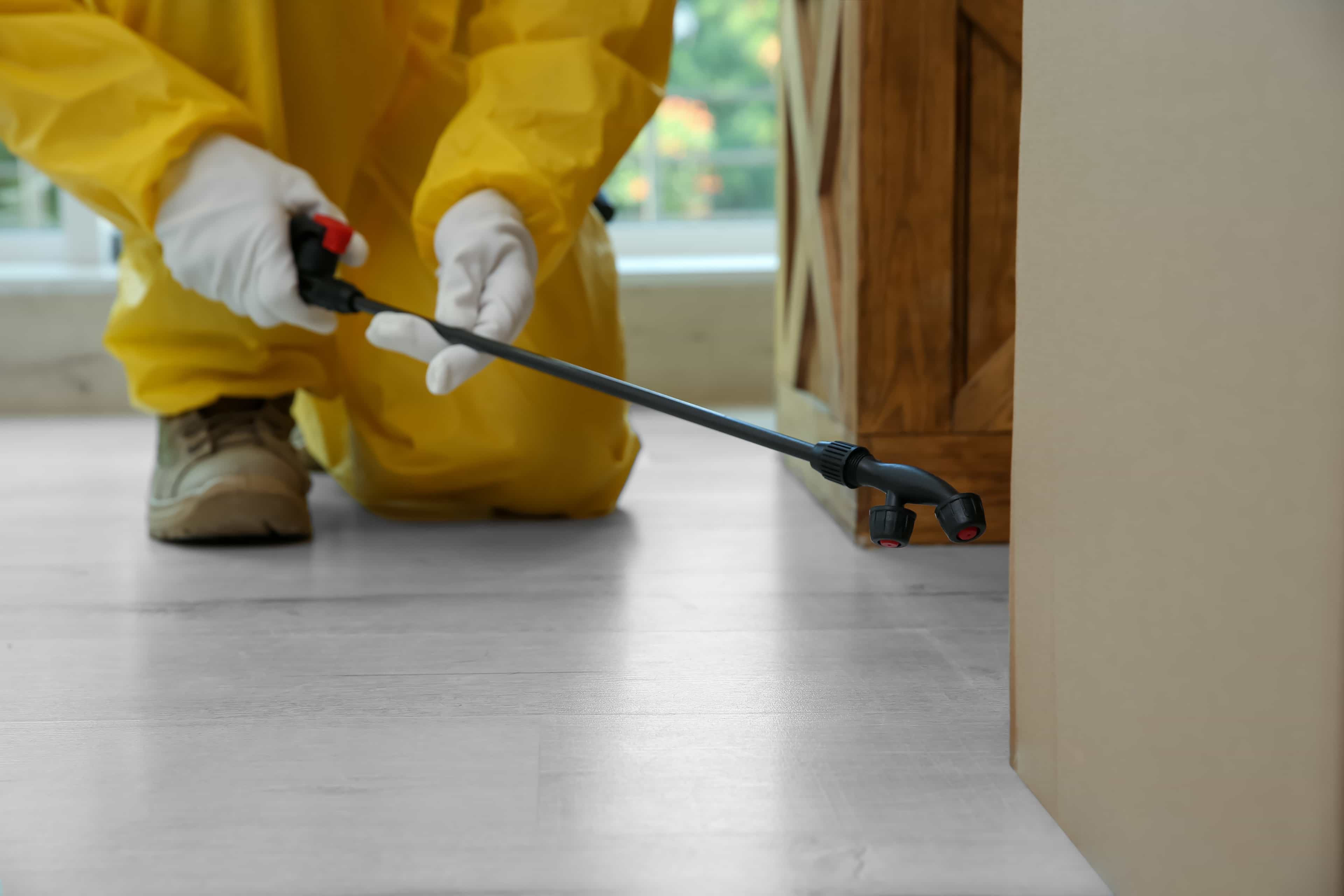
Professional barrier treatments are the most powerful single intervention available to Canadian homeowners, and also the most frequently oversold. A licensed applicator sprays a residual pyrethroid insecticide on the underside of leaves, shrubs, fence lines, and other surfaces where adult mosquitoes rest during the day. When mosquitoes contact the treated surfaces between applications, they pick up a lethal dose. A systematic review of yard-scale barrier treatments published by SAGE found that pyrethroid barrier sprays can significantly reduce adult mosquito abundance in treated yards for days to weeks, with performance varying by product, surface, vegetation density, and weather.
The most important phrase in that finding is "treated yards." Barrier sprays create a zone of relief on the property they cover. They do not eliminate mosquitoes from the surrounding neighbourhood, and the relief decays over the inter-application interval as residue breaks down. Field studies of bifenthrin-based barriers and similar products show meaningful reductions in landing rates within the treated area, while flying mosquitoes continue to move in from neighbouring properties. That is the honest framing for homeowners: a barrier treatment turns "unusable" into "comfortable" in a defined zone, not "mosquito-free" across the property.
Re-application intervals are typically every two to four weeks during peak mosquito season, depending on the product and the local conditions. Rain shortens the interval. Heavy vegetation lengthens it. A reputable service will tell you, in writing, what product is being applied, the PCP registration number, the expected re-application schedule, and the conditions—rain, wind speed, daily temperature—that will trigger a re-treatment or a postponement.