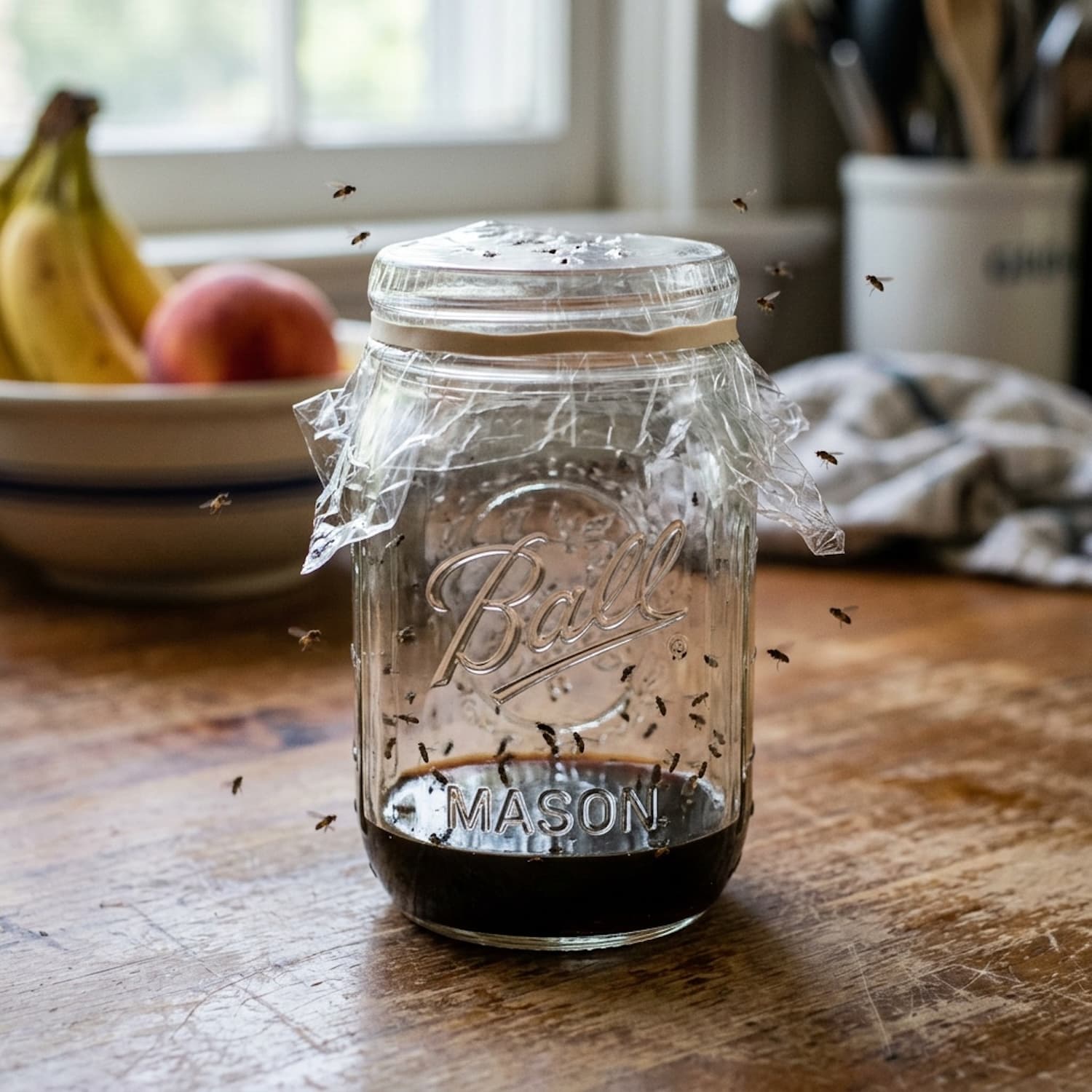
The Lure: Vinegar As A Fermentation Signal
Fruit flies are, at heart, decomposers. Their entire biology is tuned to find fermenting fruit and lay the next generation on it. When you set out a shallow pool of balsamic, you are sending out a targeted chemical broadcast — the same signal a ripe, splitting plum would put into the air on its own.
The fact that ordinary kitchen vinegar is a genuinely effective fruit fly lure is not folk wisdom. Health Canada's Pest Management Regulatory Agency has formally recognized acetic acid, at the same 6–8% concentration found in ordinary household vinegar, as the active ingredient in a registered indoor fruit fly attractant designed for use near kitchen trash, sinks, and compost bins. In other words: regulators already consider the vinegar in your pantry strong enough to do the job. You do not need to concentrate it, cut it with something fancier, or buy a commercial version. You just need to present it well.
The Kill: How One Drop Of Soap Changes Everything
Here is where the dish soap earns its keep. A fruit fly is extraordinarily light, and it uses that lightness to its advantage. On plain water — or plain vinegar — a fly can often touch down, skate briefly across the surface, and push itself back into the air before the liquid ever really takes hold of it. The surface behaves like a thin trampoline. Most flies you thought you caught in a soap-free jar have quietly walked off it.
One drop of dish soap collapses that trampoline. Dish soap is a surfactant, which is a way of saying it disrupts the cohesive pull between water molecules at the surface of a liquid. A British Columbia government cultural control factsheet describes this directly, noting that adding detergent to a water-based insect trap reduces surface tension so that pests contacting the liquid subsequently drown rather than floating and escaping. With the surface weakened, a fly that lands in your jar sinks within seconds.
This is also why more soap is not better. You need enough to break the tension, not enough to foam or change the smell of the bait. One drop. Maybe two. Stop there.
The Failsafe: Why The Petroleum Jelly Matters
Here is the piece nobody seems to talk about, and the reason my traps started clearing kitchens instead of merely thinning them out.
Even with the right vinegar and the right amount of soap, fruit flies do not all land on the liquid. Some crawl. They will slip through the pinholes in the plastic, investigate the moist underside, and — if you have given them a smooth, uninterrupted surface — work their way back toward the holes and out. Not in huge numbers, but enough to keep a population limping along. I used to watch it happen and wonder why my trap looked full but the kitchen still hummed.
The ring of petroleum jelly is what cuts off that last escape route. It creates a slick, tacky band right across the one path a climbing fly would take, and the fly simply cannot get traction across it. The tactic is borrowed from invertebrate-keeping communities, where a continuous band of petroleum jelly around the inside upper edge of a container is a standard way to stop crawling insects from scaling out. In a fruit fly trap, the same principle turns a leaky barrier into a closed one.
If your previous traps have felt like they were mostly working but never quite finishing, this is almost certainly what was missing.