Vancouver Island Homeowners Face Up to 250 mm of Rain This Week: Six Steps to Protect Basements Before Wednesday
The Heaviest Rain Falls From Early Tuesday to Wednesday Morning, Which Makes Today the Window to Act
By
Published: November 10, 2026, 12:15 p.m. ET
Fact-checked · , including Public Safety Canada, Government of British Columbia & City of Nanaimo
Credit: Homeowner.ca
Key Takeaways
•Orange rainfall warnings cover west and central Vancouver Island, Howe Sound and the Sea-to-Sky region, with flood watches across most of the Island and the South Coast.
•Most basement water this week will come from roofs, window wells, blocked street drains and overloaded sewers — all things a homeowner can influence before Wednesday morning.
•No checklist guarantees a dry basement. The goal is to remove the easy failure points and know what to do if water gets in anyway.
Environment Canada raised orange rainfall warnings on Nov. 10, 2026 for west and central Vancouver Island, Howe Sound and the Sea-to-Sky region. Parts of the Island could see more than 250 millimetres of rain, Howe Sound and Sea-to-Sky upwards of 160 millimetres, and parts of Metro Vancouver around 120 millimetres. B.C.'s River Forecast Centre has flood watches in place for much of Vancouver Island and the South Coast. The worst of it runs into Wednesday.
That timeline matters more than the totals. The rain started landing early Tuesday. The heaviest bands persist until Wednesday morning. So "before Wednesday" really means today and this evening, while it is still daylight and still safe to be outside.
This is a working guide, not a storm recap. It covers where the warnings actually sit, what orange means in Environment Canada's system, six actions that remove the most common ways water reaches a basement, and what to check and document once the rain eases. Each step includes its limit — the point where you stop and call someone else.
Stay on top of Canadian homeowner news
Where the warnings sit and when the rain peaks
The regional picture is uneven, and that changes your urgency
The headline number is a local maximum. It is not what every Island street will get.
The orange warning issued Monday describes a very robust frontal system making landfall early Tuesday, with heavy rain until Wednesday morning and moderate rain continuing until Thursday morning. According to CBC News, Environment and Climate Change Canada expects 150 to 200 millimetres across west and central Vancouver Island, with more than 250 millimetres possible in the wettest spots.
East Island communities sit under a lower tier. CHEK News reports the orange zone runs from Sooke to Kyuquot, while the stretch from Nanoose Bay to Campbell River is under a yellow warning for 50 to 100 millimetres.
6 rows · 4 columnsTap a header to sort
West and central Vancouver Island (Sooke to Kyuquot)
Orange rainfall warning
150–200 mm; locally more than 250 mm
Early Tuesday to Wednesday morning, easing Thursday
Northern Vancouver Island
Yellow rainfall warning
More than 100 mm
Tuesday to Wednesday
East Vancouver Island (Nanoose Bay to Campbell River)
Yellow rainfall warning
50–100 mm
Tuesday to Wednesday
Howe Sound and Sea-to-Sky
Orange rainfall warning
Upwards of 160 mm
Tuesday to Wednesday
Metro Vancouver North Shore
Yellow rainfall warning
Up to 120 mm
Tuesday to Wednesday
Most of Vancouver Island and the South Coast
River Forecast Centre flood watch
Rivers approaching or exceeding bankfull
In effect since Nov. 9
A yellow tier does not mean a dry basement. Fifty millimetres on soil that has already absorbed a week of atmospheric rivers can find a weak window well just as easily. The difference is margin, not immunity.
The flood watch is about rivers — your basement risk is closer to home
The River Forecast Centre flood watch, upgraded at 12:36 p.m. on Nov. 9, means river levels are rising and may exceed bankfull. Modelling points to flows in the five- to ten-year range or higher in places. Smaller creeks are the most sensitive to sudden rises, and high tides plus storm surge could add pressure near river mouths on the east side of the Island, particularly on Wednesday.
If you live beside a creek or an estuary, your priority is your local emergency alerts, not a gutter. For most Island homeowners, though, the threat is more ordinary: water arriving faster than the house was built to shed it.
Read that as a planning signal. Orange means the forecaster expects consequences, not just a wet commute. It also means municipal crews, plumbers and restoration companies will be stretched by Wednesday afternoon — another reason the useful work happens now, before the queue forms.
The same rain lands differently depending on what it falls on. Week-old saturated ground, leaf-choked drains and power already knocked out by the weekend's windstorms all raise the stakes on the Island specifically. Those are the conditions the six steps below target.
One limit worth stating plainly: coastal storm surge is a separate hazard with separate insurance treatment. If you live near the shoreline, our explainer on why storm surge sits outside most B.C. home policies covers that gap.
Orange is a statement about impact, not just volume
Read that as a planning signal. Orange means the forecaster expects consequences, not just a wet commute. It also means municipal crews, plumbers and restoration companies will be stretched by Wednesday afternoon — another reason the useful work happens now, before the queue forms.
The same rain lands differently depending on what it falls on. Week-old saturated ground, leaf-choked drains and power already knocked out by the weekend's windstorms all raise the stakes on the Island specifically. Those are the conditions the six steps below target.
One limit worth stating plainly: coastal storm surge is a separate hazard with separate insurance treatment. If you live near the shoreline, our explainer on why storm surge sits outside most B.C. home policies covers that gap.
Six steps to protect your basement before Wednesday morning
Each step below addresses one way water reaches a basement. Work through them in the order shown — outside first, while it is light, then inside.
6 rows · 4 columnsTap a header to sort
Clear eavestroughs and redirect downspouts
Roof water dumping against the foundation
30–60 minutes
The job needs a ladder in wind or heavy rain
Clear and cover window wells
Water pooling against basement glass
15 minutes per well
Water is already above the window sill
Clear the street storm grate
Water backing up across the driveway
10 minutes
The grate is in traffic or under moving water
Test the sump pump and its backup power
Groundwater rising through the pit
15 minutes
The pump does not start, runs non-stop or smells burnt
Lift valuables off the basement floor
Avoidable loss if water gets in
30–60 minutes
Water is already on the floor near outlets
Cut dishwasher and laundry use at peak rain
Sewer backup through the floor drain
No time — just timing
Water is coming up through a floor drain
Clear eavestroughs and point downspouts away from the house
Roof drainage is the quiet culprit. One of the most common reasons water pools against a home, according to Utilities Kingston's basement-flooding guidance, is eavestroughs and downspouts that stop working: when they fail, the whole roof drains right beside the house and seeps down the foundation wall.
Late autumn on the Island means needles and maple leaves packed into every corner. Scoop them out, then run a hose or watch the first rain to confirm water actually exits the downspout. The discharge should land well away from the foundation — two metres is the common Canadian guidance — on a lawn or garden that slopes away from the house, not onto a driveway that slopes back toward it or onto a neighbour's lot.
The limit: ladder work in gusting wind on wet shingles is how storm prep turns into an emergency room visit. If the eavestroughs can only be reached from a ladder and the wind is up, extend the downspouts at ground level and leave the troughs.
Clear and cover window wells
A window well is a small, open pit pressed against the basement wall. When it fills, the only thing between that water and your basement is a pane of glass and a sill seal.
Pull out leaves and debris so the drain at the bottom of the well — if there is one — can work. Then cover it. The Intact Centre on Climate Adaptation's basement checklist lists window well covers among its simple upgrades. If you do not have a fitted cover, a sheet of plywood or a heavy tarp weighted at the edges, angled so water runs off away from the house, will shed most direct rain until the storm passes.
The limit: if water is already standing above the window sill, do not try to bail the well from inside or open the window. Move valuables away from that wall and treat it as a leak in progress.
Clear the storm grate in front of your house
Street catch basins are designed to take the water your property sheds. When leaves mat over them, that water stays on the road and in the driveway — and some of it finds the low point of your foundation.
Island municipalities ask residents to help with exactly this. The City of Nanaimo asks homeowners to keep the catch basins in front of their homes clear of leaves and debris, if it is safe to do so. The province's own flood watch for this storm makes the same point: at this time of year leaves clog storm drains, so keep them clear.
Use a rake or a gloved hand to lift debris off the top of the grate. Do not try to remove the grate itself.
The limit: never clear a drain that sits in a travel lane, and never step into moving water to reach one. If a grate stays blocked or water is ponding across the street, report it to your municipality's public works line instead.
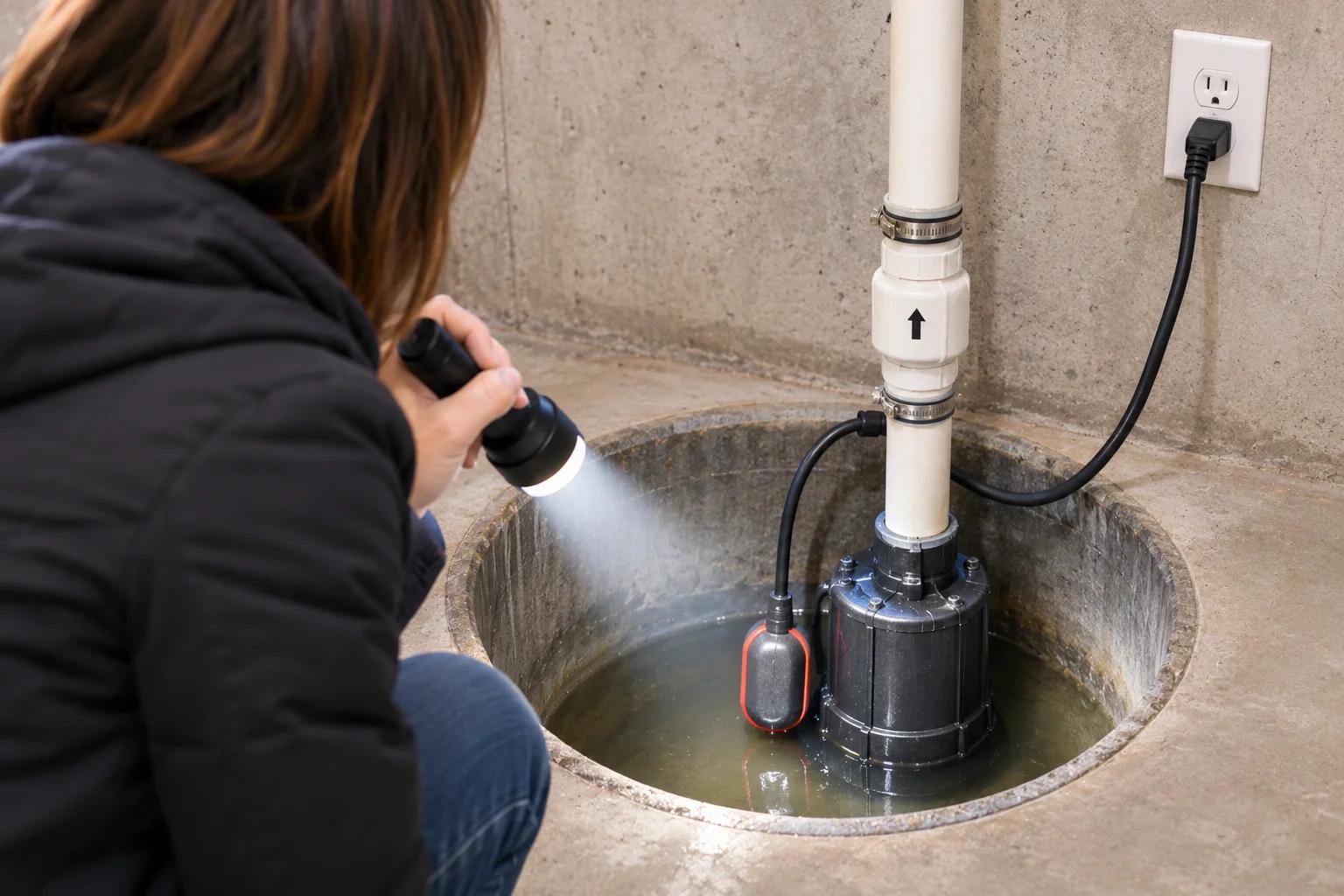
Test the sump pump and its backup power
If your house has a sump pump, it is your main defence against rising groundwater this week. Test it today, not when the pit is already full.
The federal guidance is simple. Public Safety Canada advises pouring water into the pit to confirm the pump switches on and pushes the water out, checking that the discharge pipe sends water away from your foundation, and checking the pump again during the rain and during any power outage.
Power is the weak link this week. Thousands of BC Hydro customers, including many on northern Vancouver Island, were still without power on Monday night after the weekend windstorms. A pump with no power is just a pipe in a hole: groundwater rises until it spills out of the pit and onto the floor. If you have a battery backup, confirm it is charged. If you rely on a generator, it must run outdoors, never in a garage or basement.
Warning
Never run a generator, barbecue or camp stove indoors or in an attached garage during an outage. Carbon monoxide can build up quickly and has no smell.
The limit: if the pump does not start, runs constantly without lowering the water, or smells hot, call a plumber now. Wednesday morning will be too late to get one.
Move valuables, documents and electronics off the basement floor
This step does not keep water out. It decides how much a small leak costs you.
Lift anything you would not want to replace onto shelves, tables or upstairs — photos, paperwork, electronics, rugs, cardboard boxes of seasonal gear. Store important documents on a higher floor and take phone photos of them as a backup. While you are down there, unplug electronics that sit at floor level and note where your electrical panel and main water shut-off are, so you are not searching for them in the dark.
The limit: if water is already on the floor near outlets, power bars or the panel, do not wade in to rescue belongings. Leave the basement.
Cut dishwasher and laundry use while the rain is heaviest
This is the step most people skip, and it is the one that protects you from the worst kind of basement water.
During extreme rain, municipal sewers fill up. When the sewer level rises above your basement floor, wastewater can push back up through the lowest drain in the house — usually the floor drain. Every load of laundry and every dishwasher cycle adds to that pressure.
B.C. municipalities have asked for exactly this before. During a December 2025 atmospheric river, the District of Squamish asked residents to limit dishwashing, laundry, showers and toilet flushing because its sewer system was at risk of being overwhelmed. Run the dishwasher and the washing machine today, then pause them from Tuesday evening until Wednesday afternoon.
The limit: if water or sewage is coming up through a floor drain, stop using all sinks, toilets and showers in the house and call your municipality. Water you send down the drain may come straight back up.
After the rain: check safely, then document everything
Safety comes before the camera
When the rain eases, go down carefully. If there is standing water in the basement and it could be touching outlets, cords, appliances or the panel, do not enter.
Public Safety Canada's flood guidance is clear on this: never try to shut off electricity while standing in or near water, and if the main power was not turned off before flooding, have a qualified electrician confirm the space is safe first. Flooded appliances can shock or start a fire when switched back on. Call BC Hydro or your electrician rather than testing them yourself.
What to note about the water
Take a minute to observe before you mop. Where did the water appear — at a wall, a window, the sump pit or a floor drain? Is it clear or muddy, and does it smell? Clearer water usually points to surface drainage; murky or foul-smelling water rising from a drain points to a sewer problem. That distinction matters to your municipality and, often, to your insurer.
Make a complete list of damaged items, with receipts, proofs of purchase or photos where you have them
Keep damaged items unless they pose a health hazard, and confirm with your insurer before throwing anything out
Keep notes on what happened, when, and who you spoke with
Keep every receipt for cleanup, emergency repairs and equipment rentals
Report the damage to your insurer as soon as possible, and expect a proof of loss to be due within about 30 days if one is requested
Your policy also expects you to limit further damage. That means starting cleanup — fans, dehumidifiers, removing wet materials — once it is safe, rather than waiting for an adjuster. Public Safety Canada recommends cleaning up within 48 hours where possible to avoid mould, so drying out quickly matters.
Know which kind of water your policy treats differently
Insurers do not treat all basement water the same way. The Insurance Bureau of Canada notes that basement damage from a sewer backup is only covered if you bought optional sewer-backup coverage, and that coverage for surface water from heavy rain is also optional. Every policy is different.
That makes ten minutes with your policy documents tonight a useful part of storm prep. You are not trying to settle a claim in advance. You are finding out whether you have the endorsements, what the limits are, and where your insurer's 24-hour claims number lives. Homeowners with general insurance questions can also reach IBC's Consumer Information Centre at 1-844-2ask-IBC.
Angela Nightingale is the Senior Editor at Homeowner.ca with two decades of experience in digital publishing and content strategy. She has owned two homes, taken on her share of DIY projects, and learned what most guides fail to mention. She writes from the belief that the best home guidance comes from people who have lived through the decisions — and her goal is always to leave readers feeling confident, not overwhelmed.
The Canadian Press via Global News. (2026). B.C. deluge could bring 250 mm of rain as forecasters predict flooding, landslides. Retrieved from https://globalnews.ca/
CBC News. (2026). More than 250 mm of rain forecast for some B.C. areas as storm makes landfall. Retrieved from https://www.cbc.ca/
CHEK News. (2026). Storm train continues with new wind/rain warnings for the island. Retrieved from https://cheknews.ca/
Show 15 more sourcesHide additional sources
B.C. River Forecast Centre. (2026). Flood Watch – South Coast; Northern, Western, Central and East Vancouver Island; Central Coast – Kingcome; Fraser Valley-North. Retrieved from https://bcrfc.env.gov.bc.ca/