The Province's Own Budget Tables Show a Two-Year Slide in Projected Construction — and Ministers Are No Longer Pretending the Target Is in Play

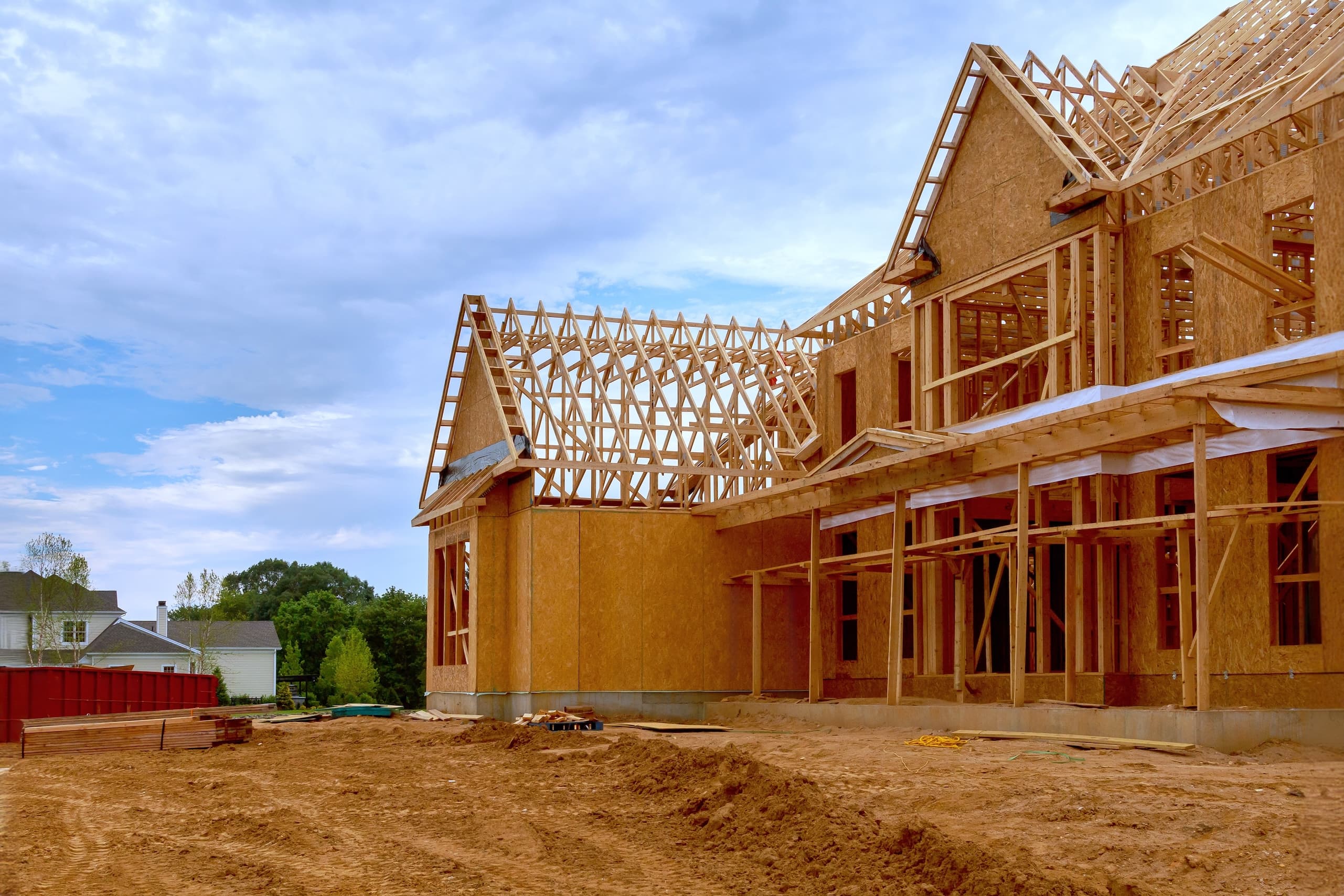
The image displays an early-stage residential construction site, highlighting the essential wooden framework against a backdrop of neighborhood homes. (Credit: Shutterstock)
Ontario's 2026 budget, tabled March 27, contains a number that matters more to homeowners than most of the policy announcements that surrounded it: the province now projects just 64,800 housing starts this year.
That is 10,000 fewer than Ontario expected when it published last year's budget — and 30,000 fewer than the 2024 plan projected for this same year. It is not an aberration. The budget's economic forecast tables show downward revisions across the entire medium-term horizon, with starts also lowered for 2025, 2027, and 2028.
The number matters because housing starts — the point at which construction actually begins on a new residential building, defined by CMHC as the moment the concrete footing is poured — are the closest thing to a real-time measure of how much new supply is actually coming. Announced targets, approved permits, and political promises all sit upstream. Starts are where metal meets ground.
The scope of the revision is clearest in the budget's own comparison table, which lines up the 2025 and 2026 budget assumptions side by side.
Source: Ontario 2026 Budget, Table 2.2. Housing starts in thousands of units.
Every year in the projection window was revised downward. The budget notes that these figures are based on the private-sector forecast average as of January 16, 2026 — meaning they reflect what banks and economists actually expect, not what the government hopes for. And the trend within those figures is telling: even the most optimistic year in the new outlook (76,800 in 2028) falls below the least optimistic year in last year's outlook (71,800 in 2025).
This is not a one-off weather-driven dip. The Financial Accountability Officer's most recent briefing reported that Q1 2025 housing starts fell to 12,700 units — a 20 per cent drop from Q4 2024 and the lowest quarterly total since late 2009. About 80 per cent of those starts were multi-unit dwellings.
Ontario's More Homes Built Faster plan, introduced as a centrepiece of the 2022 re-election campaign, committed the province to getting 1.5 million homes built between 2022 and 2031. The math was always demanding. Spread evenly, that target requires roughly 150,000 starts per year. The government's own early modelling showed the need was closer to 175,000 annually.
Ontario has never hit those numbers. The province's record high for housing starts was roughly 101,000 units in 2021, according to data compiled by the Ontario Chamber of Commerce. In the previous ten years, Ontario built fewer than 700,000 homes total.
The gap between ambition and track record is well documented. Smart Prosperity Institute has noted that the province has never exceeded 850,000 new homes in any ten-year period. The 1.5 million goal was, in the institute's framing, a "moonshot."
By mid-2024, the Financial Accountability Office calculated that Ontario was building at exactly half the required pace. The province's own transition binder — an internal briefing document prepared for an incoming associate minister — acknowledged that private-sector forecasts showed Ontario would remain behind its housing targets for the entire ten-year window. Of 50 large municipalities with assigned housing targets, 31 missed them in 2023.
The rhetorical retreat has been gradual but unmistakable. Finance Minister Peter Bethlenfalvy referred to 1.5 million homes as a "soft target" last year. On budget day, Housing Minister Rob Flack was more direct. He told reporters he does not "wake up thinking about 1.5" and is instead focused on near-term delivery. When pressed on whether the budget's measures would be enough to reach the target, neither minister recommitted to it. An earlier analysis of a 2025 housing bill found the government similarly non-committal, with Flack focusing on six-to-twelve-month horizons rather than the ten-year goal.
A housing "start" is not the same as an approved permit. The Association of Municipalities of Ontario estimates that roughly 330,000 housing units in Ontario already have municipal planning approvals but have not yet moved into construction. Approvals alone do not guarantee supply — financing conditions, construction costs, and labour availability all determine whether an approved project actually breaks ground.
For homeowners who are not looking to sell or move, the persistent supply shortfall has a straightforwardly supportive effect on property values. Fewer new units entering the market means less competition for existing homes. Population growth — driven by immigration levels that have added hundreds of thousands of new residents to Ontario in recent years — continues to place upward pressure on prices when supply is constrained, as the Ontario Chamber of Commerce has observed.
But the supply squeeze cuts the other way for homeowners who want to move up, renovate, or draw on their equity.
Move-up options narrow. With fewer new homes being built, the inventory of move-up properties — the mid-range and upper-range homes that growing families typically transition into — remains thin. A homeowner whose property has appreciated may find that the next rung of the ladder has appreciated just as much, or that options simply are not there.
Renovation timelines stretch. Labour shortages in construction are among the most acute in Ontario, driven by demographic trends and heightened demand for skilled trades. When fewer new-build projects are running, some trades capacity is freed up — but it comes at a premium.
Construction costs have risen 51 per cent since 2020, according to the Association of Municipalities of Ontario. Wages in residential construction grew nine per cent in 2022 alone — well above the average for other industries.
Property tax pressure builds quietly. This is the connection most homeowners do not see coming. Municipalities fund growth-related infrastructure — roads, sewers, water systems, police stations — through development charges levied on new construction. When housing starts fall, development charge revenue falls with it. AMO calculates that without development charges, Ontario municipalities would have needed to raise property tax revenues by roughly 20 per cent in 2022 to fund the same infrastructure. That cost does not disappear when fewer homes are built. It shifts onto the existing tax base — which means current homeowners.

The budget's headline housing measure is a temporarily expanded HST rebate on new home purchases, which the province announced alongside Ottawa the day before the budget. Homes valued up to $1.5 million will qualify for a maximum combined rebate of $130,000 for one year starting April 1, and the measure is not limited to first-time buyers. The province estimates the rebate will spur roughly 8,000 additional housing starts.
That 8,000-unit estimate is useful as a sense of scale. If it materializes, it would bring projected starts to roughly 73,000 — still less than half the annual pace the 1.5 million target requires.
The budget also signals that Ontario and the federal government are working on a program for municipalities to reduce development charges — a significant cost that builders say suppresses project viability. The federal side of this equation has been growing. Ottawa recently tabled Bill C-26, which would send $1.7 billion to provinces specifically targeting development fee reductions.
Those commitments sit alongside broader federal housing investments — including a six-billion-dollar Canada Housing Infrastructure Fund and a top-up to the Housing Accelerator Fund, as outlined in the 2025–26 Main Estimates.
The gap, though, is between the scale of those funding envelopes and the province's demonstrated capacity to convert money into actual housing starts. Federal dollars flow to provincial and municipal channels. Provincial forecasts show those channels producing fewer homes each year, not more. For homeowners, the practical implication is that the neighbourhood infrastructure tied to growth targets — schools, transit, local services — may arrive later than planned, regardless of how much federal funding is announced.
Ontario's budget revision does not exist in isolation. TD Economics reversed its national housing forecast in March, now expecting national sales to fall 1.8 per cent and prices to edge down 0.3 per cent after predicting a strong rebound in December.
CREA downgraded its own 2026 outlook earlier this month, citing tariff uncertainty.
And CMHC's most recent national framework concluded that housing starts need to roughly double — from about 250,000 to between 430,000 and 480,000 per year — to restore affordability to pre-pandemic levels by 2035.
Ontario's 64,800-unit projection is moving in the opposite direction.
The directional alignment between these institutions — Ontario's own budget, TD, CREA, and CMHC — does not make any specific outcome certain. Forecasts are not guarantees. But when a province's budget, a major bank, the national real estate association, and the federal housing agency are all pointing to a flat-to-negative near-term outlook, the burden of proof has shifted to anyone expecting a strong spring rebound.
For homeowners thinking about a sale, a renovation, a HELOC draw, or a refinance in 2026, the practical takeaway is to plan against the numbers the institutions are actually publishing — not the recovery story that was still plausible three months ago.