How to Refinish a Wood Deck: Stripping, Sanding, and Staining in One Weekend
A Two-Day Plan That Works for Canadian Decks
By
Published: May 4, 2026
Fact-checked · , including Health Canada, Canadian Wood Council
Credit: Shutterstock
Key Takeaways
•You can refinish a typical 200–400 sq ft deck over a single weekend if the wood is sound, the forecast is friendly, and you sequence the work carefully.
•The biggest decision isn't which stain to buy — it's whether your deck needs a strip, a sand, or both before any colour goes on.
•Canadian climate, retailer shelves, and federal VOC rules quietly shape every choice from stripper chemistry to drying time, so a generic American how-to will leave you guessing.
There's a particular kind of grey that tells you it's time. The boards have lost their colour, the finish has faded to a powdery patchwork, and the railings feel rough under your hand. You've heard you can fix all of that in a weekend — strip, sand, stain, done — and you're trying to decide whether to believe it.
The honest answer is: yes, often, but only if a few things line up. The deck has to be the right size and in sound shape. The forecast has to give you a clean two-day window. And the work has to be sequenced so the chemicals, the sanding, and the stain each get the time they need. Most weekend projects that go sideways do so before the stain is opened — a damp board, a stripper dried too fast, a coat applied in blazing sun.
What follows is a Canadian playbook for a 200–400 sq ft deck — which decks belong on this weekend, the strip-or-sand decision, the hour-by-hour schedule, and the products you can pick up at Home Depot Canada, RONA, or Canadian Tire on Friday night. By Sunday afternoon, you should be standing on a deck that looks reborn.
What "One Weekend" Really Means for Your Deck
The phrase "one-weekend deck refinish" is real — but it's earned, not assumed. Two days is enough time only if you start with the right deck and the right calendar week. A few honest qualifying questions, asked Friday morning, will save you a Sunday-evening rescue plan.
The Decks That Belong on a Weekend Plan
A deck between roughly 200 and 400 square feet, with sound joists, no spongy boards, and an existing finish that's worn rather than peeling in sheets, is the sweet spot. So is a deck made from cedar, hemlock, or pressure-treated softwood — the species most Canadian backyards already have. If boards are bouncy underfoot, screws are missing, or rot has crept into the joists at the ledger, you're not refinishing — you're rebuilding, and that's a different conversation. For projects that scope, Homeowner.ca's playbook for hiring a decking company is a better starting point.
A brand-new pressure-treated deck is its own special case. The lumber leaves the mill saturated with preservative and water, and most finishing guidance, including from Southern Pine producers, recommends letting new pressure-treated wood season before staining — typically several months — because too much internal moisture will keep stain from penetrating and lead to early failure. If your boards still bead water or feel cold and damp deep into the grain, that bottle of stain belongs back on the shelf for now.
When the Calendar Makes the Decision
Across most of Canada, the workable refinishing window runs from late May through mid-September, with shoulder seasons tightening that span in the Prairies and Atlantic Canada. According to a Canadian deck-staining guide from BMR, the friendliest temperature band for application sits between about 10 °C and 25 °C, with no rain expected for several hours after the stain goes on. Avoid heat waves — direct sun bakes the stain into the surface before it can soak in — and avoid the cold, damp mornings of early May or late September, when overnight humidity can interfere with curing.
Pick the weekend by the seven-day forecast, not the date on the calendar. Two clear days with morning lows above 10 °C, afternoon highs under 28 °C, and overnight humidity under 70 percent is the prize. If the forecast is shaky, it's better to wait a week than to chase a closing window with damp boards.
When to Set the Project Down
Some signals are louder than others. If your deck is over 500 square feet, has a heavily peeling solid stain across the whole surface, or hasn't been touched in a decade, the realistic timeline is closer to a long weekend, sometimes two. Same goes for railings with intricate spindles — they triple the staining time and quietly turn a Sunday afternoon into a Monday morning.
This is also the moment to be honest about your tolerance for the work itself. Stripping and sanding a deck is sweaty, dusty, slightly tedious labour. There is no shame in walking it through with a contractor instead, especially if the structure is more complicated than four sides and a flight of stairs.
The phrase "one-weekend deck refinish" is real — but it's earned, not assumed. Two days is enough time only if you start with the right deck and the right calendar week. A few honest qualifying questions, asked Friday morning, will save you a Sunday-evening rescue plan.
The Decks That Belong on a Weekend Plan
A deck between roughly 200 and 400 square feet, with sound joists, no spongy boards, and an existing finish that's worn rather than peeling in sheets, is the sweet spot. So is a deck made from cedar, hemlock, or pressure-treated softwood — the species most Canadian backyards already have. If boards are bouncy underfoot, screws are missing, or rot has crept into the joists at the ledger, you're not refinishing — you're rebuilding, and that's a different conversation. For projects that scope, Homeowner.ca's playbook for hiring a decking company is a better starting point.
A brand-new pressure-treated deck is its own special case. The lumber leaves the mill saturated with preservative and water, and most finishing guidance, including from Southern Pine producers, recommends letting new pressure-treated wood season before staining — typically several months — because too much internal moisture will keep stain from penetrating and lead to early failure. If your boards still bead water or feel cold and damp deep into the grain, that bottle of stain belongs back on the shelf for now.
When the Calendar Makes the Decision
Across most of Canada, the workable refinishing window runs from late May through mid-September, with shoulder seasons tightening that span in the Prairies and Atlantic Canada. According to a Canadian deck-staining guide from BMR, the friendliest temperature band for application sits between about 10 °C and 25 °C, with no rain expected for several hours after the stain goes on. Avoid heat waves — direct sun bakes the stain into the surface before it can soak in — and avoid the cold, damp mornings of early May or late September, when overnight humidity can interfere with curing.
Pick the weekend by the seven-day forecast, not the date on the calendar. Two clear days with morning lows above 10 °C, afternoon highs under 28 °C, and overnight humidity under 70 percent is the prize. If the forecast is shaky, it's better to wait a week than to chase a closing window with damp boards.
When to Set the Project Down
Some signals are louder than others. If your deck is over 500 square feet, has a heavily peeling solid stain across the whole surface, or hasn't been touched in a decade, the realistic timeline is closer to a long weekend, sometimes two. Same goes for railings with intricate spindles — they triple the staining time and quietly turn a Sunday afternoon into a Monday morning.
This is also the moment to be honest about your tolerance for the work itself. Stripping and sanding a deck is sweaty, dusty, slightly tedious labour. There is no shame in walking it through with a contractor instead, especially if the structure is more complicated than four sides and a flight of stairs.
The Three-Phase Workflow: Strip, Sand, or Both?
The headline reads "strip, sand, and stain," but most decks don't need all three in equal measure. The amount of stripping versus sanding the wood actually requires depends almost entirely on what's already on the boards — and on how that finish is failing.
Reading What's Already on Your Boards
Walk the deck slowly. Run your thumbnail across the surface and look at how it picks up. A finish that has faded but stayed bonded — a clear sealer or toner that's gone chalky, or a semi-transparent stain that's lost its colour — is mostly cosmetic and will respond well to a deck cleaner-brightener and a moderate sanding. A finish that's actively peeling, lifting in flakes, or showing as a patchwork of bare wood and stubborn film is a different problem. Solid (opaque) stain, in particular, doesn't fade gracefully; it cracks and peels, and any new finish applied over the loose layer will fail with it.
The other variable is the wood itself. Deep grey discolouration, fuzzy fibres, and dark waterlines tell you UV and moisture have been working on the boards, and a cleaner-brightener step is non-negotiable before stain is even considered. Mildew shows up as black speckling, often on the shaded edges, and needs treating before it gets locked under a fresh coat.
Strippers, From Mild to Mighty
There are three families of chemistry on the deck-restoration shelf, and they get progressively more aggressive. Sodium percarbonate is the gentlest — essentially oxygen bleach in granular form. It works as a cleaner and brightener, lifts grey from weathered wood, and refreshes a sound clear or toner finish. It's the right call when you don't have heavy buildup to remove. Sodium metasilicate sits in the middle, suitable for thicker semi-transparent stains. Sodium hydroxide, the strongest of the three, emulsifies solid stains and dead surface fibres but is genuinely caustic; it raises the wood grain, can darken cedar, and almost always needs a follow-up oxalic acid brightener to neutralize the surface before staining.
For most weekend refinishes — a faded semi-transparent finish on a pressure-treated or cedar deck — a sodium percarbonate cleaner does enough work to let the sander finish the rest. Reach for a hydroxide-based stripper only when you have a peeling solid stain you're determined to remove rather than recoat.
Important
Deck strippers are real chemicals, even when they come in friendly bottles. Health Canada recommends always reading the label, working in a well-ventilated area, and wearing chemical-resistant gloves, goggles, and protective clothing whenever you're using one. Avoid older methylene-chloride formulations where you can, keep products well away from children and pets, and never mix one stripper with another.
When Sanding Alone Will Do
If the existing finish is a worn clear sealer or a thin, well-bonded toner, you can often skip the chemical strip entirely and go straight to sanding. A random-orbit sander with 60- or 80-grit paper is the workhorse here. Eighty grit is the most common starting point for general deck refinishing; drop to 60 only on heavily damaged areas. Don't sand finer than 100 to 120 grit — over-polishing closes the wood's pores and reduces stain absorption. Sansin's application guidance reinforces this point, noting that proper preparation matters precisely so penetrating stains can soak in rather than sit on the surface.
Sanding is also how you handle embedded fasteners (drive any proud screws below the surface first), splintering edges, and the faint fuzz that hydroxide strippers raise on cedar. Plan on roughly an hour per 80–100 square feet with a single random-orbit sander, plus a detail sander for railings and stairs.
The Decision Table
The fastest way to know what your deck needs is to match what's already on the boards to the recommended path:
Existing Finish & Condition
Recommended Approach
Faded clear sealer or toner, no peeling
Cleaner-brightener + 80-grit sand
Semi-transparent stain, mostly faded, well bonded
Light cleaner + full 80-grit sand
Semi-transparent stain, peeling on rails or high-wear zones
Spot-strip the failures + full sand
Solid (opaque) stain, peeling
Full chemical strip + 60–80-grit sand
Heavy grey weathering, no existing finish
Cleaner-brightener + 60-grit sand, finish at 80
Bare or nearly bare sound wood
80-grit sand only
Pressure-treated, under ~3 months old
Wait — too wet to stain
If you're still weighing whether the right finish is a stain, a sealer, or a hybrid, the companion piece on deck stain versus deck sealer breaks the opacity options down before you head to the store.
The job sequences itself once you know which workflow you're running. What follows is a realistic schedule for a 250 sq ft deck with a faded semi-transparent stain — the most common starting point for a Canadian weekend refinish.
Friday Evening: Prep and Forecast Check
The night before is for clearing furniture and planters off the deck, sweeping debris from between the boards, and confirming the weekend forecast still holds. Look for two consecutive days with highs between roughly 12 °C and 28 °C, lows above 8 °C, and at least 24 hours of dry weather after your stain coat goes on. Behr's Canadian technical data sheet for its BEHR Premium Semi-Transparent Waterproofing Stain & Sealer spells out exactly why those numbers matter — surface and air temperature, humidity, and direct sun exposure all change how the stain dries, how it bonds, and whether you end up with lap marks or a sticky surface 24 hours later.
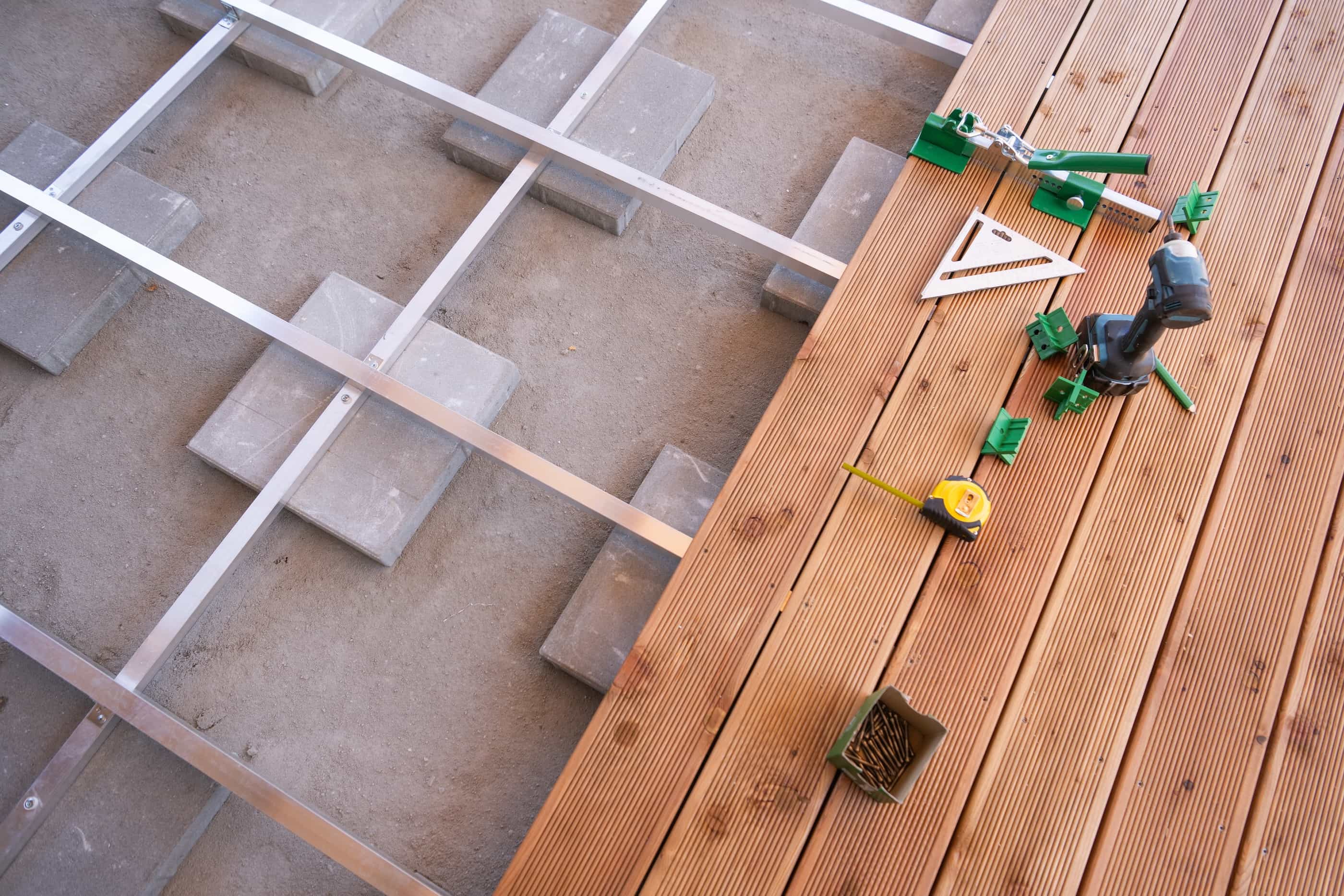
This is also the moment to drive any proud screws below the surface, mark loose or splintering boards with painter's tape so you don't miss them tomorrow, and gather your gear: random-orbit sander, detail sander, sandpaper in 60-, 80-, and 120-grit, deck cleaner or stripper, stiff scrub brush, garden sprayer, oxalic acid brightener if you're using a hydroxide stripper, painter's tape, drop cloths, gloves, goggles, an N95 dust mask, and your stain. If your deck needs a serious wash beyond a hose-and-brush, Homeowner.ca's pressure washer picks cover the right tools and pressure ratings for deck-safe cleaning.
Saturday: Clean, Strip, Sand
Start early — ideally by 8:30 a.m., once the dew has dried but the sun isn't yet beating down. Apply your cleaner or stripper to the label, working in sections of about 100 square feet so the chemistry doesn't dry on the boards. Scrub with a stiff brush along the grain, let the product dwell for the time the label specifies (usually 10 to 15 minutes), then rinse thoroughly. If you used a sodium hydroxide stripper, follow with an oxalic acid brightener to neutralize the surface.
Let the wood dry. This is the patience step that ruins more weekend projects than any other. Cool, sunny conditions give you four to six hours of drying time; cooler or more humid mornings stretch into the afternoon. The boards should feel cool but not damp before sanding begins.
Sanding takes most of Saturday afternoon. Run the random-orbit sander along the grain at 80 grit (or 60 if the surface is badly weathered), keeping the pad moving so you don't dish the wood. Hit railings, stairs, and edges with a detail sander or 80-grit hand block. Plan for two to four hours of active sanding on a 250 sq ft deck, plus a half hour of cleanup — vacuum the surface, then wipe it with a tack cloth. By dinnertime, the deck should be uniformly clean, smooth, and ready.
Sunday: Stain
Aim to start staining mid-morning, once the dew has fully burned off but before the surface temperature climbs above the manufacturer's upper limit. Sansin's Classic application guidance recommends an ideal application temperature around 21 °C and notes that drying time stretches noticeably in cold conditions or when humidity rises above about 70 percent. That's a useful rule of thumb whether or not you're using a Sansin product: cool and dry beats warm and muggy.
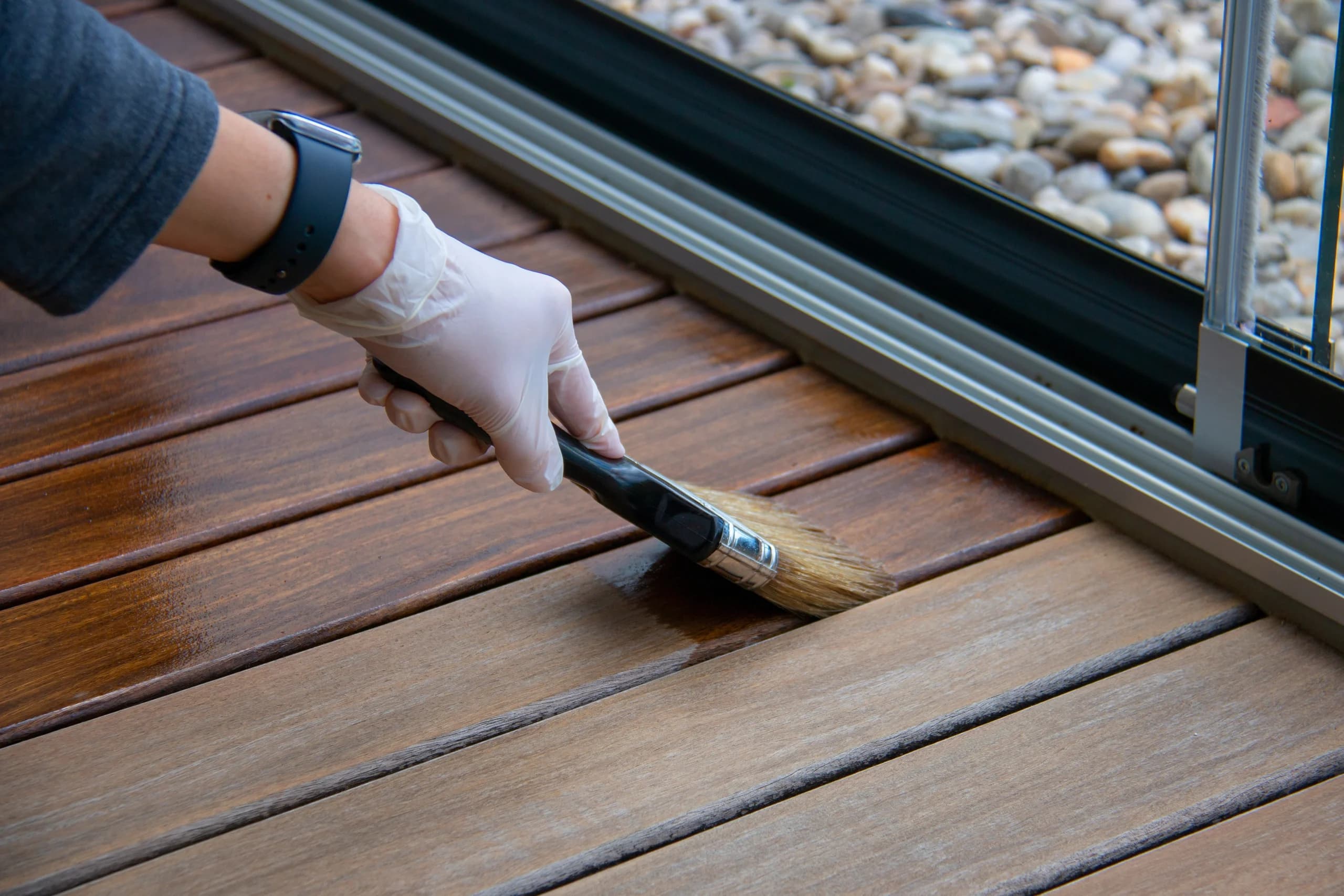
Stir the stain thoroughly — never shake it — and pour a working amount into a paint tray. Apply with a high-quality natural- or synthetic-bristle brush rated for stains, or a stain pad with a brush for back-brushing. Work two or three boards at a time, end to end, without stopping in the middle of a board. The goal is to keep a wet edge: each new section of stain blends seamlessly into the section beside it before the previous one tacks up.
The job sequences itself once you know which workflow you're running. What follows is a realistic schedule for a 250 sq ft deck with a faded semi-transparent stain — the most common starting point for a Canadian weekend refinish.
Friday Evening: Prep and Forecast Check
The night before is for clearing furniture and planters off the deck, sweeping debris from between the boards, and confirming the weekend forecast still holds. Look for two consecutive days with highs between roughly 12 °C and 28 °C, lows above 8 °C, and at least 24 hours of dry weather after your stain coat goes on. Behr's Canadian technical data sheet for its BEHR Premium Semi-Transparent Waterproofing Stain & Sealer spells out exactly why those numbers matter — surface and air temperature, humidity, and direct sun exposure all change how the stain dries, how it bonds, and whether you end up with lap marks or a sticky surface 24 hours later.
This is also the moment to drive any proud screws below the surface, mark loose or splintering boards with painter's tape so you don't miss them tomorrow, and gather your gear: random-orbit sander, detail sander, sandpaper in 60-, 80-, and 120-grit, deck cleaner or stripper, stiff scrub brush, garden sprayer, oxalic acid brightener if you're using a hydroxide stripper, painter's tape, drop cloths, gloves, goggles, an N95 dust mask, and your stain. If your deck needs a serious wash beyond a hose-and-brush, Homeowner.ca's pressure washer picks cover the right tools and pressure ratings for deck-safe cleaning.
Saturday: Clean, Strip, Sand
Start early — ideally by 8:30 a.m., once the dew has dried but the sun isn't yet beating down. Apply your cleaner or stripper to the label, working in sections of about 100 square feet so the chemistry doesn't dry on the boards. Scrub with a stiff brush along the grain, let the product dwell for the time the label specifies (usually 10 to 15 minutes), then rinse thoroughly. If you used a sodium hydroxide stripper, follow with an oxalic acid brightener to neutralize the surface.
Let the wood dry. This is the patience step that ruins more weekend projects than any other. Cool, sunny conditions give you four to six hours of drying time; cooler or more humid mornings stretch into the afternoon. The boards should feel cool but not damp before sanding begins.
Sanding takes most of Saturday afternoon. Run the random-orbit sander along the grain at 80 grit (or 60 if the surface is badly weathered), keeping the pad moving so you don't dish the wood. Hit railings, stairs, and edges with a detail sander or 80-grit hand block. Plan for two to four hours of active sanding on a 250 sq ft deck, plus a half hour of cleanup — vacuum the surface, then wipe it with a tack cloth. By dinnertime, the deck should be uniformly clean, smooth, and ready.
Sunday: Stain
Aim to start staining mid-morning, once the dew has fully burned off but before the surface temperature climbs above the manufacturer's upper limit. Sansin's Classic application guidance recommends an ideal application temperature around 21 °C and notes that drying time stretches noticeably in cold conditions or when humidity rises above about 70 percent. That's a useful rule of thumb whether or not you're using a Sansin product: cool and dry beats warm and muggy.
Stir the stain thoroughly — never shake it — and pour a working amount into a paint tray. Apply with a high-quality natural- or synthetic-bristle brush rated for stains, or a stain pad with a brush for back-brushing. Work two or three boards at a time, end to end, without stopping in the middle of a board. The goal is to keep a wet edge: each new section of stain blends seamlessly into the section beside it before the previous one tacks up.
Tip
Lap marks are the single most common cosmetic flaw in a weekend refinish, and they almost always come from stopping mid-board. Plan your route so you can complete each board in one continuous motion, and back-brush every section to even out brush strokes and push the stain into the grain. If a section starts to dry before you can blend into it, stop and let it cure rather than chasing it with more stain.
If your stain calls for a second coat, apply it within the manufacturer's specified window — usually two to four hours after the first, depending on the product. Single-coat, one-application systems like Sansin SDF or Olympic Waterguard skip this step but require a more careful first pass. By late afternoon, the deck should be glistening and dark with fresh finish; by evening, it should be tack-free; by the next morning, it's foot-traffic ready, with full cure typically taking 24 to 72 hours.
What to Buy and Where
Most weekend refinishing projects can be supplied with one stop on Friday night. The trick is knowing which lines are actually stocked at which Canadian retailer, what coverage to expect from each, and how much stain to buy for the deck you have.
The Retailer Shortlist
Home Depot Canada's deck and wood stain category carries the broadest mainstream selection: BEHR Premium and DECKplus, Olympic Waterguard, Olympic Triumph, and CIL Woodcare, in transparencies from clear and toner through semi-transparent, semi-solid, and solid — most can be tinted in-store. RONA leans on Cabot Deck and Siding Stain alongside Olympic Summit and Maximum lines. Canadian Tire stocks Cabot Oil-Based Wood Toned Deck & Siding Stain in 3.78 L cans. Independent paint stores and Home Hardware are where you'll find Benjamin Moore ARBORCOAT and Sansin's penetrating systems, both well-regarded for waterborne durability through Canadian climate cycles.
For most refinishing weekends, a semi-transparent waterborne stain is the path of least resistance. It shows enough wood grain to keep the deck looking like wood, hides minor surface inconsistencies better than a clear finish, and re-coats cleanly. Solid stains have their place — they hide more variation and last longer cosmetically — but they peel rather than fade, which means more work next time. The companion piece on deck stain versus deck sealer walks through the opacity trade-offs if you want to think it through before the store run.
The Coverage Math
Coverage rates vary more than most people expect, and buying too little stain is the fastest way to derail a Sunday afternoon. The Behr Premium technical sheet lists coverage of up to about 300 square feet per U.S. gallon for two coats on rough surfaces, with real-world coverage falling lower on porous or heavily weathered wood. Sansin's product fact sheet puts Sansin Classic in the range of roughly 200 to 300 square feet per litre per coat, while Sansin's FAQ notes that a single-coat system like Sansin SDF typically uses about one U.S. gallon per 100 to 200 square feet. Benjamin Moore ARBORCOAT runs closer to 100 to 120 square feet per litre per coat on most wood.
The practical translation, for a 250 sq ft deck refinish:
Product
Realistic quantity for 250 sq ft, two coats
Behr Premium Semi-Transparent (gallon)
1 U.S. gallon (3.78 L)
Sansin Classic (litre)
2.5 to 3 L
Benjamin Moore ARBORCOAT (litre)
4 to 5 L
Olympic Waterguard (one-coat, gallon)
1 U.S. gallon (3.78 L)
Sansin SDF (one-coat, gallon)
1 to 2 U.S. gallons (3.78–7.56 L)
Buy a slightly larger size than the math says you need. Running short of stain mid-board is the number-one cause of visible lap marks, and an unopened can keeps fine for touch-ups.
Most weekend refinishing projects can be supplied with one stop on Friday night. The trick is knowing which lines are actually stocked at which Canadian retailer, what coverage to expect from each, and how much stain to buy for the deck you have.
The Retailer Shortlist
Home Depot Canada's deck and wood stain category carries the broadest mainstream selection: BEHR Premium and DECKplus, Olympic Waterguard, Olympic Triumph, and CIL Woodcare, in transparencies from clear and toner through semi-transparent, semi-solid, and solid — most can be tinted in-store. RONA leans on Cabot Deck and Siding Stain alongside Olympic Summit and Maximum lines. Canadian Tire stocks Cabot Oil-Based Wood Toned Deck & Siding Stain in 3.78 L cans. Independent paint stores and Home Hardware are where you'll find Benjamin Moore ARBORCOAT and Sansin's penetrating systems, both well-regarded for waterborne durability through Canadian climate cycles.
For most refinishing weekends, a semi-transparent waterborne stain is the path of least resistance. It shows enough wood grain to keep the deck looking like wood, hides minor surface inconsistencies better than a clear finish, and re-coats cleanly. Solid stains have their place — they hide more variation and last longer cosmetically — but they peel rather than fade, which means more work next time. The companion piece on deck stain versus deck sealer walks through the opacity trade-offs if you want to think it through before the store run.
The Coverage Math
Coverage rates vary more than most people expect, and buying too little stain is the fastest way to derail a Sunday afternoon. The Behr Premium technical sheet lists coverage of up to about 300 square feet per U.S. gallon for two coats on rough surfaces, with real-world coverage falling lower on porous or heavily weathered wood. Sansin's product fact sheet puts Sansin Classic in the range of roughly 200 to 300 square feet per litre per coat, while Sansin's FAQ notes that a single-coat system like Sansin SDF typically uses about one U.S. gallon per 100 to 200 square feet. Benjamin Moore ARBORCOAT runs closer to 100 to 120 square feet per litre per coat on most wood.
The practical translation, for a 250 sq ft deck refinish:
Product
Realistic quantity for 250 sq ft, two coats
Behr Premium Semi-Transparent (gallon)
1 U.S. gallon (3.78 L)
Sansin Classic (litre)
2.5 to 3 L
Benjamin Moore ARBORCOAT (litre)
4 to 5 L
Olympic Waterguard (one-coat, gallon)
1 U.S. gallon (3.78 L)
Sansin SDF (one-coat, gallon)
1 to 2 U.S. gallons (3.78–7.56 L)
Buy a slightly larger size than the math says you need. Running short of stain mid-board is the number-one cause of visible lap marks, and an unopened can keeps fine for touch-ups.
VOC Rules and Why Canadian Stain Choices Look Different
If you've ever wondered why a popular American oil-based deck stain isn't on the shelf at your local Home Depot, the answer sits in a federal regulation. Environment and Climate Change Canada's VOC Concentration Limits for Architectural Coatings Regulations set mandatory volatile-organic-compound limits for 53 categories of architectural coatings — stains among them — and prohibit the sale of products exceeding those limits anywhere in Canada.
In practice, most modern Canadian deck stains are formulated as low-VOC waterborne products, including the semi-transparent and solid lines stocked at major retailers. "Low-VOC" or "waterborne" labels in Canada don't carry the same novelty they might in some U.S. markets — they're closer to a baseline. When shopping, look for products that explicitly note Canadian distribution and compliance; they're engineered to balance performance with the federal limits and will perform consistently from a coastal Vancouver Island deck to a Prairie one staring down January.
Common Mistakes to Sidestep
Most weekend deck-refinishing projects fail in the same three or four places. Knowing the patterns ahead of time is the cheapest insurance you can buy.
Lap Marks and the Wet Edge
Lap marks — the visible overlap stripes where one section of stain dried before the next blended in — come from stopping mid-board, working too small a section at a time, or staining in conditions that dry too fast (afternoon sun, low humidity, air past 30 °C). The fix is choreography: work boards end-to-end, keep sections small enough to finish a row without stopping, and back-brush the leading edge before it tacks up.
Over-Sanding to a Polish
It's tempting to keep going with finer grits, especially when the wood starts to look beautiful at 120. Resist. Penetrating stains depend on open wood pores to soak in, and over-sanding closes them. Stop at 80 grit for general deck surfaces; 100 to 120 only on railings or top caps. Sansin's application guidance is direct on this point: proper preparation, including not over-polishing, is what allows penetrating stains to perform the way the label promises.
Staining Damp Wood
A board that looks dry on top but holds moisture below will reject the stain in patches, leaving streaky colour no second coat can fix. After cleaning or stripping, give the deck 24 to 48 hours of drying time. A quick test: sprinkle water on a few boards. If it beads instantly, the wood is too wet. If it darkens and slowly soaks in, you're ready.
Letting Stripper Dry Mid-Job
Strippers and cleaners need to stay wet for their full dwell time. If they dry — which happens fast in sun or wind — they stop working and become much harder to rinse off. Work in shade where possible, mist with a garden sprayer, and keep sections small enough to scrub and rinse before evaporation outpaces you.
Treating Cleaners as "Mild" Because They're Sold to Homeowners
The Canadian Centre for Occupational Health and Safety reminds us that consumer chemical products require the same careful handling as industrial ones. A deck cleaner in a friendly green bottle is still a chemical that can irritate eyes and skin, and a stripper meant for stubborn stains is meaningfully more so. Gloves, goggles, and good ventilation are the baseline.
The Canadian Wood Council also notes that deck and stair surfaces are among the most demanding exterior wood applications, taking horizontal exposure, standing water, and constant foot traffic. Coatings designed for vertical siding aren't always rated for it — so choose a product specifically labelled for decks, and check the label on any leftover siding stain before reusing it.
Most weekend deck-refinishing projects fail in the same three or four places. Knowing the patterns ahead of time is the cheapest insurance you can buy.
Lap Marks and the Wet Edge
Lap marks — the visible overlap stripes where one section of stain dried before the next blended in — come from stopping mid-board, working too small a section at a time, or staining in conditions that dry too fast (afternoon sun, low humidity, air past 30 °C). The fix is choreography: work boards end-to-end, keep sections small enough to finish a row without stopping, and back-brush the leading edge before it tacks up.
Over-Sanding to a Polish
It's tempting to keep going with finer grits, especially when the wood starts to look beautiful at 120. Resist. Penetrating stains depend on open wood pores to soak in, and over-sanding closes them. Stop at 80 grit for general deck surfaces; 100 to 120 only on railings or top caps. Sansin's application guidance is direct on this point: proper preparation, including not over-polishing, is what allows penetrating stains to perform the way the label promises.
Staining Damp Wood
A board that looks dry on top but holds moisture below will reject the stain in patches, leaving streaky colour no second coat can fix. After cleaning or stripping, give the deck 24 to 48 hours of drying time. A quick test: sprinkle water on a few boards. If it beads instantly, the wood is too wet. If it darkens and slowly soaks in, you're ready.
Letting Stripper Dry Mid-Job
Strippers and cleaners need to stay wet for their full dwell time. If they dry — which happens fast in sun or wind — they stop working and become much harder to rinse off. Work in shade where possible, mist with a garden sprayer, and keep sections small enough to scrub and rinse before evaporation outpaces you.
Treating Cleaners as "Mild" Because They're Sold to Homeowners
The Canadian Centre for Occupational Health and Safety reminds us that consumer chemical products require the same careful handling as industrial ones. A deck cleaner in a friendly green bottle is still a chemical that can irritate eyes and skin, and a stripper meant for stubborn stains is meaningfully more so. Gloves, goggles, and good ventilation are the baseline.
The Canadian Wood Council also notes that deck and stair surfaces are among the most demanding exterior wood applications, taking horizontal exposure, standing water, and constant foot traffic. Coatings designed for vertical siding aren't always rated for it — so choose a product specifically labelled for decks, and check the label on any leftover siding stain before reusing it.
Keeping the Finish Through Canadian Winters
A good weekend refinish should hold up for a few seasons. How many depends on the stain you chose, the deck's exposure, and how well you follow up with light maintenance.
What to Expect
Deck-stain industry guidance points to most exterior deck surfaces and top railings needing re-staining every one to three years, depending on stain opacity, UV exposure, and climate — even when manufacturers advertise longer protection windows. Clear and toner finishes sit at the shorter end of that range, semi-transparents in the middle, and solid stains hold longest cosmetically, though they trade longevity for eventual stripping. Vertical elements like spindles and post sides last longer than horizontal boards, which is why you'll often see a deck where the floor needs attention while the rails still look fresh. Canadian freeze-thaw cycles tighten the timeline: water that soaks into a small breach in the finish, then freezes and expands, opens that breach a little wider every winter.
The Spring Walk-Around
Each May, before you put the patio furniture back, walk the deck carefully. Look for grey patches where the stain has thinned, splinters along board edges, mildew speckling in shaded corners, and any board that flexes or feels soft. A quick scrub with a sodium percarbonate cleaner, a light sand on rough patches, and a recoat on the high-wear areas — usually the centre boards along the main path and the top of the railing — can buy you another full year before a full refinish.
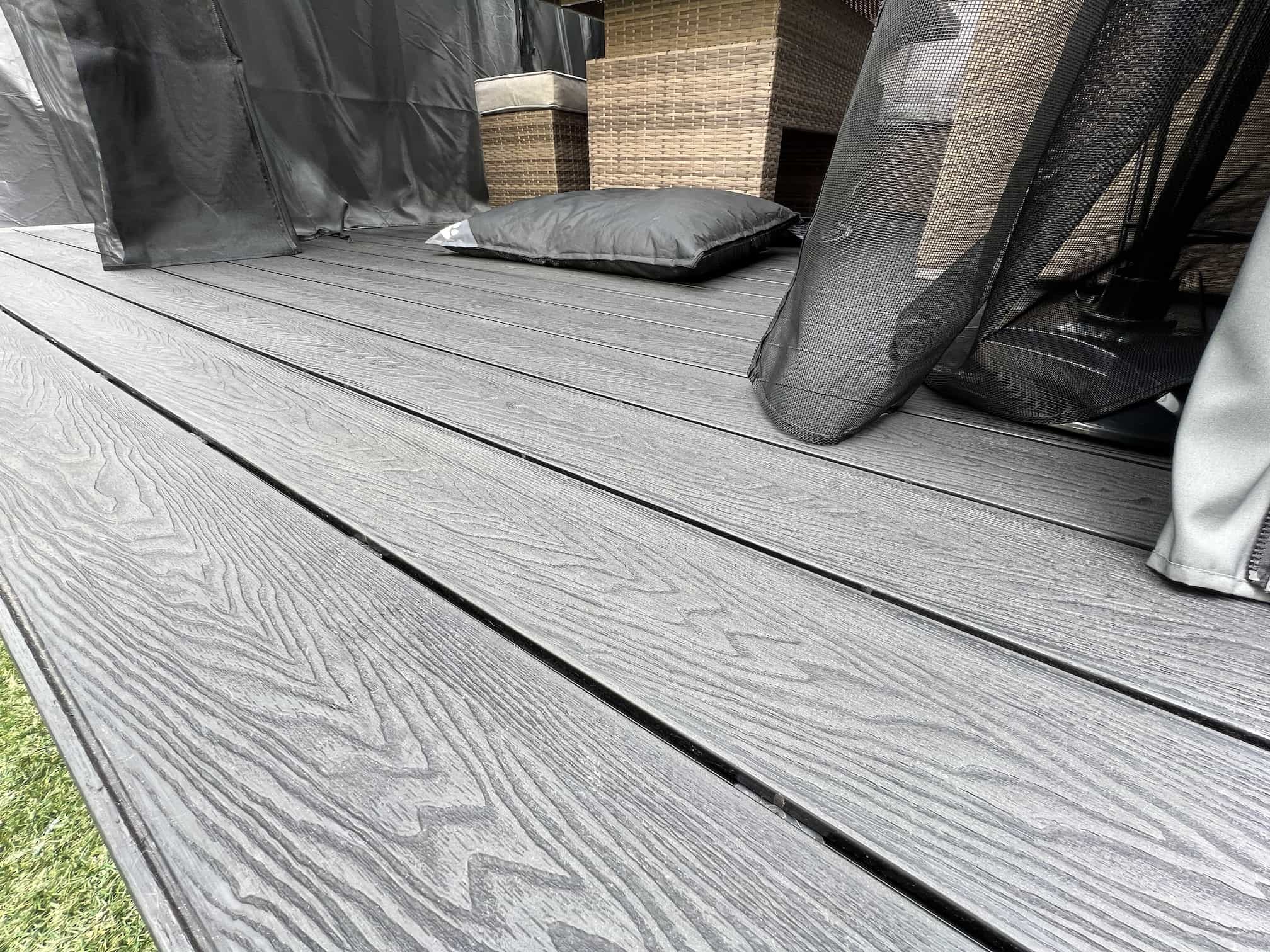
If the work is starting to feel like a tax you pay every spring, that's a fair feeling. Wood decks reward maintenance with character; composite and PVC alternatives reward it with skipped weekends. The composite decking buyer's guide walks through what changes if you're ready to consider that swap on the next rebuild — but for the deck you have today, a careful refinish every few years is the deal you've signed.
Angela Nightingale is the Senior Editor at Homeowner.ca with two decades of experience in digital publishing and content strategy. She has owned two homes, taken on her share of DIY projects, and learned what most guides fail to mention. She writes from the belief that the best home guidance comes from people who have lived through the decisions — and her goal is always to leave readers feeling confident, not overwhelmed.
Yes, if your deck is roughly 200 to 400 square feet, structurally sound, and has a finish that's faded rather than heavily peeling — and if the forecast gives you two consecutive days with highs between about 12 °C and 28 °C and no rain. Larger decks, peeling solid stains, or uncooperative weather push the project into a long weekend or beyond.
Not always. A faded clear sealer, toner, or well-bonded semi-transparent stain usually only needs a deck cleaner-brightener plus a thorough sanding. Full chemical stripping is reserved for peeling solid stains or thick layers that won't sand off cleanly.
Eighty grit is the standard starting point, with 60 grit reserved for badly weathered or heavily damaged areas. Avoid going finer than 100 to 120 grit — over-polishing closes the wood's pores and reduces stain absorption.
No. New pressure-treated lumber is saturated with preservative and water from the mill and typically needs to season for several months. If water still beads on the boards or they feel cold and damp deep in the grain, wait — or apply only a clear water-repellent labelled for new pressure-treated wood.
Most Canadian guidance and manufacturer data sheets converge on a 10 °C to 25 °C target band, with 15 °C to 21 °C as the sweet spot. Avoid direct hot sun, humidity above about 70 percent, and any forecast with rain in the next 24 to 48 hours.
Coverage varies by product. Behr Premium Semi-Transparent covers up to about 300 sq ft per U.S. gallon for two coats. Sansin Classic runs roughly 200 to 300 sq ft per litre per coat, and Benjamin Moore ARBORCOAT closer to 100 to 120 sq ft per litre per coat. For a 250 sq ft deck, plan on one U.S. gallon of a Behr-style product or 2.5 to 3 litres of a Sansin-style product, plus a small buffer.
Yes, but the Environment and Climate Change Canada VOC Concentration Limits for Architectural Coatings Regulations cap how much volatile organic compound an oil-based stain can contain, which is why many older U.S. oil-heavy formulations aren't sold here. Cabot Oil-Based Wood Toned Deck & Siding Stain, for example, is stocked at Canadian Tire and meets the federal limits.
Industry guidance points to every one to three years, depending on stain opacity, UV exposure, and climate — even when the can advertises longer. Clear and toner finishes at the shorter end, semi-transparents in the middle, solids longest. Top railings and walking-path centre boards always need attention before the perimeter does.
Read the label first — requirements vary by chemistry. At minimum, work outdoors with chemical-resistant gloves, goggles, and an N95 dust mask during sanding. For sodium hydroxide–based strippers or any label specifying respiratory protection, an organic-vapour respirator rated for the chemical is the right call.