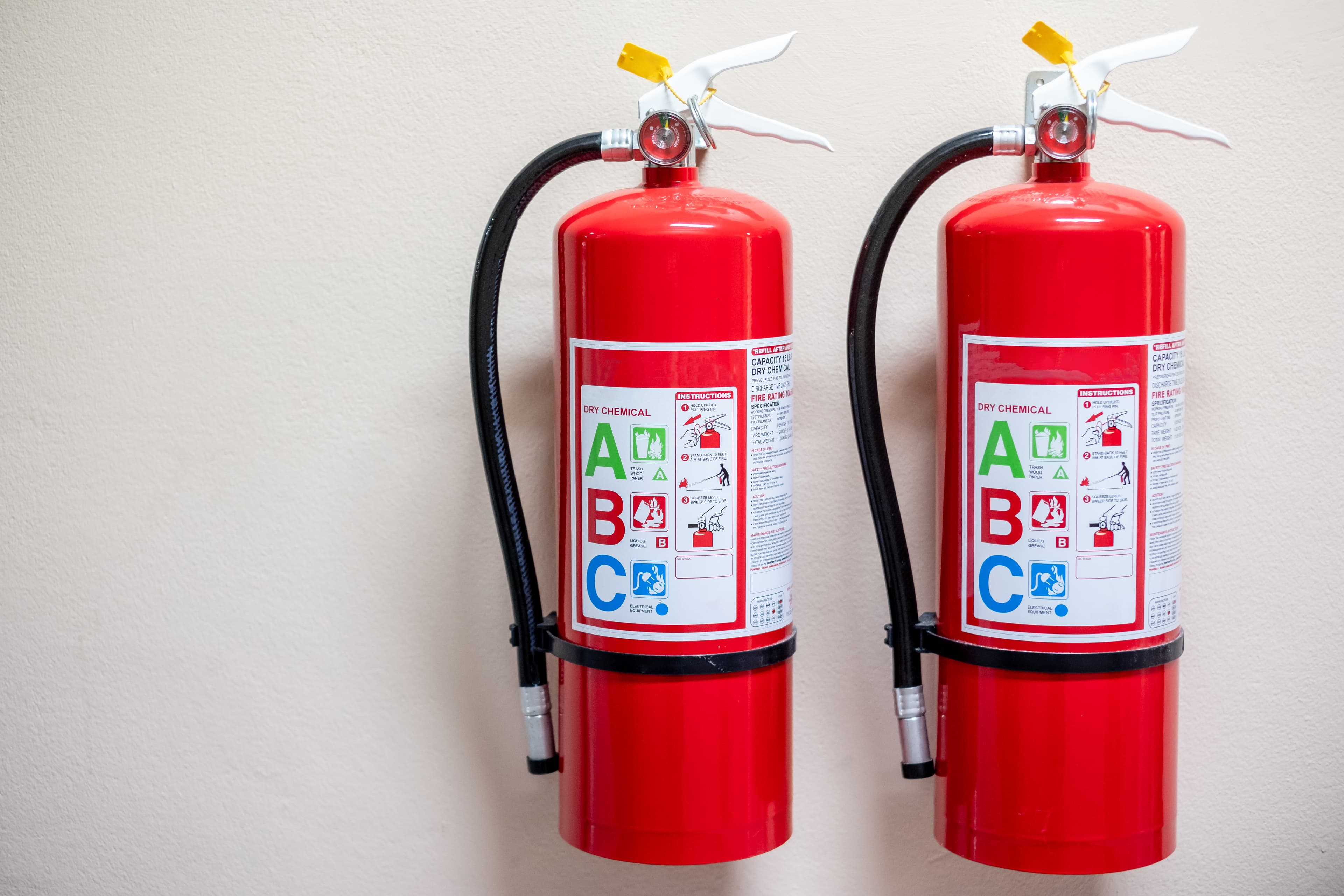
“ABC” means the extinguisher is rated for Class A (ordinary combustibles), Class B (flammable liquids/gases), and Class C (energized electrical equipment). It’s a common multipurpose rating for homes and many light-commercial settings.
A Canadian Field Guide to Decoding What’s on the Cylinder and Verifying It’s Ready

Twin ABC-rated extinguishers stand ready, where label codes and inspection tags decide real-world reliability. (Credit: Shutterstock.com)
If you’ve ever picked up a fire extinguisher and felt like the label was written in code, you’re not alone. Between letter classes, number ratings, certification marks, stamped dates, and a dangling inspection tag, it’s easy to miss what actually matters—especially because you usually only look at an extinguisher when you’re mounting it, moving it, or doing a quick check.
The good news is that most extinguisher labels follow a predictable structure. Once you know what you’re looking at, you can answer the practical homeowner questions fast: Is this the right extinguisher for my risks? Is it certified for Canada? Is it still in its service life? Is it pressurized and untampered?
For small business owners, the stakes are higher. You’re not just checking readiness—you’re also checking whether an extinguisher appears to be maintained and documented in a way that aligns with common Canadian inspection expectations. A tag that’s incomplete or confusing is a signal to dig deeper.
In this guide, you’ll learn how to read the label like a checklist: fire classes, rating codes, weight and capacity cues, certification marks, date clues, gauge interpretation, and the story told by service tags. If you only do one thing after reading: take five minutes to inspect your extinguishers now—before the moment you actually need one.
As baseline consumer guidance, the Ontario Association of Fire Chiefs recommends looking for a multipurpose ABC extinguisher and checking for a Canadian certification label, which is exactly the kind of label literacy this article is designed to build.

Start with the big letters. The “class” is the first filter: it tells you what kind of fuel the extinguisher is built and tested to fight.
A classification reference from McGill University outlines the common portable extinguisher classes in Canada as:
For most homes, the label you’ll see most often is ABC (multipurpose). That’s because the usual household hazards fit into A, B, and C buckets: paper/wood, flammable liquids, and energized electrical equipment.
Where homeowners get tripped up is assuming “ABC” means “safe on everything.” It doesn’t. If you’re dealing with a true Class D (metal) risk or a Class K cooking-oil risk, you’re into specialized extinguishers—and the label will say so clearly.
If you keep an extinguisher in or near a kitchen, the “Class K” label isn’t marketing—it’s a clue that the unit is designed for cooking oils and fats, which behave differently than wood, paper, or gasoline.
Once you know the class letters, the next line to decode is the rating format, often written like:
2-A:10-B:C
or
3-A:40-B:C
This is where many people make an understandable mistake: they treat those numbers like a “size label,” the way you might compare 2 lb vs 5 lb. In reality, the number-letter rating is a performance rating from standardized fire tests.
A ratings explainer from Kidde Canada clarifies that the letters identify the fire classes and the numbers indicate relative firefighting capacity, so a higher number generally means greater extinguishing power rather than simply a bigger cylinder.
Here’s how to think about the numbers in practical terms:
To make that less abstract, municipal guidance from the Town of Amherstburg explains that the Class B numeric rating approximates the square footage of a flammable-liquid fire an untrained person might be expected to extinguish.
If you compare two extinguishers that both say “ABC,” don’t stop there—read the numbers. “ABC” tells you the types of fires; the numbers tell you the tested capacity.
Labels usually give you at least two “size” signals:
The tradeoff is simple: more agent usually means more capacity, but also more weight. If the extinguisher is too heavy for the person most likely to grab it, the rating doesn’t help much.
A weight-and-rating reference from Kidde links common multipurpose ratings to typical dry-chemical agent weights, which is a useful way to sanity-check what you’re buying and what you’re mounting on a wall.
Here’s a practical “what you’ll commonly see” snapshot:
The key is to match the extinguisher to the user and the location:
If you want a real-world example of the “common baseline,” a product listing like the Kidde 2A:10BC Pro Series from Home Depot Canada shows the kind of rating and size many Canadian homeowners recognize.
Try a “one-hand lift test” before you mount it. If you can’t comfortably lift and aim it with control, consider a smaller unit in that location and a larger one where you’ll have better leverage and space.
If the class and rating tell you what an extinguisher should do, the certification mark tells you whether it has been evaluated and listed for a market and standard—critical if you’re buying online or inheriting an extinguisher with no box or paperwork.
In Canada, one common “good sign” is a ULC Listing Mark. A description of the traditional ULC Listing Mark from UL Solutions Canada explains that certified products may show the ULC-in-a-circle symbol plus “LISTED,” along with identifiers like a company name or file number and an issue/control number.
You may also see a UL mark that indicates Canadian certification (often called “cUL” marks). A guide to certification mark variations from UL Solutions notes that a UL mark with a Canadian indicator (such as a preceding “C” or “CA” country code on enhanced marks) signals certification to Canadian standards for Canada.
If you want a “why do labels mention standards” explanation, an overview of extinguisher testing from UL Solutions describes how extinguisher ratings are based on UL and CAN/ULC standards and are used in contexts like NFPA 10 and Canadian fire code expectations, which is why you sometimes see standard references printed on the label.
And if your label references CAN/ULC-S508 specifically, the standard listing for CAN/ULC-S508 in the Standards Council of Canada database from SCC-CCN is a clue that the extinguisher’s rating relates to a formal Canadian test framework.
What to do with all that in real life:
A label that looks “official” isn’t the same as a label that is actually backed by a recognized listing mark. Certification marks are meant to be verifiable identifiers, not decorative graphics.
Dates on extinguishers are confusing because there can be multiple “date-like” markings:
A practical starting point is knowing where the manufacturing date actually is. A support guide on locating extinguisher information from Kidde Canada explains that the manufacturing date often isn’t printed prominently on the front label and may be stamped on the cylinder or encoded in a longer serial/model code, with specific digits identifying the year.
Once you can find the manufacturing year, you can interpret “age guidance” correctly. A refill and replacement page from Kidde Canada states that if the pressure gauge is in the green/full area and the manufacture date is less than 12 years ago, the extinguisher is still considered good—implying that age can take an extinguisher out of the “good” category even if the needle looks fine.
Now add the “why 12 years comes up in service tags” layer, especially in workplaces. An Ontario-focused summary of maintenance milestones from Fire Service Pro describes NFPA 10-aligned expectations such as internal maintenance at 6 years for some stored-pressure rechargeable dry-chemical units and hydrostatic testing at 12 years, while non-rechargeable dry-chemical extinguishers are typically removed from service rather than recharged at the 12-year mark.
A second Ontario maintenance explainer from Peterborough Fire Extinguishers reinforces the practical meaning of those intervals for businesses: some extinguishers get opened and maintained internally at the 6-year point, and then face a hydrostatic shell test around the 12-year point depending on type.
Finally, it helps to zoom out and remember that extinguishers are part of a broader category of safety equipment that ages out. A lifespan overview from National Fire Supply discusses lifespan considerations for fire safety equipment, which is a useful reminder that “it looks fine” is not the same as “it’s still within expected service life.”
If you can’t confidently locate the manufacturing date or decode the year, treat that as an information gap—not a green light. In practice, uncertainty about age is often a reason to get the extinguisher assessed by a service provider.
Most common home and light-commercial extinguishers are stored-pressure units with a gauge. The gauge is one of the fastest checks you can do—but only if you interpret it correctly.
A gauge-reading primer from National Fire Supply explains the typical colour-zone logic: the green zone indicates the extinguisher is properly pressurized, while a needle in the left red zone indicates under-pressure and a needle in the right red zone indicates over-pressure—both conditions that call for service.
Here’s the homeowner-friendly rule:
Take a clear phone photo of the gauge and the manufacturing code the day you install the extinguisher. If you ever need to prove “what changed” over time, that photo becomes a baseline.
You don’t need tools to catch most problems early. A quick monthly routine is about confirming the extinguisher is present, visible, pressurized, and untampered.
A workplace-focused inspection overview from FC Fire describes a practical monthly check that aligns with common Canadian expectations: confirm access and visibility, check the gauge and condition, verify the pin and tamper seal, check the hose/nozzle, confirm annual inspection timing on the tag, and then document the check.
Use that logic as a repeatable flow:
Confirm it’s accessible and visible
Stand where you’d normally approach it. Make sure it isn’t blocked by boxes, coats, or stored materials. If you have multiple extinguishers, confirm the one you’re looking at is the one you think it is (location and numbering matter in businesses).
Confirm the label is readable and facing outward
You shouldn’t have to rotate the extinguisher to read the operating instructions. If the label is peeling or unreadable, replace the label if possible or replace the extinguisher—because in an emergency, unreadable instructions are a real usability issue.
A fire protection checklist from the Canadian Centre for Occupational Health and Safety emphasizes the importance of having extinguishers clearly marked and accessible, which is exactly what this step is checking.
Read the gauge
Needle in green is the minimum “ready” condition. Red means remove from service and replace or service.
Check the pin and tamper seal
You want the pin seated and the seal intact. A missing seal doesn’t automatically mean the extinguisher was used, but it does mean you can’t trust it as “untouched.”
Check the hose/nozzle and body condition
Look for cracks, blockages, dents, heavy corrosion, or anything that suggests physical damage. Don’t ignore corrosion under plates or brackets if you can see it.
Check the tag or log (especially for workplaces)
Confirm the most recent monthly check is recorded and that annual service appears current if you’re in a setting that requires it.
Document the check
Initial the tag or log, or note it in your maintenance tracker. Consistency is what makes tags useful.
A frequency and scheduling guide from FC Fire provides additional context on how monthly checks, annual inspections, and longer-term maintenance fit together in Ontario practice, which helps explain why tags sometimes show different “layers” of inspection.
For homeowners, manufacturer guidance can reinforce the same habit. A service-interval overview from Kidde Canada explains that residential extinguishers should be visually inspected monthly and that commercial extinguishers typically follow monthly, annual, and longer-term maintenance intervals aligned with NFPA 10.
If you have more than one extinguisher, write the room name (or an extinguisher number) on the tag and keep a simple list in your home maintenance notes. That way, when you do your monthly check, you’re verifying coverage—not just checking whichever unit you happened to notice.
In a business setting, a professional visit typically does more than a visual glance. Technicians may verify correct placement, accessibility, pressure, parts condition, and that the extinguisher meets relevant code and manufacturer expectations—then they update the tag and provide documentation.
A service overview from Marley Fire Protection describes providing inspection and maintenance services and documentation as part of ongoing fire protection support, which matches what many businesses experience as “tag updates plus paperwork.”
Similarly, a services outline from PF Protection describes professional fire protection services that can include extinguisher inspection programs and reporting, which is why businesses often end up with both a tag on the extinguisher and a separate inspection record.
From a label-reading perspective, the takeaway is simple: after a professional service, you should expect the extinguisher to have an updated tag and sometimes additional documentation (like a certificate or report) that matches what’s hanging off the unit.
Because extinguishers are safety equipment, counterfeits are not a harmless knockoff. A counterfeit label can look convincing while hiding the fact that the unit hasn’t been evaluated or listed.
A public warning from UL Solutions describes cases where fire extinguishers bore counterfeit UL and ULC marks or counterfeit references to testing standards, and it recommends removing such products from service because they were not evaluated by UL/ULC.
Practical homeowner and small-business red flags include:
The safe default is simple: if the certification mark looks wrong or the label quality is questionable, treat it as a verification required moment—not a “probably fine” moment.
If you suspect an extinguisher is counterfeit or misrepresented, remove it from service and replace it with a unit from a reputable Canadian supplier or have a qualified service provider assess it. In an emergency, you don’t get a second chance to find out your extinguisher wasn’t legitimate.
“ABC” means the extinguisher is rated for Class A (ordinary combustibles), Class B (flammable liquids/gases), and Class C (energized electrical equipment). It’s a common multipurpose rating for homes and many light-commercial settings.
Often it correlates with more agent weight, but the rating is ultimately a tested performance measure—not a simple “size label.” Two extinguishers can be similar in physical shape while still having different ratings depending on design and agent quantity.
In many consumer explanations, the Class B number is used like an approximate “coverage” indicator for a flammable-liquid fire. It’s best treated as a comparative guide: higher B numbers generally mean more capability on liquid-fuel fires.
Class C indicates suitability for energized electrical equipment. The key point is that you can use the extinguisher when electrical equipment is still energized, but you still need to consider what’s actually burning (often Class A or B materials) once power is shut off.
On many extinguishers, the year is stamped on the cylinder (often the bottom) or encoded in a longer serial/model code printed on the side. The label may not show it clearly, which is why checking the metal stamp or code matters.
No. Green typically means the unit is pressurized, but you still need to confirm the extinguisher is within its service life, untampered (pin/seal intact), and not physically damaged or corroded.
A rechargeable extinguisher is designed to be serviced and recharged by professionals after use or at maintenance milestones. A non-rechargeable (disposable) unit is typically removed from service at end-of-life rather than being recharged, even if it looks pressurized.
Those are common maintenance milestones for certain stored-pressure extinguishers, where internal maintenance and hydrostatic testing occur on longer cycles in addition to monthly and annual checks, depending on extinguisher type and workplace requirements.
At minimum, you should be able to see inspection dates, servicing/recharging dates if applicable, and who performed the work (person and servicing agency). A tag should help you understand maintenance history at a glance.
Treat it as a reason to verify. A credible tag should clearly identify the service company and the work performed, and you should be able to match it to invoices, reports, or your internal maintenance records.
Often it’s a ULC Listing Mark or a UL mark that includes a Canadian indicator. The mark typically includes a recognizable symbol plus listing language and identifiers like a file number or control number.
Poor print quality, obvious typos, vague certification claims without a credible mark, suspiciously low prices for high-rated units, and anything that suggests the label is mimicking a known brand without matching its normal branding and documentation.