Basement Leak Triage: The Signs That Tell You Where the Water Is Coming From
A Calm, Practical Framework To Narrow The Source—And Know What To Do Next
By
Published: March 22, 2026
Updated: March 23, 2026
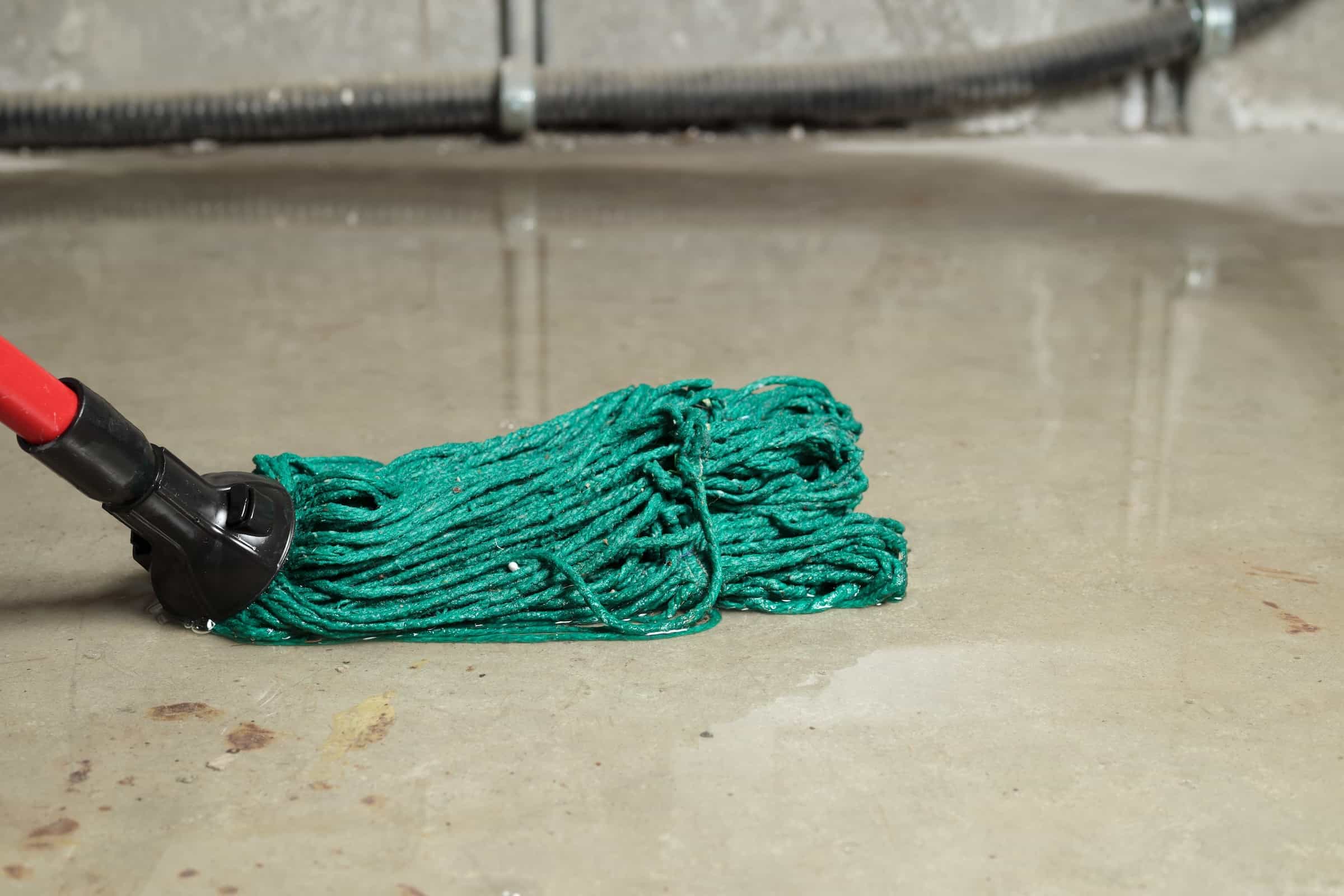
Mop strokes chase spreading puddles across bare concrete, where leak clues hide in plain sight. (Credit: Shutterstock)
Key Takeaways
•Start with safety: if there’s any chance water has reached electrical or gas equipment, treat the basement as unsafe until a professional says otherwise.
•The pattern matters more than the puddle: where water shows up (wall–floor joint, floor drain, ceiling stain) usually points to the source category.
•Your goal in the first day isn’t a perfect diagnosis—it’s to reduce damage, document evidence, and make the right call (plumber vs. utility vs. restoration vs. waterproofing).
A basement leak feels urgent because it is—but “urgent” doesn’t always mean “panic.” The fastest way to regain control is to triage the situation the same way you would a health symptom: stabilize first, then match what you’re seeing to the most likely causes, then decide who needs to get involved.
In Canadian homes, many basement water events cluster around storms, rapid snowmelt, and freeze–thaw cycles, and the City of Toronto’s basement flooding guidance highlights how often the trigger is drainage and water management around the foundation rather than a mysterious “random” leak. That’s good news, because it means your observations can be genuinely useful.
At the same time, not every wet basement is an exterior drainage problem. A slow plumbing leak can travel along joists and show up far from the actual break, and a sewer backup can look like “just water” until the smell or the entry point gives it away. A general reference like Baseline Inspections’ basement flooding overview reinforces that there are multiple common categories, which is exactly why a symptom-to-source checklist works.
This page is built for the first hour and the first day: safe actions, simple checks you can do without tools, clear “call now vs. schedule” thresholds, and a clean handoff to the right professional. You’ll see phrases like “often indicates” on purpose—your goal is a confident shortlist, then confirmation by a qualified pro where needed.

Fast Safety + Damage-Control (First Hour)
Start Safe, Then Get Control Of Water, Photos, And Air
If you do only one thing right, do this: treat safety as the first diagnostic step. Water changes the rules around electricity, gas appliances, and contamination.
A simple first-hour sequence (in order):
Pause at the top of the stairs. Look for water depth and whether it’s near outlets, baseboard heaters, a furnace, or an electrical panel.
If you suspect a plumbing supply leak, shut off water at the nearest shutoff or the main.
Stop using drains/fixtures if there’s any sign of backup (toilets bubbling, floor drain rising, multiple slow drains).
Start documentation early (photos/video, water level, where it appears first, weather conditions).
Begin damage control only when it’s safe: move belongings to a dry area, lift items off the floor, and plan for drying.
Warning
Ontario’s Electrical Safety Authority in its flood safety guidance warns that if floodwater has reached electrical equipment, you should stay out because electricity can travel through water and wet surfaces and cause severe shock.
What “safe enough to enter” usually looks like:
The floor you’ll stand on is dry.
You are not reaching past wet surfaces to access a switch, outlet, or panel.
There’s no sewage odour, sludge, or drain overflow.
For breaker panels in particular, Government of Canada guidance on preparing for power outages emphasizes avoiding contact with electrical systems when you’re wet or standing on damp ground, which is why it’s smarter to step back and call for help if there’s any doubt.
If water has reached plugs/outlets or gas-fired appliances, the City of Ottawa’s basement flooding page points residents toward utility support and inspection before using electrical or gas equipment again, which helps take the “who do I call?” guesswork out of the moment.
Damage control that’s worth doing early (when safe):
Photograph before you move things so you preserve evidence of water level and entry points.
Lift porous items (cardboard, fabric bins, area rugs) off the floor.
Separate wet from dry so you don’t spread contamination.
Plan to dry quickly: Health Canada’s flood cleanup indoor air quality guidance notes homes are much less likely to grow mould if they’re dried within about 48 hours, which is why same-day drying plans matter.
Common “don’t” moves that cause expensive secondary damage:
Don’t wade in to “just grab a few things” if water might be energized.
Don’t run extension cords or plug in fans/dehumidifiers in a wet area until power safety is confirmed.
Don’t keep using sinks, showers, laundry, or dishwashers if you suspect a main drain issue.
Don’t start ripping out finished materials until you’ve taken clear photos for documentation and triage.
Advertisement — Article Continues Below
Symptom-to-Source Checklist
Match The Pattern You See To The Most Likely Source Category
You’re looking for three clues: where the water shows up, when it shows up, and what it looks/smells like. Use these pairings as “often indicates,” not as a final diagnosis.
If Water Is Clear And Appears Along The Wall–Floor Edge After Rain Or Snowmelt
Water that shows up along the base of a foundation wall often points to exterior drainage, hydrostatic pressure, or a path in at the joint—not necessarily a burst pipe. Basement water specialists like Nu-Site Group in their warning signs of basement water problems describe staining or rust marks near the wall–floor joint as a common indicator of groundwater infiltration at the base.
Often indicates:
Exterior grading pushing water toward the home
Downspout discharge too close to the foundation
Foundation cracks or gaps at the wall–floor joint
Weeping tile/drainage system issues
Sump pump or discharge problems (if you have one)
Useful next observation: Does it happen only during/after storms, or even in dry weather?
If Water Is Brown/Murky And Coming Up From A Floor Drain Or Fixture
This pattern is a red flag because it’s frequently a backup, not seepage. The City of Toronto’s basement flooding guidance distinguishes clearer water entering near walls from muddy or brown water coming up through drains or fixtures, which is one of the fastest ways to sort “outside in” from “pipes and sewers up.”
Often indicates:
Sanitary sewer backup or a blocked service line
A main drain obstruction (sometimes triggered by heavy rain)
A problem affecting multiple fixtures at once
If Multiple Drains Are Slow, Toilets Gurgle, Or You Smell Sewage Near A Drain
Early warning signs tend to show up as “systems behaviour,” not a single puddle. Brokerlink’s sewer backup overview describes indicators like multiple slow drains, gurgling toilets, odours near drains, and fixtures affecting each other, which is why you should stop running water and get help quickly when the whole house seems “off.”
Often indicates:
Developing main drain blockage
Sewer lateral issue on private property
Municipal surcharge issues during major storms (varies by neighbourhood)
Important
If you suspect a sewer backup, guidance like Flood Services Canada’s explanation of what causes basement sewer backup supports treating the water as contaminated and avoiding DIY cleanup until you know what you’re dealing with.
If You See White, Chalky Powder On Concrete Or Masonry (Even Without Active Drips)
That powdery residue is a clue that moisture has been moving through the wall and evaporating. G.W. Savage’s write-up on signs of basement water damage explains efflorescence as mineral deposits left when water migrates through concrete or masonry, which is why recurring deposits matter even if the floor looks dry today.
Often indicates:
Chronic moisture seepage (past or ongoing)
A foundation wall that is drying to the inside
Conditions that can support hidden mould behind finishes
If It Smells Musty Or Earthy, But You Don’t See A Leak
Smell is often your earliest “instrument.” Restoration Mate’s guide on musty basement smells points to musty odours as a strong signal of dampness and potential hidden mould, which is why odour alone can justify further checks behind stored items and along finished walls.
Often indicates:
Slow seepage that evaporates before pooling
Condensation and humidity problems
Hidden dampness behind drywall, insulation, or storage
Safe Observations That Often Clarify “Outside In” Vs. “Inside Out”
Think of these as yes/no filters that narrow your shortlist. They’re intentionally simple and low-risk, and you can stop as soon as you hit a safety boundary.
Correlation Checks (Timing Is A Clue)
Did it start during heavy rain or rapid melt? That points toward surface drainage, foundation seepage, or storm-related surcharge.
Did it start when nobody was home and no water was running? That leans away from a supply pipe leak and toward seepage or groundwater.
Does it spike when you run laundry or a shower? That leans toward a drain or sewer issue.
Brokerlink’s prevention-focused article on preventing flooding and sewer backup reinforces that tracking what was happening in the home and outside (storm vs. appliance use) is a practical way to separate drainage events from plumbing events.
Entry-Point Checks (Where It First Appears)
Walk the perimeter only if safe and look for the first wet spot, not the biggest puddle.
Wet at wall–floor joint: often seepage or exterior water management.
Wet around a floor drain: often backup or drain issue.
Ceiling stain below a bathroom/kitchen: often plumbing leak from above.
Wet under a window or in a corner: often window well or grading/downspout discharge.
If you’re trying to sanity-check exterior water management, a municipal resource like Utilities Kingston’s guide to protecting your basement from flooding emphasizes basics like keeping water directed away from the foundation, which is why downspout discharge location and splash patterns are worth a quick look.
System Behaviour Checks (Is It A Drain Problem?)
You don’t need tools to notice “connected symptoms.”
Check whether more than one drain is slow (sink + tub + basement drain).
Listen for gurgling when another fixture drains.
Look for water level changes in the toilet bowl after other fixtures run.
A plumbing-focused explainer like AbsoluteDP’s notes on drain backup symptoms describes multi-fixture slowdowns and backup behaviour as warning signs, which is why “it’s not just one drain” should change your urgency level.
Sump/Discharge Reality Check (If You Have A Sump Pump)
Without touching electrical components:
Look for standing water in the sump pit that seems unusually high.
Check whether the discharge pipe appears blocked, frozen, or disconnected.
Note whether the leak coincides with power outages or tripped breakers.
If the scenario is trending toward a sewer backup, Mr. Rooter’s overview of common causes of sewer backups highlights how blockages and system constraints can show up as basement-level symptoms, which supports calling a plumber sooner rather than trying repeated flushes or drain experiments.
Tip
When in doubt, stop testing the moment you suspect electricity risk, gas risk, or sewage contamination—your best “no-tool test” is knowing when to hand off.
Advertisement — Article Continues Below
Urgency Thresholds: Call Now vs. Schedule
A technician prepares for basement waterproofing by inspecting the sump pump and ensuring all tools are ready for use in a DIY environment. (Credit: Shutterstock)
A Calm Rubric For What Needs Immediate Help
Use this as a practical sorting tool. If any “call now” item is true, you’re not overreacting by escalating.
Call Now (Today / Immediately)
Call a professional or utility now if any of the following are true:
Structural red flags (buckling walls, shifted flooring, unusual cracking after a flood event)
Fast-rising water or repeated inflow you can’t stabilize
High-risk household members (asthma, allergies, immunocompromised, pregnant people, infants) who could be affected by mould or contaminants
Public health guidance like North Western Health Unit’s note on potential health risks related to floods stresses that floodwaters may contain chemicals and raw sewage, which is why it’s reasonable to treat unknown water as contaminated until proven otherwise.
If you’re noticing mould or suspect hidden growth, a public health resource like the North Bay Parry Sound District Health Unit’s page on mould and health outlines respiratory irritation and allergic reactions as possible impacts, which supports moving vulnerable people away from the affected area early.
For mould size thresholds, Healthy Environment for Kids in its guidance on flooding and mould notes that large or recurring mould problems should be assessed and addressed by qualified professionals, which is a helpful line to draw if you’re seeing significant spread or repeat regrowth.
Schedule Soon (Within 24–72 Hours)
Scheduling is usually reasonable when:
You have a small, contained damp area with no ongoing inflow.
The water appears clean, and there’s no drain involvement.
You can keep the area isolated and drying without safety risks.
The issue is repeatable and mild (for example, a small seep after heavy rain), suggesting you can gather better observations for a contractor.
For safety after a flood and the “don’t reoccupy unsafe spaces” principle, PreparedBC’s guidance on what to do after a flood supports leaving and seeking help when there’s visible damage or unsafe conditions, which can remove the pressure to “push through” and DIY your way into risk.
Once you’ve stabilized and narrowed the likely category, you’ll save time (and usually money) by calling the right first contact—and giving them the evidence they’ll ask for anyway.
Who To Call (Based On The Category)
Here’s a simple handoff table you can follow.
What It Looks Like
Likely Category
Best First Call
What To Say / Share
Water at wall–floor joint after rain
Exterior drainage / seepage
Waterproofing/foundation drainage specialist (or a qualified inspector)
Where it appears first, rainfall timing, photos of staining/efflorescence
Ceiling stains or water under a bathroom/kitchen
Plumbing leak
Licensed plumber
Which fixture is above, when it worsens, photos of ceiling and any wet pipes
Brown water from floor drain, sewage odour, multiple slow drains
Sewer/drain backup
Licensed plumber (and possibly restoration)
Which drains are affected, whether you stopped using water, photos of floor drain/overflow
Water touched outlets/panel/furnace
Electrical safety
Licensed Electrical Contractor
Where water reached, whether power is on/off, photos from a safe distance
Finished basement soaked, insulation/drywall wet
Restoration/drying
Restoration company
Square footage affected, material types, how long it’s been wet
If you’re unsure whether the municipality is involved, the City of Markham’s page on basement flooding and sewer backup prevention clarifies that homeowners remain responsible for many private-property risks (including some sewer lateral issues), which helps set expectations for whether you’ll need a private contractor.
For sewer backup risk framing and why it’s treated as a serious event, RBC Insurance’s explainer on what a sewer backup is supports the idea that contaminated water requires different handling than clean seepage, which is why restoration support is often part of the call.
What To Collect (So Pros And Insurers Can Move Faster)
Treat this like building a “case file” in 10 minutes:
Wide photos of each room (showing water extent)
Close-ups of the suspected entry point (wall joint, drain, pipe, window well)
A short timeline: when you noticed it, what the weather was, what appliances were running
A quick inventory of damaged items (especially porous materials)
Receipts for emergency actions you paid for (pump-out, temporary stay, fans from a rental shop, etc.)
The Insurance Bureau of Canada’s seasonal reminder about preparing for flood season encourages prompt documentation and contact, which is why you shouldn’t wait for a perfect diagnosis before starting a paper trail.
Note
Coverage can vary by cause, and reporting early helps you understand your options; reporting like Global News’ overview of flood insurance in Canada underscores that overland flooding and sewer backup are often add-ons rather than automatic coverage.
For electrical handoff specifically, Ontario’s Electrical Safety Authority in its flood safety guidance emphasizes inspection by a Licensed Electrical Contractor when electrical systems may have contacted water, which is why this is not the moment for DIY electrical troubleshooting.
Advertisement — Article Continues Below
Conclusion
Basement leak triage is about narrowing uncertainty safely. Once you’ve answered a few high-value questions—Where did it show up first? What triggered it? Is it clean seepage or a drain/sewer event?—you can take decisive next steps without guessing.
If you’re feeling stuck, remember that “document + isolate + escalate appropriately” is a complete plan for the first day. You can schedule diagnostics for seepage patterns, but you should escalate immediately for any sign of sewage, electrical risk, or structural concerns.
If you need one final mental model to stay calm, use this: stabilize the hazard, then stabilize the building, then stabilize the paperwork. Post-flood safety messaging echoed in releases like the Newswire update where the Insurance Bureau of Canada urged safety after flooding reinforces that staying safe is the first priority, and everything else comes second.
If water is coming up from a floor drain or fixtures and looks/smells contaminated, treat it as a sewer backup; Flood Services Canada’s explanation of basement sewer backup causes supports using entry point and water character as quick triage signals.
Yes—odour can be an early indicator of dampness and hidden mould, and Restoration Mate’s guidance on musty basement smells frames persistent mustiness as a reason to investigate further even before you see puddles.
Don’t rush into a potentially energized area; local safety messaging in coverage like CK News Today’s article on storm safety tips reinforces avoiding flooded areas where electricity may be present and getting the right help instead.
The risk rises quickly when materials stay wet, and Health Canada’s flood cleanup indoor air quality guidance notes drying within about 48 hours makes mould growth less likely.
That residue is often efflorescence (mineral deposits left by moving moisture), and G.W. Savage’s explanation of basement water damage signs describes it as a clue that water has been travelling through masonry even if you don’t see standing water.
Multi-fixture symptoms can point to a developing main drain issue, and AbsoluteDP’s overview of drain backup warning signs supports treating “whole-house” drain changes as a higher-urgency pattern.
Blockages and system constraints are frequent culprits, and Mr. Rooter’s summary of common causes of sewer backups is consistent with calling early when you see gurgling, backups, or multi-drain slowdowns.
Many risks on private property remain the homeowner’s responsibility, and the City of Markham’s page on basement flooding and sewer backup prevention outlines that boundary in practical terms.
Floodwater can contain contaminants and prolonged dampness can worsen respiratory issues, and the University of Waterloo Partners for Action note on health effects of flooding supports taking exposure and cleanup conditions seriously.
As early as possible once you’ve stabilized safety and started documentation, because the Insurance Bureau of Canada’s reminder about preparing for flood season encourages prompt contact and record-keeping after flood events.