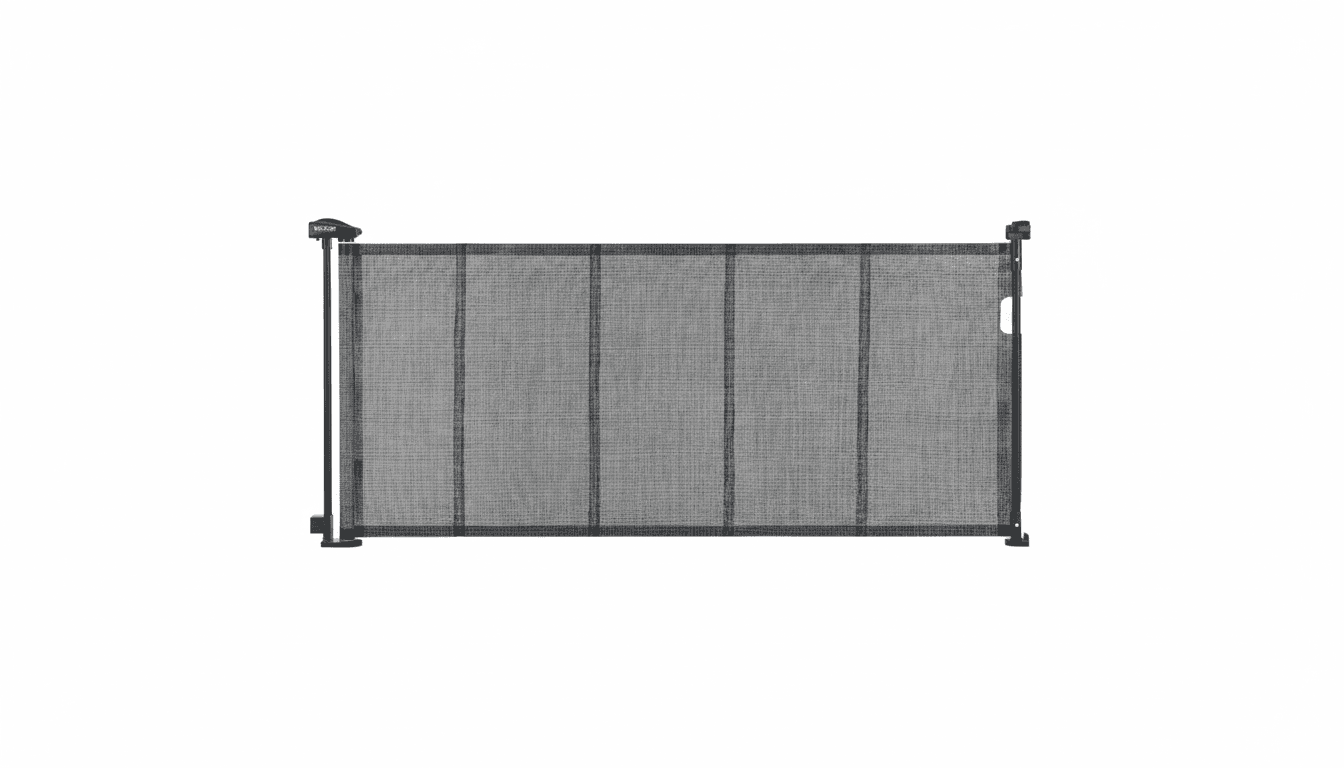
The March 2026 recall points to an easy-to-miss floor-gap flaw that Canadian families should check on any retractable mesh gate.

A simple and efficient expandable safety gate designed to secure household areas, ideal for child and pet safety. (Credit: Homeowner.ca)
On March 20, 2026, Health Canada’s recall notice said Vevor Retractable Baby Gates in model families YJ-3355, YJ-3371, and YJ-33110 can allow a child’s torso to fit through the opening between the gate and the floor, creating a risk of serious injury due to entrapment. The notice says about 1,660 units were sold in Canada from November 2023 to March 2026, and that no incidents or injuries had been reported in Canada as of March 13.
That makes this a recall about more than one brand name. Baby gates are ordinary fixtures in Canadian homes with toddlers, pets, and split-level layouts. What this notice highlights is a failure mode that many parents would not naturally check for: not whether the mesh looks closed, but whether the bottom edge of the gate leaves enough space for a child’s torso to slip through.
That distinction matters because retractable gates are often bought for flexibility and a cleaner look. They can feel less bulky than swing gates, and many are sold through online marketplaces or direct-to-consumer sites where the buying decision happens fast. This recall is a reminder that the key safety question is not whether a gate looks tidy in the doorway, but whether it actually blocks a child the way a gate is supposed to.
The recalled products are Vevor retractable mesh baby gates sold in black, grey, and white. Across the recalled line, the gates are about 34.2 inches (87 cm) high and use a retractable screen mounted between side posts. “Vevor” is printed on a label on the corner post, and the model number appears on the product packaging and in the user manual.
Here is the quick ID check:
If your gate matches that general description, do not rely on memory or colour alone. Check the label on the post, then confirm the model number against the packaging or manual if you still have it. A lot of retractable gates look similar at a glance, especially in online listings, so the model number is the fastest way to separate “looks like it” from “is it.”
This is also why the sales window matters. These gates were sold in Canada over a long stretch, from late 2023 into March 2026. In practical terms, that means the recalled units could still be installed in homes that bought them months ago and have not thought about the product since the day it went up.

In the U.S. Consumer Product Safety Commission’s parallel recall, the agency said about 10,400 of the same gates were sold in the United States and that the product violates the mandatory standard for expansion gates and expandable enclosures because a child’s torso can fit through the opening between the gate and the floor. Like the Canadian notice, the U.S. recall said no incidents or injuries had been reported.
“Entrapment hazard” can sound abstract, but the mechanism here is fairly easy to picture. A child does not need to pass fully through the gate for the situation to become dangerous. If the lower opening admits the torso, the child can end up wedged, pinned, or hanging in a way the gate was never meant to allow. That is why regulators focus so closely on opening size and geometry, not just on whether the gate latches.
Retractable designs can make this harder to spot than a rigid gate problem. A mesh panel can look flat and secure from a standing adult’s viewpoint, while the real issue sits right where the barrier meets the floor. In day-to-day use, that is exactly the kind of detail a tired parent or caregiver might never notice until a recall points it out.
As Health Canada’s consumer instructions explain, owners should immediately stop using the recalled gate, destroy it by cutting through the mesh, and send a photo of the destroyed gate to recalling@vevor.com to obtain a full refund from MARIFEL LTD. The recall notice also lists a toll-free contact number, 855-599-6320, for consumers who need more information.
A recalled gate should not be resold, donated, posted in a neighbourhood group, or handed down to another family. In Canada, recalled consumer products cannot legally be redistributed, sold, or even given away.
For families, the practical point is simple: do not move the gate to a “less important” doorway and keep using it. The problem identified in the recall is the opening geometry itself. A different room does not change that. If the gate is still installed, take it down. If it is in storage, do not reinstall it.
If you have experienced a problem with the gate, or if you notice a similar issue with another product, Health Canada says consumers can also file a report through the federal Consumer Product Incident Report process. That matters because recalls are not just enforcement tools; they also depend on households reporting hazards when they see them.
This is not the first VEVOR gate recall in Canada. In late 2024, Health Canada recalled a different VEVOR baby gate after warning that a child’s torso could fit through an opening between the gate slat and side wall, creating another entrapment hazard. That earlier case involved a different gate design, but the common thread is hard to miss: the risk came from an opening that let too much of a child’s body pass through.
And Vevor is not the only recent retractable-gate example. A Justia roundup of baby-gate recalls shows several 2025 and 2026 U.S. recalls involving retractable gates described with the same core hazard pattern: a child’s torso fitting through the opening between the gate and the floor. That does not prove every retractable gate is unsafe. It does show this is a known design failure mode, not a one-off oddity.
That broader context is where this story becomes useful for homeowners. Many lower-cost gates are bought through marketplace listings or direct-to-consumer storefronts where product pages emphasize width, colour, and price more than testing details. The safest takeaway is not panic and it is not brand-wide condemnation. It is vigilance. A retractable gate should be treated like a safety product first and a convenience product second.
If you have another retractable mesh gate at home, the right question is not “Does it look similar to Vevor?” The right question is “Does it show the same hazard pattern?”
A quick sense-check should focus on these points:
None of that is a substitute for an official recall check, and it is not a reason to modify the gate yourself. It is simply a better way to look at a product category that can hide its weakness in plain sight. For many families, that is the real value of this recall: it teaches you what to watch for before another close call teaches the lesson for you.