The Winter 2026 refresh gives homeowners a clearer starting point for seeing whether flood mapping exists for their area, who owns it, and what to do next

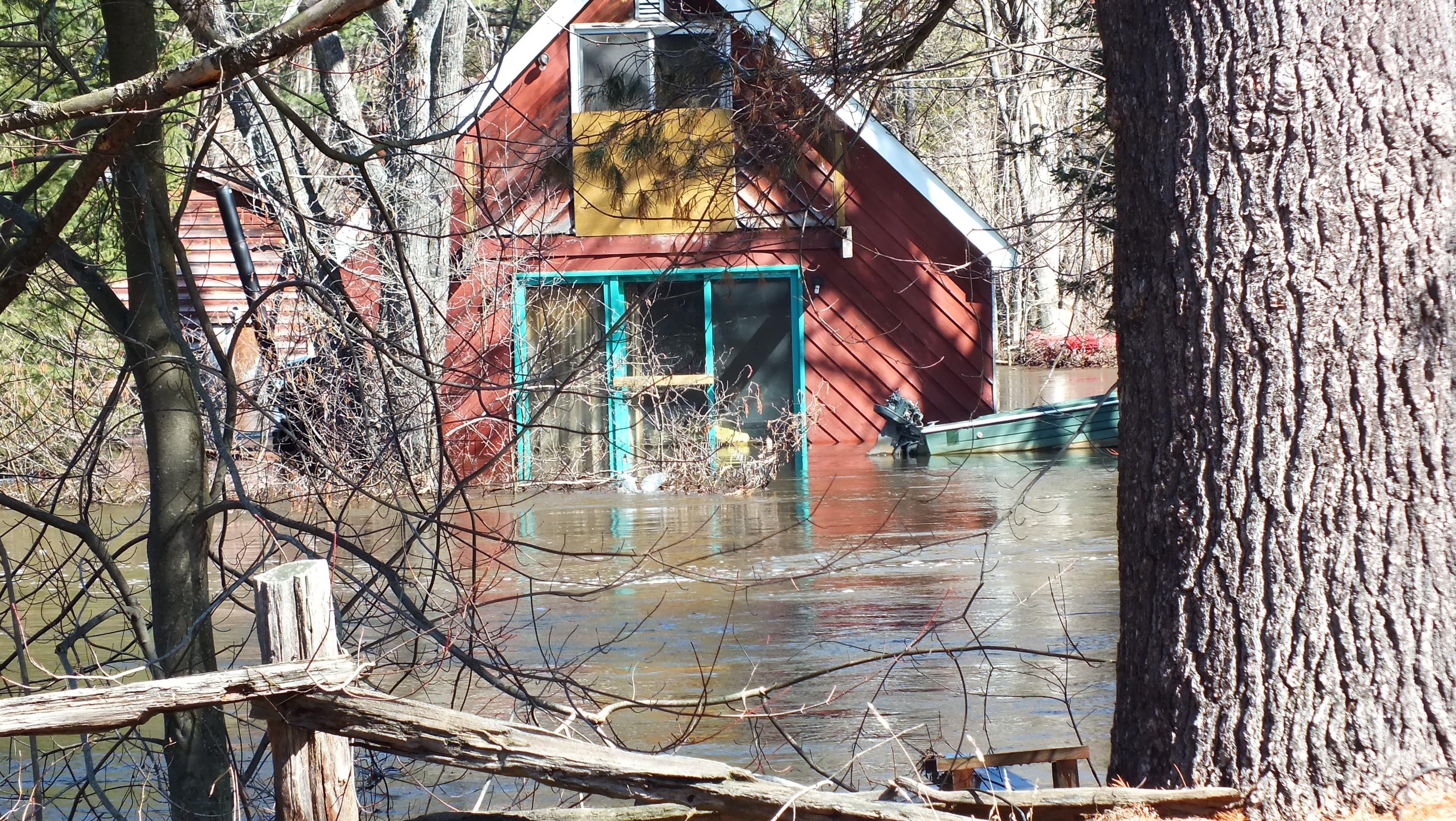
Rural home hemmed in by rising water as new hazard studies redraw Canada’s flood-risk lines. (Credit: Shutterstock)
On March 4, 2026, Natural Resources Canada’s Winter 2026 update to the Canada Flood Map Inventory reported 44 newly added flood hazard studies and refreshed information in 110 existing records. For homeowners, that is more than a database update. It is a practical improvement to a free, government-backed tool that can help answer a basic question many people still cannot answer confidently: has my area been mapped for flood hazard, and where do I find the official source?
That matters because flood exposure is still easy to underestimate. Many owners only start digging when they are buying, renovating, reviewing insurance, or reacting to a nearby weather event. The updated inventory lowers the friction of that first check. It gives people a more usable path into the records, the map owners, and the public links that sit behind Canada’s patchwork of federal, provincial, territorial, and local flood mapping.
This explainer focuses on the part homeowners actually need: what changed in the Winter 2026 release, what the inventory is and is not, how to use it through GEO.ca without getting lost in technical jargon, how to read the common fields at a high level, and what to do if your property is in or near a mapped hazard area.
According to Natural Resources Canada’s Winter 2026 update, the refresh added 44 new flood hazard studies — 28 partially funded through the Flood Hazard Identification and Mapping Program and 16 from other contributors or programs — and updated information in 110 existing studies. Those updates were not cosmetic. They included cleaner public links to flood maps, clearer data-owner details, and better references to provincial and territorial flood-mapping resources.
For homeowners, that improves the part of flood mapping that often feels most frustrating: finding the right record and the right organization. In Canada, flood maps are not housed in one simple nationwide repository with one standard local workflow. Some records sit with provinces and territories, some with municipalities, and some with other local or regional authorities. A stronger national inventory does not erase that complexity, but it does make it easier to navigate.
It also signals that this is an ongoing build rather than a one-time upload. In its Flood Hazard Identification and Mapping Program factsheet, the federal government says it is investing more than $227 million to expand flood mapping coverage and improve public access to flood hazard information. The Winter 2026 refresh fits that broader pattern: more studies, better metadata, and fewer dead ends for the public.
On GEO.ca’s Canada Flood Map Inventory page, the federal portal describes the tool as a way to see where Natural Resources Canada has collected flood hazard maps and how those maps can be accessed; it also makes clear that the inventory itself does not display flood zones or extents.
That distinction is the most important one in the entire tool. The inventory is closer to a library catalogue than a property-level flood score. It helps you find out whether mapping exists for an area, who owns the map, and sometimes where the files can be downloaded. It does not, by itself, tell you whether your exact house will flood, how severe flooding would be at your foundation, or whether a lender or insurer will interpret the risk in a particular way.
That is why the best way to use the inventory is as a starting point for better questions, not as a final verdict. It is excellent for orienting yourself. It is less useful if you expect a simple red-or-green answer for a single address.
The most homeowner-friendly approach is to start broad and narrow down. Begin with your municipality, neighbourhood, river reach, shoreline area, or another local reference point you can recognize easily. Once you find a study record that appears relevant, your goal is not to make an instant yes-or-no judgement. Your goal is to identify the right study, the right map owner, and the most current public source.
Once you find a relevant record, save more than a screenshot. The study title, the organization that owns the map, the link you used, and the date you accessed it are the details that matter later. They let you return to the same source, compare it with future updates, and use consistent language if you need to follow up with a local authority.
As GEO.ca’s disclaimer for the inventory explains, a blank result is not proof that your area has never been mapped. The inventory is not the official repository for every flood hazard map in Canada, so a missing record should send you to the responsible provincial, territorial, municipal, or other local authority for confirmation.
In Natural Resources Canada’s flood-mapping data hub, the department describes the inventory as a way to discover which regions have been mapped and how to access that material. Once you open a relevant record, five details tend to matter most for homeowners.
The practical reading rule is simple: treat every record as context, not a verdict. A study that touches the edge of your neighbourhood deserves attention, but it is not the same as a parcel-specific engineering opinion. Likewise, a broad regional study may tell you that flood hazard mapping exists without answering a narrow, lot-level question.
This is also where homeowners can save themselves time by resisting overconfidence. If the study appears old, if the coverage area is unclear, or if the map owner is not obvious, that is your signal to verify before making decisions. The inventory helps you identify where to ask. It does not remove the need to ask.
If your home appears in or near a mapped hazard area, the first useful move is documentation. Save the study title, the map date, the organization that owns the map, and the direct link to the record or file. Then ask whether the version you found is the current official map and whether there are companion materials, notes, or local updates that explain the mapped area in more detail.
For homeowners, that information can be useful in several ordinary situations. It can help you frame questions before a renovation, inform a purchase discussion, or support a more grounded conversation about insurance. The inventory does not replace local interpretation or professional advice, but it gives you something far better than a vague internet search: a named study, a responsible organization, and a traceable paper trail.
A sensible follow-up list is short. Ask whether newer mapping exists, whether the record you found is still the official version, and whether the mapped area includes your property or only the wider surrounding zone. If the answer remains unclear, keep the uncertainty visible rather than pretending the problem is settled. In flood awareness, honest uncertainty is better than false certainty.

The bigger reason this update matters is that a University of Waterloo survey of homeowners in designated flood-risk communities found that 94 per cent of respondents did not know they were at risk. That is the real gap the updated inventory helps close. Flood information may exist, but if people do not know where to look — or assume the answer should appear as one simple score — the practical value stays locked away.
The Winter 2026 refresh does not solve every problem. The inventory is still incomplete, some answers still live with local authorities, and some records will raise new questions rather than resolve them. But it gives homeowners a much more concrete first move: check whether mapping exists, identify the study, see who owns it, note how recent it is, and follow the record back to the official source.
For many households, that is the difference between not knowing where to begin and having a defensible starting point. And for a topic as consequential as flooding, a better starting point is not a small thing. It is how awareness becomes action.