The March 2026 deal gives the federal housing agency its second provincial partnership and points to a faster, more operational phase of affordable housing delivery.

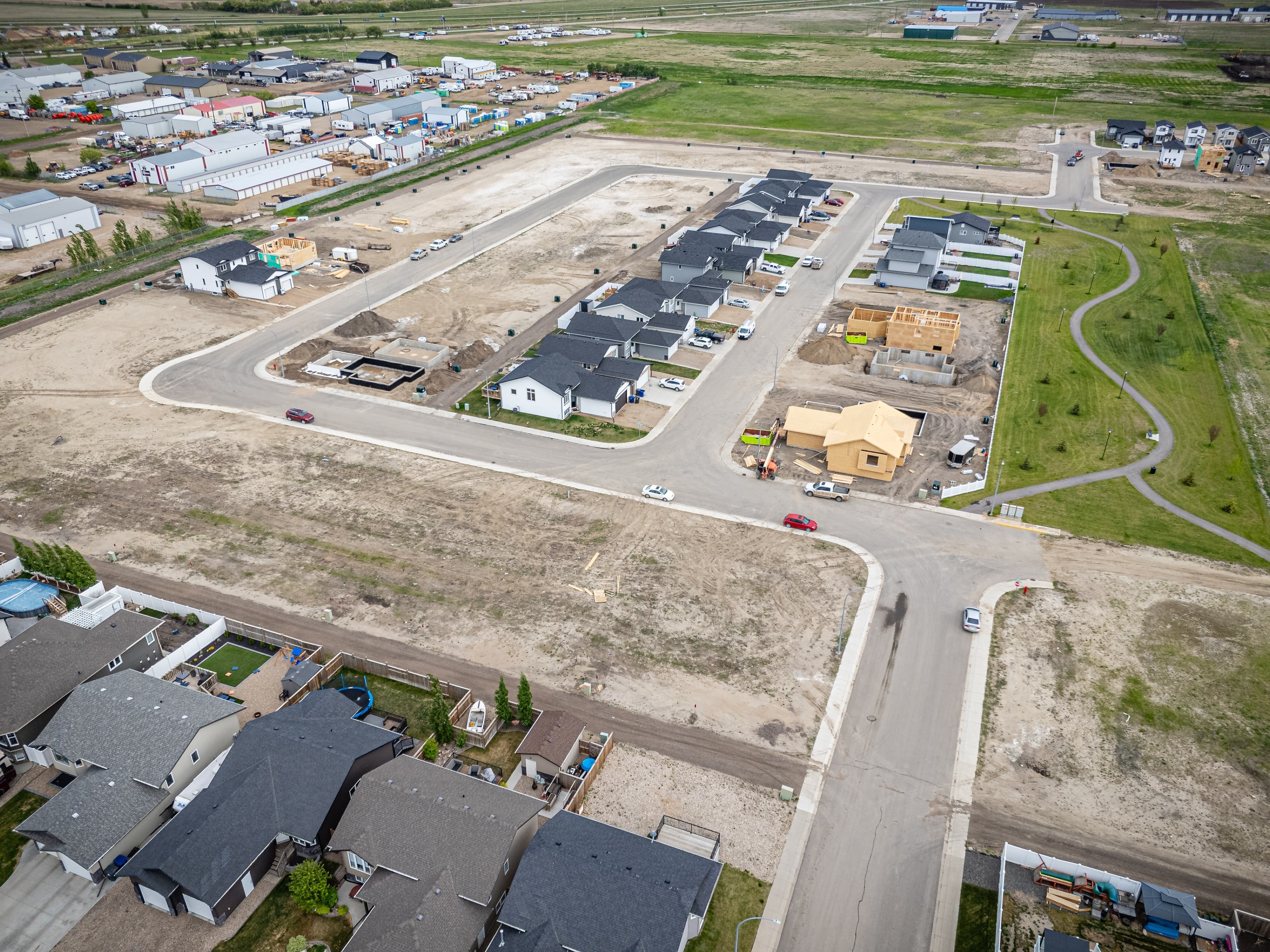
This aerial shot displays the expansion of a Canadian subdivision, highlighting its growth and potential for future residents. (Credit: Shutterstock)
According to the March 20 federal release, the Government of Canada and the Province of New Brunswick announced a partnership through Build Canada Homes to deliver up to 1,200 shovel-ready affordable homes, with the potential to scale that portfolio to 1,500. For a federal housing agency that is still in its early life, that is more than another headline. It is a visible test of whether Ottawa can turn a new institution into a real delivery channel.
For New Brunswick residents, the significance is not limited to the unit count. In a smaller Atlantic market, a portfolio of this size can affect more than formal housing supply. It can shape development discussions, pressure on supportive housing systems, municipal decision-making, and neighbourhood expectations about where new homes will go and who they will serve.
What is known now is substantial, but it is not complete. This announcement sets out funding intent, priorities, and governance. It does not yet provide a final public schedule for every site. That distinction matters, because the next stage is where a promising framework either turns into occupied homes or stalls in execution.
In the federal news release, the two governments said Build Canada Homes intends to contribute up to $150 million and New Brunswick intends to contribute up to $150 million in combined capital and operating funding, for a total package of up to $300 million to support an initial 1,200-home portfolio, subject to required approvals.
The affordability mix is one of the most important parts of the announcement. These are not being framed as lightly discounted units spread across a general rental pipeline. At least half of the homes are meant to serve lower-income Canadians, and at least 160 units are set aside for supportive and transitional housing, backed by long-term operating funding for wrap-around services. That places the New Brunswick deal closer to targeted affordable and community housing delivery than to a broad market-supply program.
“Shovel-ready” also deserves a plain-language reading. In this context, it does not appear to mean every building already has shovels in the ground. It means governments are talking about an existing pipeline of proposed projects that is far enough along to focus on funding, municipal barrier removal, modern construction methods, and final selection, rather than starting from a blank page.
This is a delivery framework with a proposed portfolio, not a full public build-out calendar. Final funding decisions still run through a Joint Implementation Table, so site-by-site timing, final unit mix, and opening dates remain to be clarified.
On its Build Canada Homes overview page, the federal government describes the agency as a new entity designed to build affordable housing at scale by combining flexible financial tools, land access, and development expertise, while prioritizing factory-built and prefabricated construction to move projects faster.
That distinction matters. Build Canada Homes is not being presented as a traditional grant stream that simply waits for applications and approves them one by one. The model is broader. It is supposed to help structure large portfolios, support financing, act more directly in development, and push the construction industry toward repeatable methods that can shorten timelines and reduce friction.
So when observers say the agency is now operational in two provinces, the practical meaning is straightforward. Ottawa is no longer only describing a future housing vehicle. It is signing real provincial agreements, attaching public money, setting delivery criteria, and testing a model it can potentially repeat elsewhere. For readers trying to judge whether this is substance or symbolism, that is the key shift.
The comparison point is February’s British Columbia partnership, where Build Canada Homes and the province announced 1,100 homes, including 700 supportive and transitional homes expected to begin construction within 12 months and at least 400 additional affordable rental homes using standardized designs and prefabricated Canadian-made components.
Seen beside British Columbia, New Brunswick looks less like a one-off arrangement and more like the early shape of a federal delivery template. Province-level partnership. Shovel-ready portfolio. Supportive housing built into the mix. Public money tied to modern construction methods. A stated goal of moving faster than business as usual. That combination is starting to look intentional.
For New Brunswick, that matters because smaller markets can feel targeted supply additions differently than larger metropolitan regions do. This does not mean anyone should expect a neat, immediate drop in rents or home prices. Housing markets do not work that cleanly, and affordable housing portfolios affect communities through several channels at once. But it does mean added units can influence pressure points such as wait-lists, transitional housing demand, nonprofit operating capacity, and local planning debates well before a broad market trend becomes obvious.
If a meaningful share of the portfolio lands outside the largest centres, the effects may also be more local and more visible. In smaller communities, a few hundred units can be a major planning event. The neighbourhood conversation is often about infrastructure, services, land use, and fit, not just raw numbers.

That regional capacity question is already visible in the Atlantic Canada Opportunities Agency’s January announcement, which said Ottawa was investing nearly $13 million in 28 Atlantic projects to help builders, suppliers, and trades adopt modular and prefabricated construction methods in support of Build Canada Homes.
Read together, the two announcements suggest a two-track strategy. One track funds homes directly. The other tries to improve the region’s ability to build those homes faster. That is important in Atlantic Canada, where delivery can be constrained not only by money, but by manufacturing capacity, trades availability, project management depth, and how quickly local partners can scale.
The near-term watch list is practical. Which proposed projects survive final review? How many municipalities actually reduce or waive development fees, expedite permits, or offer temporary property tax relief where that tool exists? How quickly can supportive housing operators staff services alongside new buildings? And how much of the 40% modern-methods target proves realistic once projects move from announcement language into procurement and construction sequencing?
The hardest part of this deal is not the headline number. It is the execution chain behind it: approvals, municipal cooperation, project readiness, construction capacity, and long-term service delivery for supportive housing.
In the Build Canada Homes framework agreement, the agency is described as a mission-driven Special Operating Agency within Housing, Infrastructure and Communities Canada, created as an interim structure on the way to a more standalone end-state model.
That institutional detail is easy to overlook, but it changes how the New Brunswick news should be read. Ottawa is not waiting for a perfectly settled long-term structure before it starts signing and shaping real deals. It is building the organization and the project pipeline at the same time. That is one reason this announcement matters beyond its local footprint.
For New Brunswick, the immediate takeaway is clear enough: a large affordable housing portfolio now has serious federal and provincial backing, with a strong emphasis on lower-income households, supportive housing, rural reach, and faster delivery methods. For the rest of Canada, the bigger question is whether this becomes a repeatable federal model.
If Build Canada Homes keeps converting announcements into approvals, construction, and occupied units, it could become a durable part of Canada’s affordable housing system. If not, “operational in two provinces” will read more like early momentum than structural change. As of March 2026, though, the agency looks increasingly like a real delivery platform rather than a policy concept.