It can, especially if you choose an ENERGY STAR model, size it correctly for cold inlet water, and keep up with flushing/descaling. Savings are most reliable when the heater isn’t struggling to meet peak demand and isn’t scaled up internally.
A Canadian Homeowner’s Guide To Choosing The Right Unit Without Overpaying Or Under-Sizing

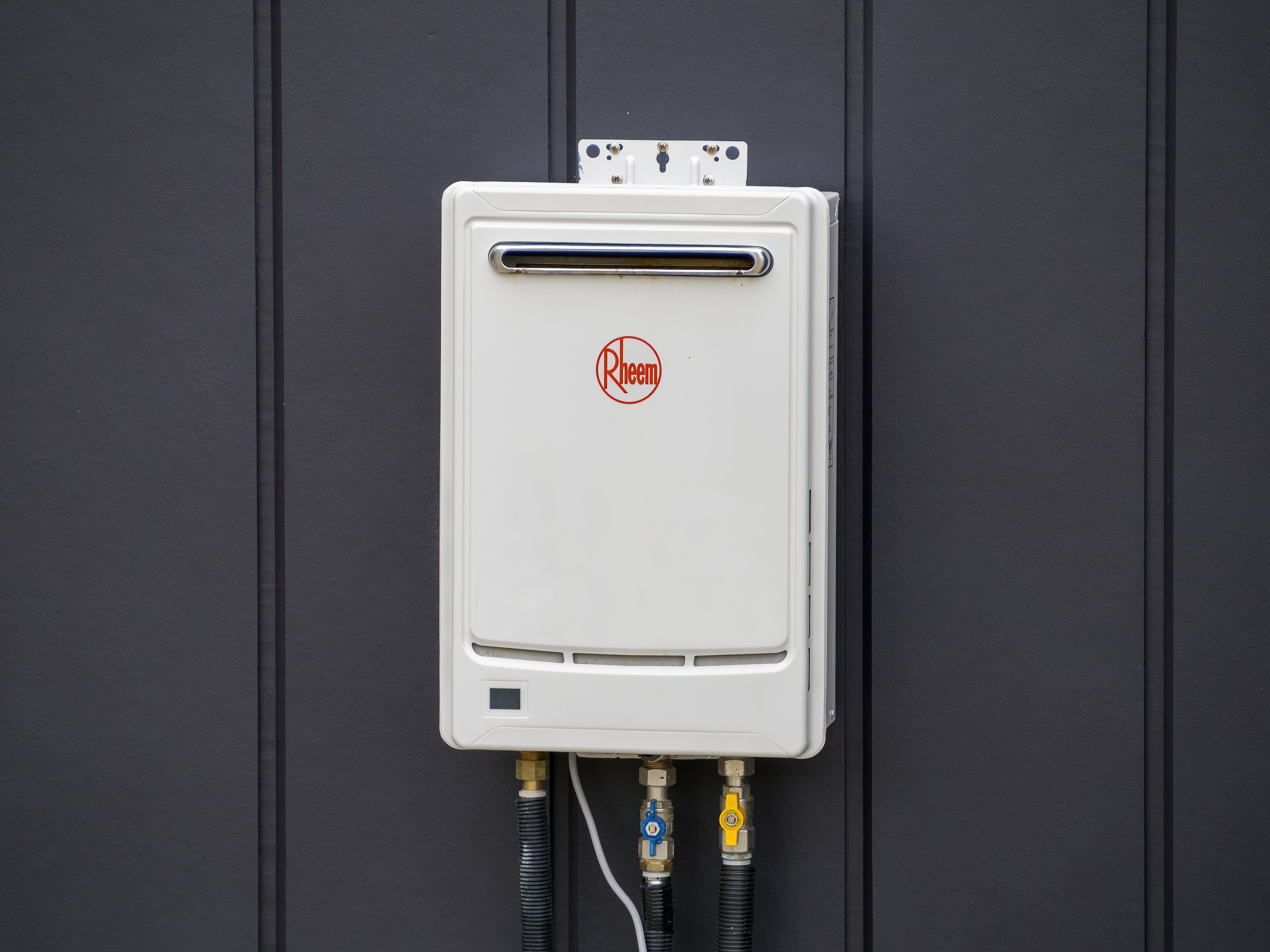
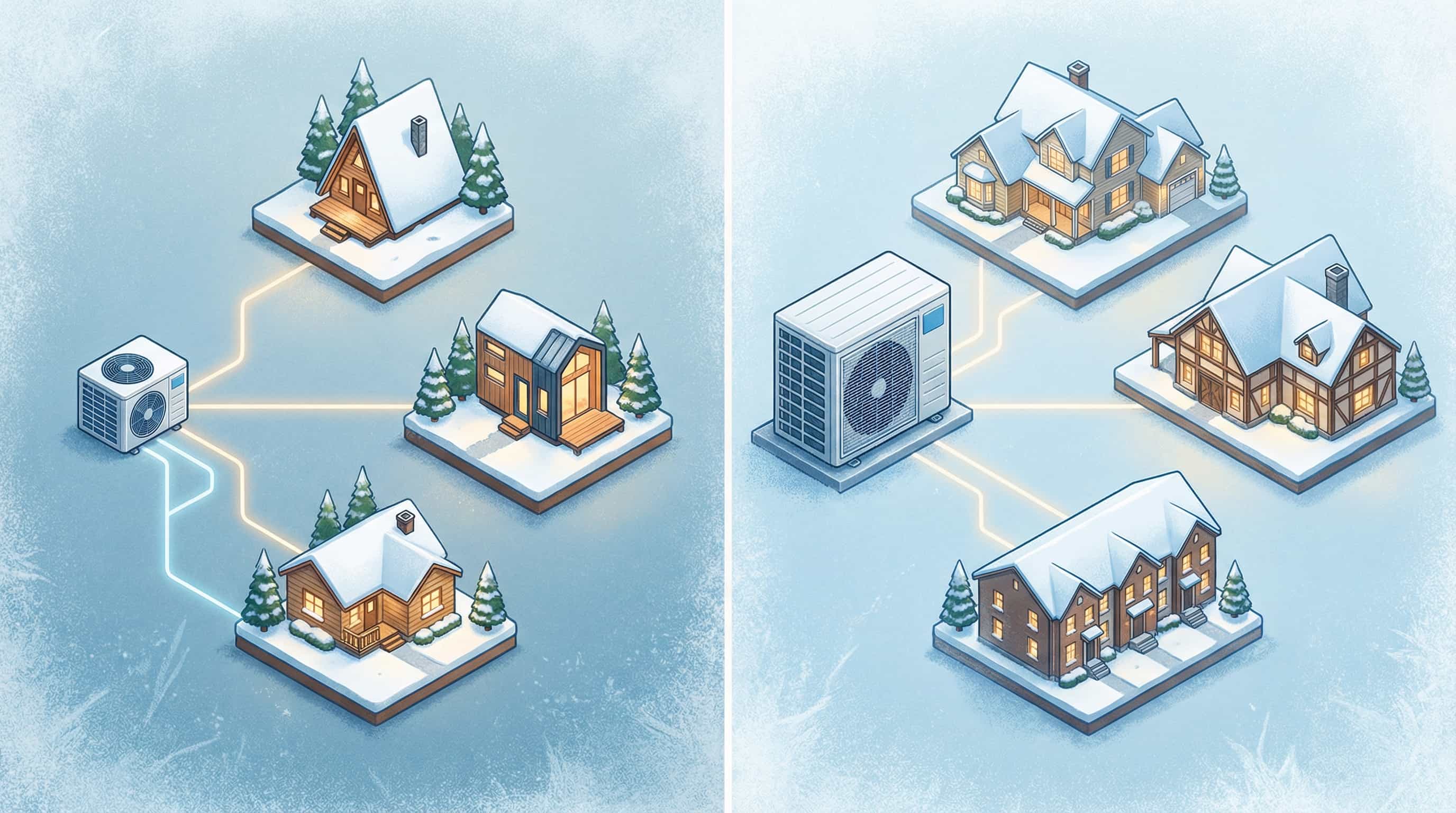
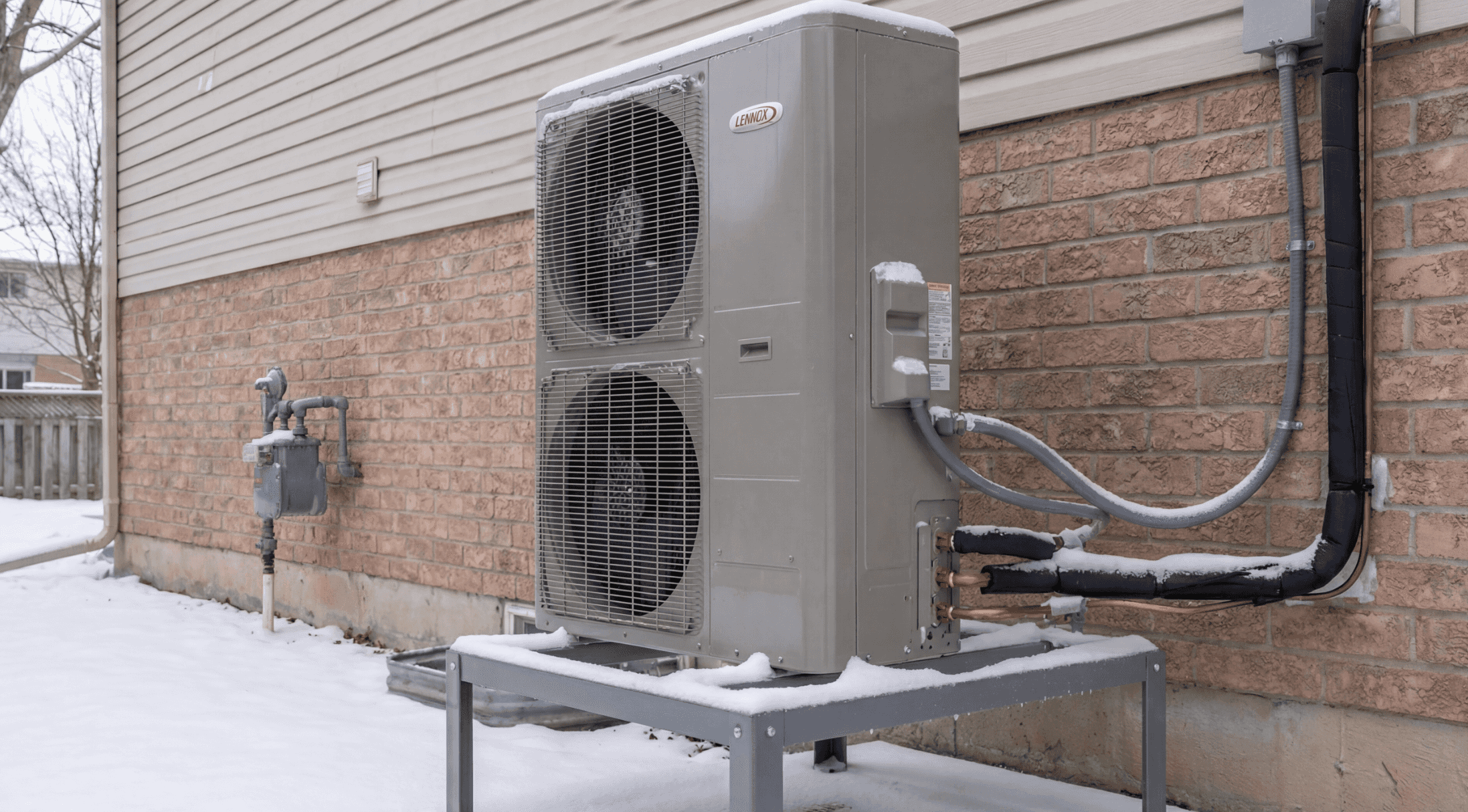
Tankless unit on an exterior wall meets Canada’s winter temperature rise, where sizing decides hot or lukewarm showers. (Credit: Shutterstock.com)
Tankless water heaters sound simple: no tank, heat water on demand, and never “run out” in the middle of a shower. In practice, the decision is less about the slogan and more about capacity planning—matching your home’s hot-water behaviour to a heater that can deliver enough flow at the temperature rise Canada demands.
The upside is real. Hot water is a major load in Canadian homes, so any efficiency gain has leverage. Natural Resources Canada notes on its water-heater guidance that water heating is about 17.2% of the energy used in the average Canadian home and that Canadians use about 75 litres of hot water per person per day, according to Natural Resources Canada’s water-heater efficiency page.
The trade-off is that tankless units are less forgiving when you ask for “everything at once”—two showers, a dishwasher fill, and a laundry cycle—especially when the incoming groundwater is near-freezing. The right way to shop is to treat this as a sizing and infrastructure project first, and a “product pick” second.
This guide walks through: (1) what tankless is good at (and where it disappoints), (2) how to size it for Canadian conditions, (3) what installation typically involves, (4) what it costs in Canada (with region-specific context), and (5) how to maintain it so it stays efficient and reliable.

A tankless water heater has no storage tank; it heats water as it flows through the unit using gas burners or electric elements, as described in Natural Resources Canada’s guide to residential water heaters. That on-demand design is why you can take back-to-back showers without “draining the tank.”
What tankless can’t do is magically create unlimited hot water at unlimited flow. Every model has a maximum output (often shown as a flow rate at a specific temperature rise). When demand exceeds that output, you’ll see one or more of the following:
To make the core trade-off concrete, here’s the mental model that keeps homeowners out of trouble:
“Endless hot water” is best interpreted as “endless duration at a supported flow,” not “endless fixtures at once.”
In Canada, the installed price is the only number that matters—because installation complexity can outweigh the heater cost. A helpful baseline is that a typical tankless upgrade (unit + common venting and gas/electrical work) often lands in the low-to-mid thousands, with plenty of exceptions, as summarized in PlumbingCheckup’s water-heater replacement cost guide.
Here’s a decision-useful way to think about tankless budgeting.
The “unit” and “labour” bands above align with national figures reported by HomeStars’ water-heater installation price guide. For local reality checks, GTA pricing is outlined in AeroFusion’s tankless installation cost article and Calgary/Alberta ranges plus common upgrade line items are detailed by Ranger Pros Heating & Cooling.
Ask each contractor to break the quote into these categories:
If you’re in Ontario, you’ll see especially detailed price bands in Dynamic Heating & Cooling’s Ontario buyer’s guide, which is useful for sanity-checking whether an estimate is “within market” for your province and install type.
The most expensive tankless quote is often the one that includes the upgrades your home actually needs (correct venting, correct gas supply, correct electrical supply). The cheapest quote can be cheap because it quietly assumes your infrastructure is already ready.
ENERGY STAR certified tankless water heaters can materially reduce energy use compared to standard storage tanks; the Government of Canada notes that an ENERGY STAR certified tankless water heater uses about 30% less energy on average than a standard storage-tank model, as stated on Natural Resources Canada’s ENERGY STAR tankless water heater listings. That efficiency can translate into lower bills and a smaller household carbon footprint, especially in homes with consistent hot-water demand patterns.
Efficiency also has a “behavioural partner”: less hot-water use equals less water heating. Québec’s energy-transition agency gives practical usage examples—like roughly 35 litres for a 6‑minute low-flow showerhead shower and 75–150 litres for a bath—on its homeowner guidance about hot-water use in the home. Those reference points make it easier to spot the biggest demand drivers (showers, baths, and laundry) before you assume equipment alone will fix costs.
At the same time, some savings claims get overstated. In real homes, savings depend on:
If your goal is primarily environmental impact, combine an efficient heater choice with fewer litres used. Newfoundland and Labrador’s water conservation guidance explicitly ties water conservation to reduced energy used to heat and pump water in its overview of water conservation benefits.
Sizing is where most tankless disappointments are born. The correct approach is not “pick a big one,” and it’s not “match my old tank size.” It’s a two-part calculation:
Canadian groundwater is cold enough that it changes the whole sizing conversation. Mr. Rooter Canada notes that average groundwater temperature in Canada can be roughly 1.67–5.55 °C while typical hot-water faucet temperatures are about 43–49 °C, as explained in its guide to what size tankless water heater you need. That implies temperature rises commonly in the 40 °C range, which reduces the effective flow a unit can deliver.
Use this worksheet:
Tankless units are commonly described by flow rate (often in gallons per minute). For rough planning, The Spruce lists typical fixture flows—about 2–2.5 GPM for a shower and 1–1.5 GPM for a bathroom faucet—in its tankless water heater buying guide. You don’t need perfect numbers; you need an honest picture of how your household overlaps hot-water use.
Build a “peak moment” scenario:
Now apply the cold-climate reality check: the same guide provides an example where a unit rated 11.1 GPM in ideal conditions can drop to roughly 4.6 GPM with 37 °F (≈3 °C) groundwater in colder northern regions, which includes Canada. The takeaway is not the specific brand or model—it’s that cold inlet water can cut “advertised” flow dramatically, so you size with temperature rise in mind.
Most homeowners don’t need to pick the exact model from first principles; they need to walk into a quote conversation with the correct constraints:
Then, let the installer confirm with manufacturer spec tables for your region and fuel type.
Under-sizing doesn’t just mean “slightly cooler water.” It often creates temperature swings when another fixture opens, which many homeowners interpret as “the unit is defective” when it’s actually a capacity mismatch.
Instead of “which brand,” start with “which architecture fits my home.”
Installation complexity is a real differentiator here. Many homes need upgraded gas lines or increased electrical capacity plus proper venting, and those upgrades can significantly add to installation costs, as noted in BKV Energy’s overview of tankless pros and cons.
When you’re comparing models, don’t get lost in marketing language. Canada’s ENERGY STAR water-heater guidance points buyers toward energy performance metrics such as energy factor (EF) and emphasizes choosing higher-efficiency models and buying the right size, in Natural Resources Canada’s ENERGY STAR water heater listings. In other words: compare like with like, and don’t let a high EF distract you from under-sizing.
Think of efficiency as “how much energy per litre delivered,” and sizing as “how many litres per minute at my temperature rise.” You need both to win.
A professional installation is not just swapping a box. Natural Resources Canada explicitly advises homeowners to buy the right size and hire a licensed professional for installation in its broader guide to residential water heaters, and that guidance is especially relevant for gas units and vented appliances.
A typical retrofit flow looks like this:
If you live in a high-performance or tightly sealed home, ventilation and combustion safety become even more important. Natural Resources Canada’s overview of the R-2000 Standard is a useful reference point for why mechanical systems design and verified performance matter more as homes get tighter and more energy efficient.
For gas tankless units, venting and combustion air are safety-critical systems, not “optional upgrades.” Treat them as part of the heater, not accessories.
Tankless ownership is closer to “owning a small machine” than “owning a passive tank.” Plan for routine care, or your performance and efficiency will drift.
Natural Resources Canada recommends servicing a water heater once every one to two years by a qualified professional and following your owner’s manual for specific needs, as stated on its ENERGY STAR tankless water heater resource. That’s your baseline.
FortisBC adds practical detail on what a service should include—checking operating and safety controls, testing ignition and burner operation, examining venting, and flushing the heat exchanger to remove hard-water deposits—on its guidance for appliance maintenance and safety. It also highlights a very Canadian winter issue: keep outdoor intake vents clear of dust, debris, and snow.
On filter cleaning and the consequences of deferring maintenance, Prudent Reviews notes (citing Rheem) that many tankless systems call for monthly inlet filter cleaning and annual professional maintenance including flushing/descaling, and it warns that mineral buildup can reduce efficiency and flow and may void warranties in its tankless pros and cons review.
Scale is primarily calcium and magnesium deposits that accumulate on the heat exchanger and internal passages. B. Carlson’s FAQ explains that scale reduces heat transfer, can cause fluctuating temperatures, and lowers efficiency, and it recommends descaling about once per year (or every 6–9 months for hard water or heavy use) in its guidance on tankless water heater descaling. You don’t need to memorize the chemistry—you just need to recognize that hard water turns “optional maintenance” into “performance insurance.”
If your home has hard water and you’re buying tankless, ask for the maintenance plan before you sign the quote: isolation valves, service ports, and whether the contractor offers a recurring flush service.
A big part of the value proposition is longevity and reduced leak exposure. POM Plumbing notes that a high-quality tankless heater can last up to about 20 years with proper maintenance and that tankless units reduce the risk of major water damage because they don’t store a large volume of water in a tank, as discussed in its overview of tankless pros and cons. That doesn’t eliminate leak risk entirely, but it changes the failure mode: fewer “tank ruptures,” more “component service.”
Score yourself honestly:
If you’re uncertain, a conservative approach is to treat tankless as a project (home readiness + heater choice + maintenance plan), not a product.
It can, especially if you choose an ENERGY STAR model, size it correctly for cold inlet water, and keep up with flushing/descaling. Savings are most reliable when the heater isn’t struggling to meet peak demand and isn’t scaled up internally.
Winter (and Canadian groundwater generally) increases the required temperature rise, which reduces the flow a unit can deliver at a comfortable hot-water temperature. The result is often reduced flow or cooler water during simultaneous use.
It’s the difference between your incoming cold-water temperature and your target hot-water temperature. Tankless capacity depends heavily on this number.
Start with people and habits (showers, baths, laundry). Use real activities: a short low-flow shower, a bath, and washer loads give you a practical picture of demand, then focus on what overlaps at the same time.
You size for total simultaneous flow at your temperature rise. Two showers often mean roughly 5 GPM combined, but cold inlet temperatures can reduce delivered flow significantly—so you need a model whose cold-climate spec supports that peak.
Gas whole-home units are often better for higher peak demand in colder climates. Electric can work well in smaller homes with modest peak demand, but may require large electrical upgrades.
Venting changes and gas line or electrical capacity upgrades are frequent cost drivers. The heater price is only part of the project.
With proper maintenance, high-quality units can last a long time (often cited as up to about 20 years). Actual lifespan depends on water quality, usage, and whether maintenance is done on schedule.
Not always, but in hard-water areas it can reduce scale and the frequency/severity of descaling. At minimum, plan for regular flushing/descaling.
Common guidance is about annually, with more frequent intervals (such as every 6–9 months) in hard-water homes or heavy-use households.
Many homeowners can clean the inlet filter and keep intake/exhaust terminations clear. Flushing/descaling can be DIY if you have the correct kit and follow the manual, but many households choose professional service.
Yes. Many manufacturers specify required maintenance (filter cleaning and periodic flushing/descaling). Skipping it can contribute to failures and may jeopardize warranty claims.
That’s commonly a capacity/flow-control issue: the unit is trying to satisfy more demand than it can support at that temperature rise, so it modulates and the delivered temperature can swing.
It depends. Recirculation improves convenience (faster hot water at taps) but can increase energy use if it runs constantly. If you want it, use smart controls (timers, occupancy, or demand-based triggers) and discuss how it integrates with the tankless model.
It can be, but mechanical design details matter more as homes get tighter—especially for combustion appliances. Ensure the installer accounts for venting and combustion air requirements and commissions the system properly.
Ask how they sized it (temperature rise + peak flow), what upgrades are included (venting, gas, electrical), whether isolation valves are included for flushing, what maintenance they recommend, and what the expected cold-climate performance will be.